Cat Coughing and Wheezing: Asthma, Hairballs or Heart
Reviewed by the LabReadAI medical team
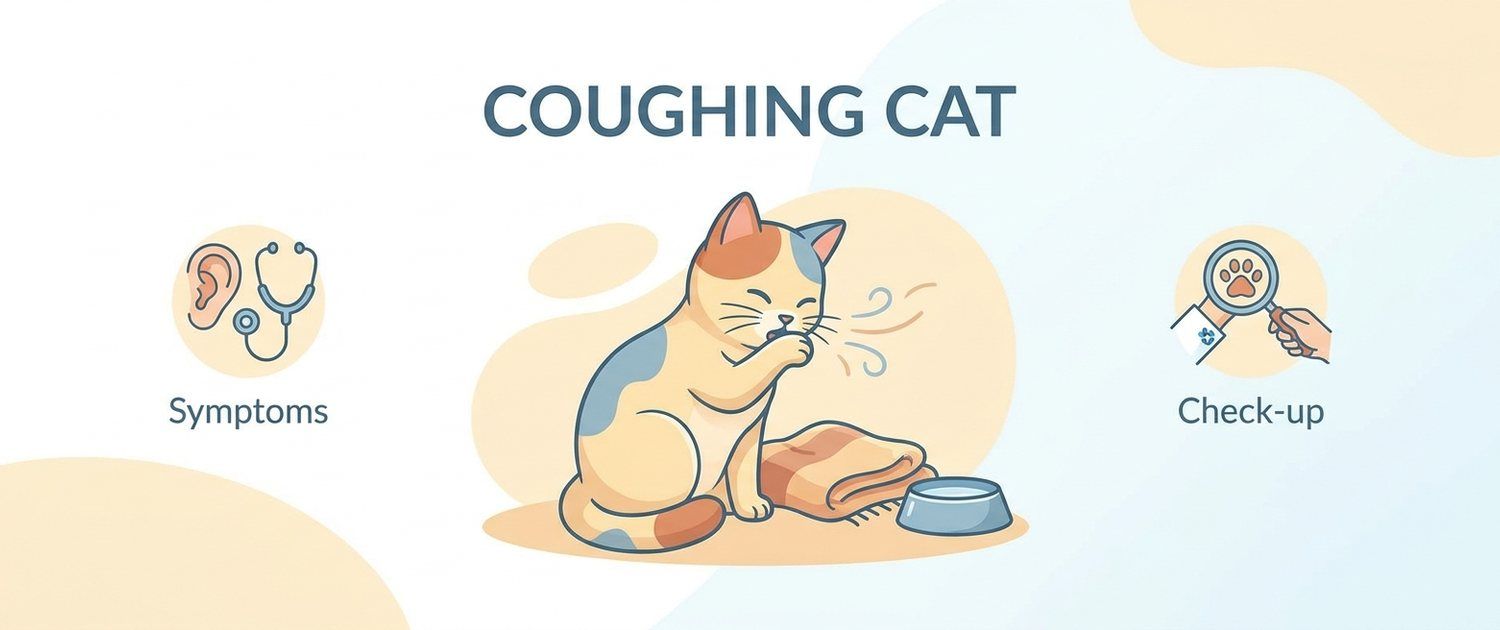
Coughing in cats is chronically underrated, and the posture is to blame. The cat crouches, stretches its neck forward and makes several convulsive efforts — from the outside that reads as trying to bring up fur, and owners treat it as normal for years. In fact this is what an asthma attack looks like, and it is not normal at any age.
Why Is My Cat Coughing: Three Main Answers
- Chronic lower airway disease — asthma and chronic bronchitis. The leading cause of chronic coughing in cats.
- Gagging on hairballs — not a cough at all but a different reflex that gets mistaken for one.
- Lungworm — in cats with outdoor access, and heartworm in endemic regions.
Less often: airway infections, a foreign body, aspirated food, tumours, pleural disease. The heart stands apart — and in cats it almost never speaks through coughing.
Feline Asthma Symptoms That Get Missed
Asthma is chronic allergic inflammation of the bronchi with spasm and excess mucus. The typical portrait: a young or middle-aged indoor cat with attacks repeating over weeks and months.
What an attack looks like:
- the cat crouches, stretching head and neck forward, elbows out;
- several forceful exhalations in a row, sometimes with wheezing;
- it ends with nothing, or a drop of clear mucus;
- between attacks the cat looks entirely well.
Triggers: dusty litter, smoke, aerosols, air fresheners, candles, dust from cleaning, seasonal pollen. A severe attack can tip into life-threatening bronchospasm within minutes, at which point the cat breathes with an open mouth and needs emergency care.
Why it gets missed: everything is normal between attacks, and in the consulting room the cat often does not cough at all. That makes a video of an attack filmed at home more valuable than any examination.
Cat Coughing Hairball, or Actually Coughing?
This is the main fork, and you can resolve it without a vet:
| Feature | Cough | Gagging on a hairball |
|---|---|---|
| How it ends | Nothing, or a drop of mucus | A hairball, food, fluid |
| Movement | Sharp exhalations, sound from the chest | A wave from the belly, abdominal wall works |
| Posture | Crouched, neck stretched forward | Standing, head down, back arched |
| Pattern | In bouts, repeating | Usually occasional |
One number matters: hairballs more than once or twice a month are no longer normal, and signal either a coat and grooming problem or disturbed gut motility. If vomiting repeats, see vomiting and diarrhoea in cats. The role of diet and fibre here is covered in choosing food for a cat.
Cat Heart Disease and Cough: Why Cats Differ From Dogs
In dogs a cough is a classic sign of heart disease, so cat owners look for the same thing by analogy. In cats that logic fails.
The reason lies in anatomy and in how feline heart failure develops: an enlarged feline heart does not press on the airways the way a dog's does, and on decompensation fluid moves quickly into the lungs and the pleural space. So a cat with heart disease arrives not with a cough but with rapid breathing, respiratory distress and a sudden collapse.
Practical conclusion: a cat that coughs points to the airways; a cat that does not cough but is breathing fast points to the heart. The opposite logic in dogs is set out in a coughing dog, and what echocardiography shows is in dog heart ultrasound and ECG.
Cat Wheezing When Breathing: What the Sound Means
Where the sound is born matters more than how loud it is:
- A nasal sound that changes with sneezing — upper airway; see a sneezing cat.
- Whistling and wheezing on exhalation — bronchi, typical of asthma.
- Bubbling, wet crackles — fluid in the airways.
- Breathing gone quiet and shallow, the cat unable to lie down — possibly fluid or air in the pleural space; the most dangerous pattern, because here quiet means bad.
- Snoring while awake, a changed voice — an obstruction in the nasopharynx or larynx.
Other Cat Cough Causes: Parasites, Infection, Foreign Bodies
- Lungworm — in cats that go outside and hunt rodents and snails; produces coughing indistinguishable from asthma and is found only by a specialised faecal method.
- Heartworm — in endemic regions; in cats it behaves atypically and dangerously.
- Infections — more often in kittens and in group housing.
- Foreign body or aspiration — a sudden first-ever bout in a cat that never coughed before.
- Tumours — in older cats, usually with weight loss and systemic signs, see a lethargic cat.
Cat Breathing Fast Is No Longer a Cough
The difference between coughing and dyspnoea is fundamental: a cough can wait for an appointment, breathlessness cannot.
One home tool is worth learning in advance: count the breathing rate of a sleeping cat. One rise and fall of the chest is one breath. A healthy sleeping cat is usually under 30 per minute. Consistently above 30–40 means going to the clinic, however calm the cat seems. It is the one home number that genuinely helps.
When to See a Vet Urgently
- Open-mouth breathing, belly breathing, an extended neck, elbows held out.
- Blue or very pale gums and tongue.
- A resting breathing rate consistently above 40 per minute.
- The cat cannot lie on its side and sits propped on its front legs.
- Coughing up blood or pink froth.
- A sudden first attack in a cat that never coughed — a foreign body is possible.
- Coughing plus refusing food and lethargy for over a day.
- Sudden painful weakness of the hind legs — in cats this can be thromboembolism from heart disease, and it is an emergency.
What Not to Do at Home
- No human medicines. Human cough suppressants, painkillers and fever drugs are lethal to cats. Any medication is a vet's decision only.
- No essential oils, diffusers, scented lamps or steam inhalations — these are toxic to cats and can trigger bronchospasm themselves.
- Do not reach into the throat with fingers or tweezers if you think the cat is choking.
- Do not give hairball pastes just in case when breathing is hard: first establish whether this is coughing or dyspnoea.
- Do not skip the video. Film an attack on your phone — it is the most valuable thing you can bring to the vet.
- Do not smoke indoors, and switch to a dust-free litter: for an asthmatic cat that is half the treatment.
What Tests and Scans Will Clarify the Cough
- Chest X-rays — the baseline: the lung pattern of asthma, pleural fluid, heart size, foreign bodies. What a film shows is covered in cat X-ray.
- Blood count and biochemistry — eosinophils in allergic inflammation and parasitism, plus general condition; how to read the form is in cat blood test.
- Specialised faecal testing — lungworm larvae, invisible on a routine sample.
- Echocardiography — the only way to answer the heart question; radiographs judge feline heart size poorly.
- Bronchoalveolar lavage — airway wash with cytology and culture when a definite answer is needed.
- Chest CT — for unclear pictures and suspected masses; see MRI and CT in dogs and cats.
Wheezing in small pets reads differently: in rats and rabbits it usually means chronic respiratory infection — see rabbit and rodent diseases.
An existing lab form can be read in the pet results interpretation service, a scan or report in understand a pet scan, and where nothing has been tested yet you can describe the symptoms to get likely causes and urgency.
This article is informational. Diagnosis and treatment of your pet are the job of a veterinarian.
For informational purposes only
This article is for informational purposes only and does not constitute medical advice, diagnosis, or treatment. Please consult a healthcare professional for medical guidance.