Online Vet Consultation: What a Blood Test Can Show
Reviewed by the LabReadAI medical team
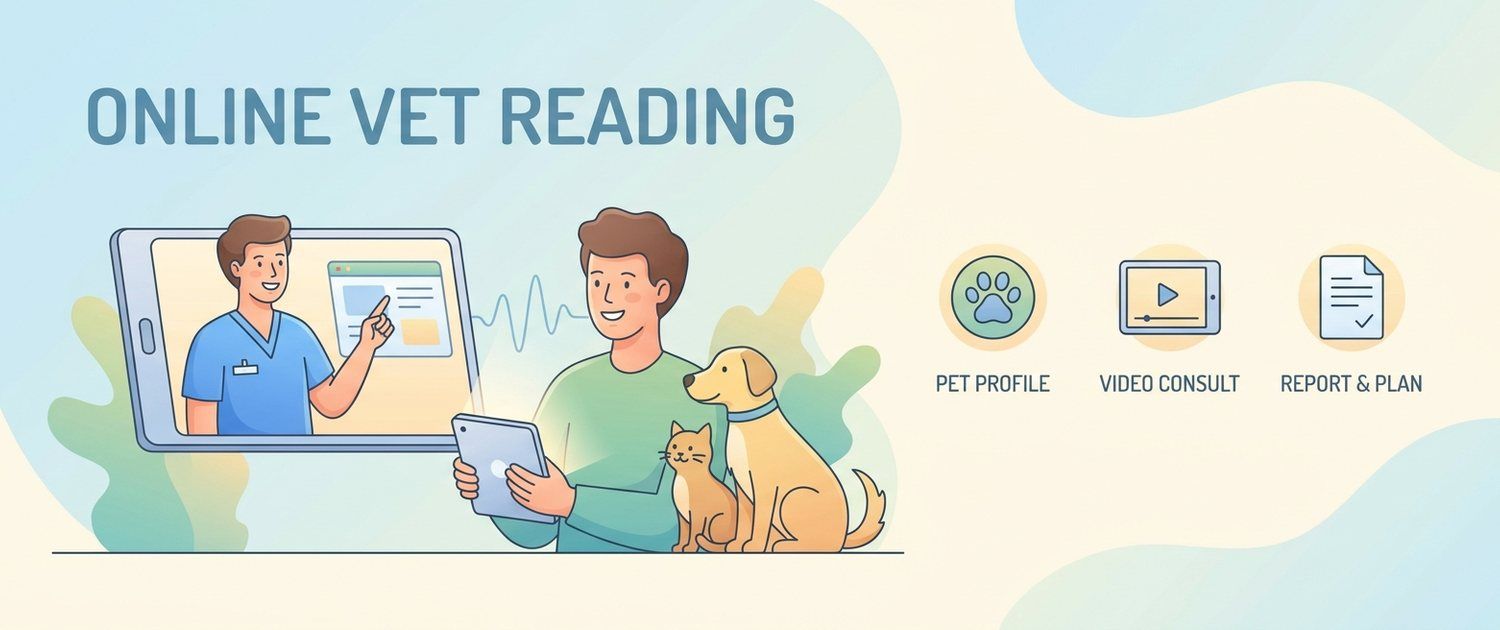
"Online vet" usually means one of two things. Either someone has a lab form in hand and wants to know what it says before the appointment, or their animal is unwell right now and the clinic is far away. These are very different needs, and the honest answer differs: an online reading handles the first well and the second not at all.
What an Online Vet Consultation Actually Means
An online consultation works only with what is already recorded: a lab result, an ultrasound report, an image, your description of behaviour. A physical appointment adds what no file contains — temperature, gum colour, pulse quality, abdominal pain under the hand, skin turgor, the reaction to touch.
Hence the rule worth keeping: an online reading is strongest where the data already exists and useless where it still has to be gathered by hand. It does not replace the vet; it makes the appointment more productive.
What a Blood Test Can Show About a Pet
A remote reading does three useful things.
It translates the form. A veterinary panel carries two dozen abbreviations and a column of lab reference ranges almost nobody reads. Which line left the range, by how much and in which direction is answerable without a visit.
It shows how markers connect. A single number means little; meaning appears in pairs. Urea without creatinine points to dehydration or a protein load more often than to kidneys. A high haematocrit with thick blood says the same. Low total protein changes how calcium is read.
It builds questions. The most practical output is a short list for the clinic: which markers to repeat, after how long, whether urine is needed alongside blood, whether an image would add anything.
You can upload a form for a cat, dog, rabbit, tortoise or horse to the pet results interpretation service, which reads markers against the species.
Which Tests People Bring Most Often
| Test | What it really reflects |
|---|---|
| Complete blood count | inflammation, anaemia, marrow response |
| Biochemistry | kidneys, liver, metabolism, electrolytes |
| Urinalysis | concentrating ability, crystals, inflammation |
| Thyroid hormones | hyperthyroidism in older cats, hypothyroidism in dogs |
| Faecal analysis | parasites, digestion |
Feline ranges are laid out in cat blood test, canine ones in dog blood test. Large animals follow the same logic on a different scale — see horse blood test. Rabbits, tortoises and rodents are sampled far less often, and why is covered in diseases of rabbits and tortoises.
Veterinary Norms Differ by Species
The commonest self-reading error is comparing a number with a human range found online. A cat's upper creatinine limit sits above the human one, a dog's differs again, and in a horse muscle mass shifts the picture further still. Even cats and dogs share almost no reference range.
Age, breed and the moment of sampling form a second layer. Feline glucose spikes from the clinic visit alone and is not diabetes. Sighthounds run a physiologically higher haematocrit. A worked horse changes half its biochemistry within an hour.
What Remote Reading Cannot Do
The limit deserves plain words.
- A physical examination cannot be reproduced remotely. Abdomen, lymph nodes, joints, mouth, mucous membranes: hands only.
- No prescriptions. No drug, no dose, no schedule. That decision belongs to the vet who carries responsibility for it.
- No emergency care. Oxygen, fluids, analgesia, decompression are physical acts.
- No diagnosis. A reading describes what the form holds and what it may mean; the label belongs to the clinician.
- Nothing appears from nothing. If a test was never run, it cannot be read. Sometimes the right answer is "another test is needed".
Red Flags That Override Any Reading
Go to a clinic immediately if the animal shows:
- laboured breathing, open-mouth breathing in a cat, a bluish tongue;
- pale, white or yellow gums;
- repeated failed attempts to urinate, especially in a male cat;
- a distended tense abdomen with unproductive retching in a large dog;
- seizures, collapse, an animal that will not rise;
- relentless vomiting or diarrhoea beyond a day — see vomiting and diarrhoea in cats.
How to Ask and What to Attach
The quality of an answer is set by the input. Attach:
- The whole form, not a fragment. A cropped header removes the lab's own reference ranges.
- Date and laboratory. Different analysers, different ranges.
- The previous result. A creatinine that doubled within the range over six months says more than one spot value.
- Species, age, weight, neuter status, current diet. All of it changes interpretation.
- The complaint in words. Not "seems off" but "eating half as much for three days, drinking noticeably more".
If there is no form yet, only behaviour, start from the complaint: cat symptoms or dog symptoms suggest which tests are worth running.
Questions to Ask Your Vet
- Which deviations do you treat as meaningful, and which as noise?
- What should be repeated, and after how long?
- Is urine needed alongside blood?
- Is imaging needed, and which modality?
- Are we changing the diet — and which marker will tell us it worked?
That last question is underrated. Diet is the one tool an owner applies daily: when a therapeutic line is genuinely justified is covered in therapeutic pet food, and everyday choice in choosing food for a cat. With a persistently high creatinine the conversation moves to feeding a cat with kidney disease.
Blood Tests and Images Answer Different Questions
Blood describes function; an image describes structure. An ultrasound report reaches the owner as text that is no clearer than a lab form — how to read it is in ultrasound for dogs and cats, and what film shows in a cat is in cat radiographs. Images and reports go to the pet imaging review.
The pairing matters most when a sign is unspecific. A cat drinking more may mean kidneys, diabetes or thyroid — where to start is in a cat drinking a lot.
This article is informational. Diagnosis and treatment of your pet are the job of a veterinarian.
For informational purposes only
This article is for informational purposes only and does not constitute medical advice, diagnosis, or treatment. Please consult a healthcare professional for medical guidance.