Feeding a Cat With Kidney Disease: Phosphorus and Stages
Reviewed by the LabReadAI medical team
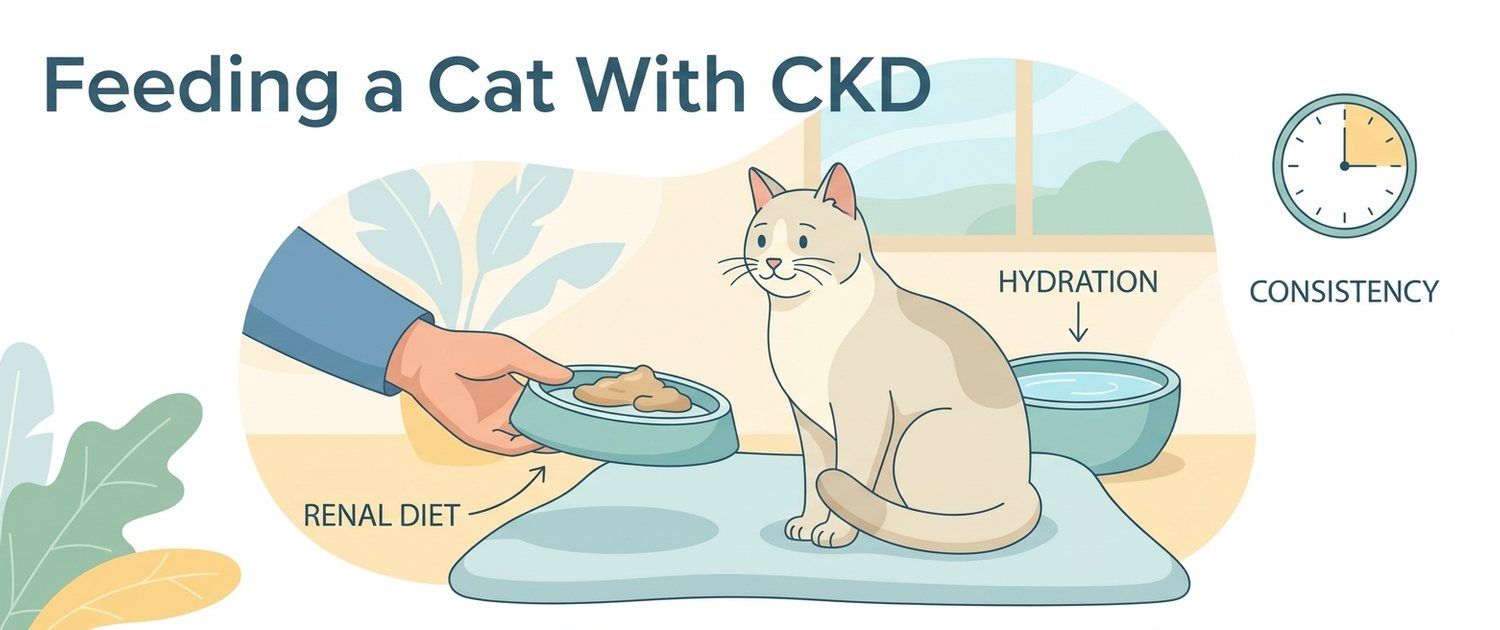
Chronic kidney disease is the commonest diagnosis in cats over ten. Kidneys do not regenerate, but how fast the disease moves depends on what the cat eats. This guide covers feeding a cat with kidney disease on the evidence: which part of the ration matters most, and why the familiar advice about "less protein" is out of date.
Why Phosphorus Is the Central Parameter
As the kidneys lose their ability to excrete phosphorus, it accumulates in the blood. The body answers with hormones that pull calcium from bone and damage the kidneys further — the circle closes and the disease accelerates itself.
That is why phosphorus restriction is the core of a renal ration. Ordinary foods, expensive ones included, carry far more phosphorus than a cat with damaged kidneys needs: it arrives with meat, with bone content and with additives. When diet alone is not enough, the vet adds phosphate binders — chosen by the vet, not by the packaging.
One more detail: tissue mineralisation and a rising phosphorus level show up in results before the animal feels worse. So the ration changes on the numbers, not on the symptoms.
IRIS Stages: What Changes at Each
The international IRIS classification splits kidney disease into four stages by creatinine and SDMA, refined by urine protein and blood pressure. The practical meaning is simple: the higher the stage, the stricter the ration.
| Stage | What is usually happening | What happens to feeding |
|---|---|---|
| 1 | Creatinine normal, but urine or ultrasound abnormal | Ordinary quality food, water, monitoring |
| 2 | Mild creatinine rise, often without symptoms | Phosphorus restriction is discussed — the proven point of intervention |
| 3 | Thirst, weight loss, falling appetite | Renal ration, potassium and blood pressure control |
| 4 | Nausea, vomiting, weakness, anaemia | The priority is that the cat eats and stays hydrated |
The stage is set by a vet from stable results, not from a single sample taken while dehydrated. What stands behind creatinine and urea is covered in cat blood test; kidney structure is shown by abdominal ultrasound for a cat, and a finished report can be explained by pet imaging interpretation.
The Low Protein Myth and Why It Hurts
"Feed less protein" dates from a time when protein and phosphorus were not separated. It is now clear that the harm comes from excess phosphorus, while protein in renal rations is moderate but good quality — and that distinction matters.
What happens when protein is cut hard:
- the cat loses muscle, which is already declining with age;
- creatinine falls — not because the kidneys improved but because there is less muscle, which makes the results misleading;
- the owner reads the weakness as the disease advancing, when it is wasting;
- appetite drops further, because low-protein food tastes worse.
The correct formulation runs differently: restrict phosphorus, keep protein moderate and good, supply enough calories. Weight loss in kidney disease is a poor prognostic sign and is not written off as age — see a cat losing weight.
What a Renal Diet Delivers: the Proven Part
This is one of the rare places in veterinary nutrition with direct evidence: cats fed a renal ration lived longer and had fewer uraemic crises than cats on ordinary food. The effect belongs to a package, not to one restriction:
- reduced phosphorus;
- moderate, good-quality protein;
- added potassium, which is lost in the urine in kidney disease;
- omega-3 fatty acids;
- alkalinising components against blood acidification;
- higher water content in the wet versions.
That is why a renal ration is not assembled at home from "diet" ingredients — it is a balanced construction. What this category covers is explained in therapeutic pet food.
If the Cat Refuses the Therapeutic Food
The commonest practical problem. A cat with kidney disease often eats poorly: nausea interferes, taste changes, and if the new food was first offered in a clinic or during a bad spell, a lasting aversion forms.
What helps:
- do not switch abruptly, and not in hospital: start at home while the cat feels relatively well;
- warm the food to body temperature — the smell strengthens;
- try different textures within the same class: pâté, chunks, dry;
- treat the nausea: anti-nausea support is prescribed by a vet and often restores appetite by itself;
- never starve the cat: two days without food risk hepatic lipidosis.
The rule is simple: a cat eating ordinary food is better off than a cat not eating a renal one. Persistent refusal is covered in why a cat is not eating, and vomiting alongside kidney disease in vomiting and diarrhoea in cats.
Water, Potassium and Blood Pressure
Damaged kidneys cannot conserve water, so the cat drinks a great deal and still dehydrates. A wet ration, several bowls and a fountain are part of the treatment rather than a detail; in advanced stages the vet teaches owners subcutaneous fluids.
Potassium is often lost in the urine, and a shortage causes weakness and a drooping neck. Blood pressure rises in a substantial share of cats with kidney disease and damages eyes and brain — it is measured at the visit, not guessed. The early signs look ordinary: a cat drinking a lot, and only later a lethargic cat.
Feeding a Dog With Kidney Disease
The logic is the same, the details differ. In dogs the disease more often runs with protein loss in the urine, so the urine protein-to-creatinine ratio is measured and the ration adjusted to it. Phosphorus restriction remains central, and good protein is preserved — wasting is just as dangerous in a dog. A rise in thirst is covered in a dog drinking a lot, and the reference values in dog blood test.
Liver Diets for Dogs and Cats: Almost the Opposite Logic
The liver calls for nearly the reverse approach, and confusing the two is costly.
- Protein is not cut in liver disease without a reason: the liver builds its own repair from it. It is restricted only in hepatic encephalopathy, when toxins affect the brain, and a vet decides that.
- The priority is that the animal does not starve. In a cat, two or three days without food trigger hepatic lipidosis, which is worse than the original disease.
- Copper matters in particular dog breeds with inherited copper accumulation, where the ration is tailored deliberately.
- A raised ALT does not prescribe a diet by itself. The cause comes first: bile ducts, pancreas, medication, tumour.
The practical conclusion: a liver diet is built from the diagnosis, not from one line of the form. How liver markers shift with age is covered in feeding senior pets.
Which Markers Are Tracked
| Marker | What it shows |
|---|---|
| Creatinine and SDMA | The IRIS stage; SDMA rises earlier than creatinine |
| Blood phosphorus | The main target of dietary intervention |
| Urea | Adds to the picture but depends on food and hydration |
| Potassium | Often low; a shortage causes weakness |
| Urine gravity and urine protein | An early sign and a refinement of the stage |
| Haematocrit | Anaemia in later stages |
| Blood pressure | Damages eyes and brain if never measured |
Cats with kidney disease often carry urinary stone disease alongside, where the ration follows a different principle — see cat urinary stone diet. If the picture is unclear, the signs can be described in a cat symptom review.
When to See a Vet Urgently
- the cat has not eaten for over a day, or vomits repeatedly;
- sudden weakness, an unsteady gait, seizures;
- an ammonia-like smell from the mouth, or mouth ulcers;
- urination has stopped or dropped sharply;
- sudden blindness or widely dilated pupils — likely high blood pressure.
To read the form line by line before the visit, upload it to pet results interpretation: the analysis explains what creatinine, SDMA and phosphorus mean and which questions to put to the vet. How that differs from a consultation is described in online vet results review.
This article is informational. Diagnosis and treatment of your pet are the job of a veterinarian.
For informational purposes only
This article is for informational purposes only and does not constitute medical advice, diagnosis, or treatment. Please consult a healthcare professional for medical guidance.