A Cat Losing Weight on a Normal Appetite: Causes and Tests
Reviewed by the LabReadAI medical team
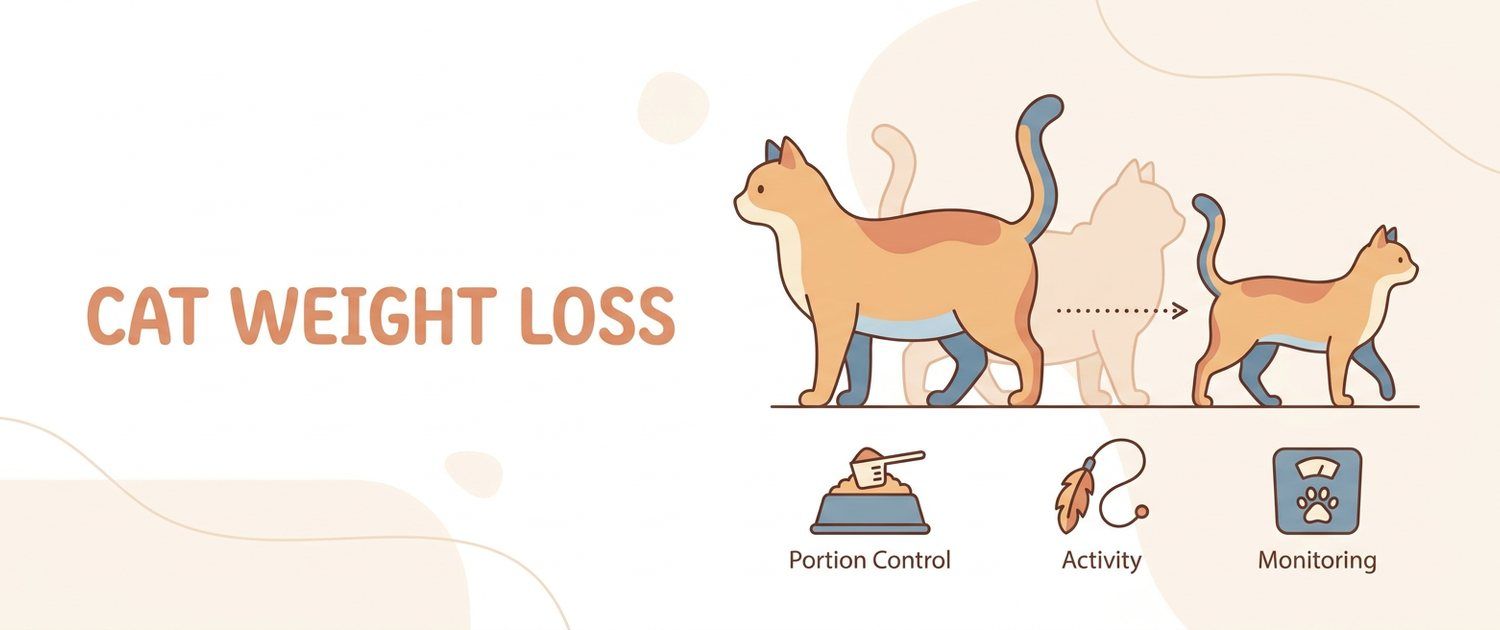
"Eats the same and melts away" is the sentence that brings most cats over seven into a clinic. It is one of the rare signs that narrows the field sharply: if the food going in has not changed and the weight is falling, the body is either failing to absorb it or burning it faster than it arrives. Both are metabolic, and both are settled by tests.
Weight Loss on a Normal Appetite: What It Means
Separate two situations. A cat that has stopped eating and is losing weight is a different story, covered in why a cat is not eating, where the causes start with the mouth, pain and stress. A cat that eats the same or more while the weight falls has a much narrower list:
- hyperthyroidism — the thyroid drives metabolism up;
- diabetes mellitus — glucose never reaches the cells and leaves in the urine;
- chronic kidney disease — protein loss and poorer absorption;
- inflammatory bowel disease and gut lymphoma — food is not absorbed;
- parasites in young and outdoor cats;
- cancer elsewhere and chronic pain.
Rule out the obvious first: a switch to a less calorie-dense food, or a second pet eating part of the portion. How to count the energy in a diet is covered in choosing food for a cat.
Scales Beat the Eye
The eye is a poor instrument. Long fur hides up to 15% of body mass, and an owner who sees the cat daily misses a slow drift. So:
- Use kitchen scales — put the carrier on them, or hold the cat on bathroom scales and subtract your own weight. Record one number a month.
- Count percentages, not grams. Losing 400 g from a 4 kg cat is 10% of body mass — the equivalent of 7 kg in a 70 kg person. That is how "a little thinner" turns out to be a lot.
- Feel the ribs and spine. Normally ribs are palpable under a thin layer of fat but do not stand out. A suddenly prominent spine with hollows beside it already means muscle loss.
- Compare photos. A picture from three months ago beats memory.
The threshold for a vet visit: more than 5% of body mass in a month, or more than 10% in three months, with no change of diet.
Hyperthyroidism: The Commonest Cause Over Seven
Excess thyroid hormone drives metabolism, and the picture is characteristic: the cat eats a lot, loses weight, is restless and yowls at night, the coat looks unkempt, there may be vomiting and loose stools, and the heart races. Owners often describe it as rejuvenation: an old cat suddenly active and hungry.
One blood value — total T4 — answers it. An important subtlety: hyperthyroidism masks kidney disease by driving blood flow through the kidneys, so the kidneys only surface after treatment begins. That is why T4 and renal markers are read together.
Diabetes: Losing Weight While Eating and Drinking More
In diabetes glucose stays in the blood and leaves in the urine, dragging water with it. Hence the triad: heavy thirst, a wet litter tray and weight loss on an excellent appetite. Neutered, overweight, indoor male cats are over-represented. Thirst as a sign in its own right is covered in a cat drinking a lot.
The dangerous turn is ketoacidosis: the cat becomes suddenly dull, refuses food, vomits, and the breath smells of acetone. That is an emergency, see a lethargic cat.
Kidney Disease and the Gut
Kidney disease in cats runs silently for a long time, and weight loss is often the first thing an owner notices — earlier than thirst. Dullness, a poor coat, mouth ulcers and ammonia breath follow, see cat drooling. Diet changes the outlook here, so it is covered separately in feeding a cat with CKD.
From the gut, weight goes in inflammatory bowel disease and lymphoma: soft or frequent stools, sometimes vomiting — see vomiting and diarrhoea in cats and gastritis and food allergy. In older cats the diet is rebuilt to protect muscle, covered in feeding senior pets.
When to See a Vet Urgently
- weight loss with dullness, refusing food or vomiting — do not postpone;
- acetone breath, a wobbly gait, a cat that will not stand — suspected ketoacidosis;
- an abrupt loss of more than 10% of body mass in a month;
- weight loss plus pale gums, laboured breathing or a swollen abdomen;
- a cat that loses weight while eating greedily — that is not a good appetite but a driven metabolism.
If you cannot tell whether to wait or drive, describe it in plain words and get an urgency read from the symptom review.
What Not to Do at Home
- Do not simply feed more. In hyperthyroidism and diabetes a bigger portion will not restore the weight, it only delays the diagnosis by months.
- Do not give human medicines or supplements. Human painkillers and fever medicines are lethal to cats; any drug or vitamin is prescribed by a veterinarian only.
- Do not switch to a "prescription" food at random. Renal, diabetic and gastrointestinal diets differ and are chosen after a diagnosis.
- Do not deworm blindly in an older cat: the causes there are usually elsewhere, and time is being spent.
What Tests Separate These Versions
The panel is compact and nearly always the same:
| Test | What it separates |
|---|---|
| Complete blood count | anaemia, inflammation, leukaemia |
| Biochemistry (urea, creatinine, protein, liver) | kidneys, liver, wasting |
| Total T4 | hyperthyroidism |
| Glucose and fructosamine | diabetes versus stress hyperglycaemia |
| Urinalysis with specific gravity | kidneys, diabetes, infection |
| Faecal examination | worms and protozoa |
What the numbers mean is explained in cat blood test; a completed form can be uploaded for pet results interpretation in plain language. If blood and urine are clean and the weight keeps falling, imaging is next: cat abdominal ultrasound shows bowel wall thickening, lymph nodes and masses, and a cat X-ray covers the chest. A clinic report is read through pet imaging interpretation. Other feline signs are collected on the cat symptoms page.
This article is informational. Diagnosis and treatment of your pet are the job of a veterinarian.
For informational purposes only
This article is for informational purposes only and does not constitute medical advice, diagnosis, or treatment. Please consult a healthcare professional for medical guidance.