How to Choose Food for a Cat: Dry, Wet or Home-Made
Reviewed by the LabReadAI medical team
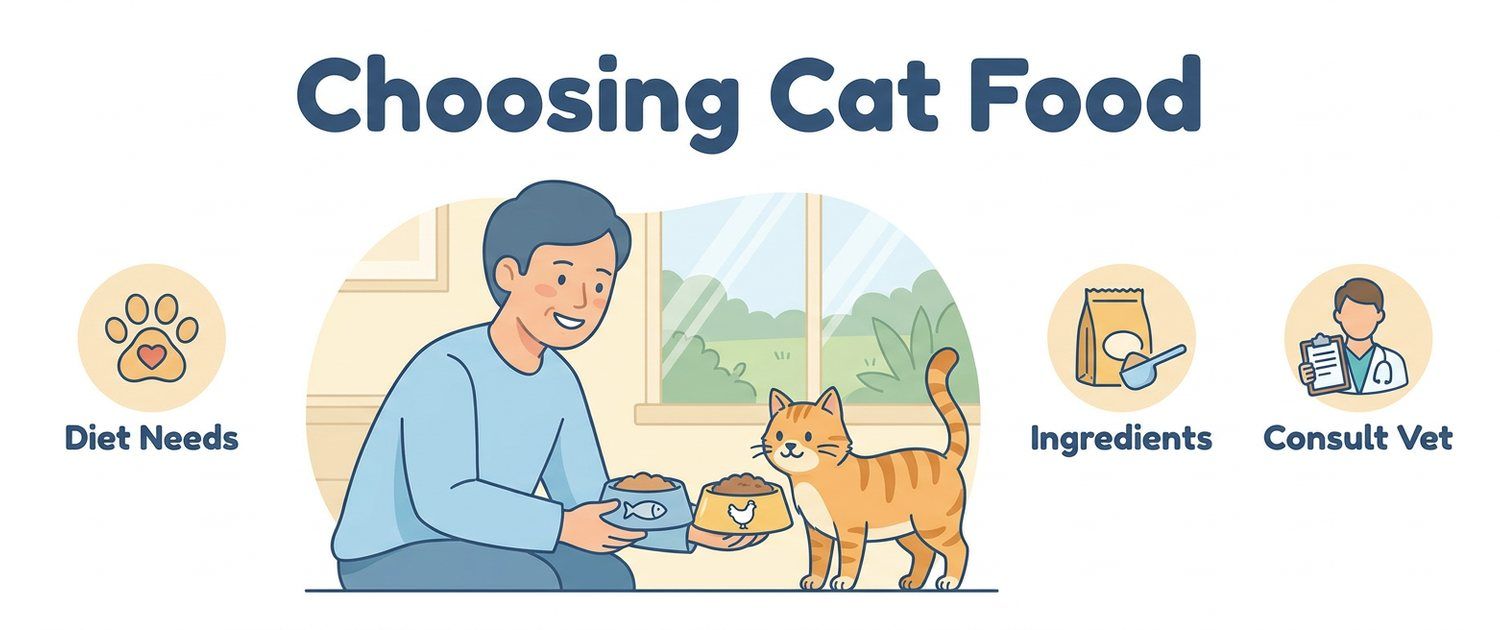
"Which food should I choose for my cat" is usually asked as a question about brands. In practice three physiological facts decide more than any label: a cat drinks poorly, a cat must have animal protein, and a cat is prone to urinary and kidney disease. Everything else follows from those three.
Water Is the Point: Why Moisture Matters in Cat Food
The domestic cat descends from a desert ancestor that took nearly all its water from prey. Its thirst drive is weak: moved onto a dry ration, a cat drinks more but usually does not make up the previous total intake. The result is more concentrated urine.
| Ration type | Moisture | What follows |
|---|---|---|
| Dry | 6–10 % | concentrated urine, deliberate hydration needed |
| Wet (pouches, tins) | 75–82 % | higher total water intake, more dilute urine |
| Home-made (meat, offal) | 65–75 % | close to wet, but the ration must be balanced |
The practical conclusion: if a cat has already had urinary trouble, the proportion of wet food is not a matter of taste. What to do with crystals and stones is in feeding a cat with urinary stones, and the sign that usually starts it is in blood in a cat's urine.
Dry, Wet or Home-Made: What Actually Differs
- Dry. Cheap per gram, can sit out all day, complete by formulation. The downside is low moisture and high energy density: a cat gains weight more easily when food is available around the clock.
- Wet. More water, fewer calories per volume, usually eaten more willingly. The downside is cost and the fact that a bowl cannot stand all day.
- Home-made. Full control of ingredients, but it demands arithmetic: the calcium-to-phosphorus ratio, daily taurine, vitamins A and E. "Meat plus porridge" is unbalanced almost every time.
- Mixed. A workable compromise: dry during the day, wet morning and evening. Count total energy rather than adding two full rations.
None of the four is therapeutic. A therapeutic line is a separate tool aimed at a measured deviation — see therapeutic pet food.
Protein and Taurine: What a Cat Must Get From Food
Obligate carnivore is not a metaphor. Several metabolic routes that dogs and humans use are absent in cats:
- taurine is not synthesised in sufficient amounts, and deficiency damages heart muscle and retina;
- vitamin A is not made from plant carotene;
- arachidonic acid must arrive preformed, from animal fat;
- protein is needed continuously: a cat burns amino acids even while fasting, which makes prolonged appetite loss more dangerous than in a dog — see why a cat is not eating.
How to Choose Food by Age
A kitten needs higher energy and protein for growth, an adult a stable ration, an older cat enough protein to hold muscle plus kidney markers under watch. Age-specific detail is in feeding an older cat or dog. Once creatinine starts climbing the conversation moves to feeding a cat with kidney disease.
Food for Neutered Cats and Cats After Spaying
Daily energy need drops by roughly a quarter after surgery while appetite stays the same. That, not hormones as such, is why neutering so often ends in excess weight. The calculation is in feeding a cat after spaying.
How Much to Feed a Cat Per Day
The table on the bag is an average by weight and it misses regularly. Judge by outcome instead:
- Weigh the cat fortnightly on the same scales.
- Score the body by hand: ribs palpable under a thin fat layer, waist visible from above.
- Adjust the portion by about 10 % and wait two weeks rather than halving it at once.
Rapid weight loss with a good appetite is a warning, not a dieting success — see a cat losing weight.
Reading a Cat Food Label
- The first entries carry most of the mass. Named "chicken" or "turkey" tells you more than "meat and animal derivatives".
- A complete-food statement means the ration covers daily requirements rather than complementing something else.
- Moisture content is what separates dry from wet, not a marketing tier.
- Declared taurine is mandatory for cats.
- Life stage — kitten, adult, senior — describes genuinely different profiles.
Brand names help little here: two products of one brand from different lines differ more than two brands within one category.
Home-Made Diets: What You Have to Count
A home-made ration is possible but it is work. At minimum: calcium-to-phosphorus ratio, daily taurine, vitamins A, D and E, a fatty-acid source. Meat without a mineral source skews phosphorus, which is unwelcome in kidney disease. Fish as a base leads to vitamin E deficiency and phosphorus excess. For the long term, build the ration with a veterinary nutritionist rather than from internet recipes.
How Much Water Does a Cat Need
Roughly 40–60 ml per kilogram of body weight per day in total, food included. Ways to raise intake:
- the share of wet food in the ration;
- several bowls in different rooms, away from the litter tray;
- a wide bowl, since whiskers touching the rim deters some cats;
- a fountain, if the cat responds to moving water.
A cat that suddenly starts drinking far more on its own is showing a symptom, not an improvement — see a cat drinking a lot and the symptom check.
How Blood Tests Help Choose a Ration
You do not select a healthy cat's ration from a lab form; you run tests to confirm the cat is still healthy and to catch a reason to change in time. Useful items are a complete blood count, biochemistry with creatinine, urea and phosphorus, and urinalysis with density and sediment. How to read such a form is in cat blood test and online vet reading; results can be uploaded to the pet results interpretation. If there are complaints but no form yet, start from cat symptoms. Digestive reactions to a food change are covered in vomiting and diarrhoea in cats.
This article is informational. Diagnosis and treatment of your pet are the job of a veterinarian.
For informational purposes only
This article is for informational purposes only and does not constitute medical advice, diagnosis, or treatment. Please consult a healthcare professional for medical guidance.