Feeding a Cat With Urinary Stones: Struvite and Oxalate
Reviewed by the LabReadAI medical team
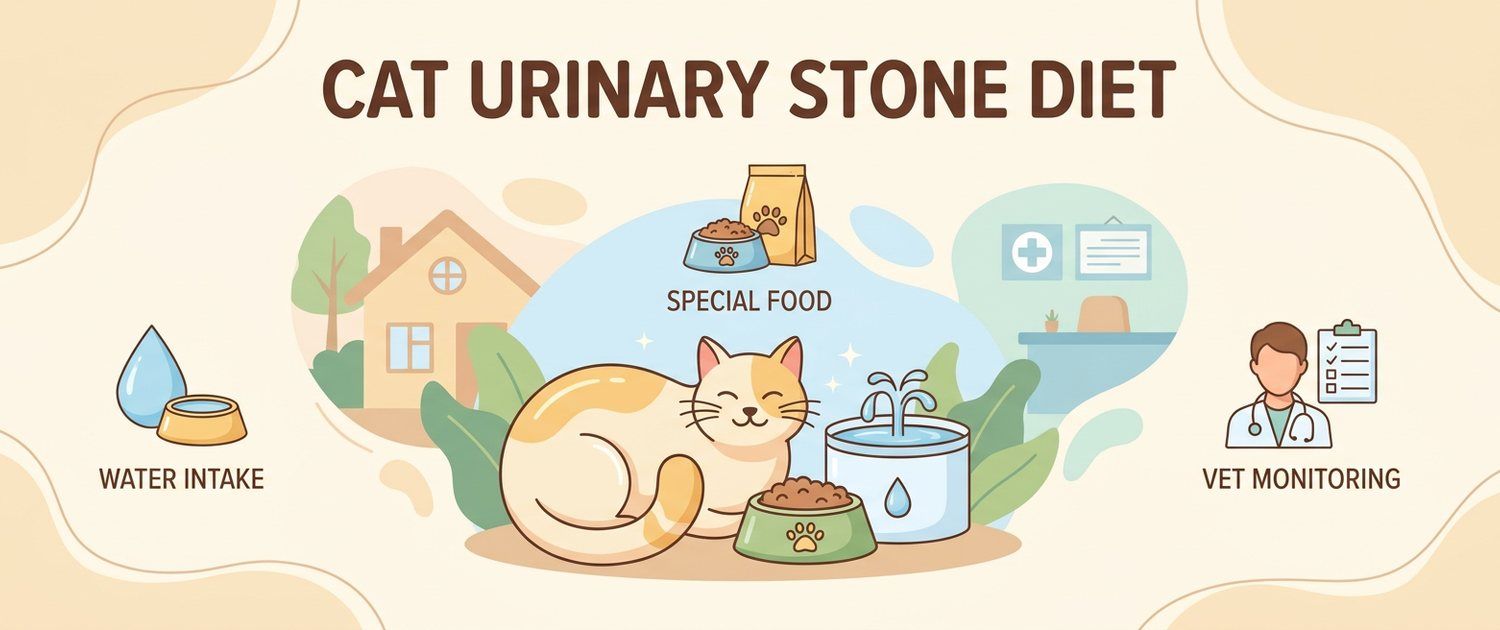
Urinary stone disease in cats is not one disease but at least two, and they call for opposite feeding. That is why a urinary food chosen by the name on the bag sometimes works against the animal. This guide covers feeding a cat with urinary stones so that the ration matches the stone actually present.
Struvite and Oxalate: Two Stones, Two Opposite Diets
| Struvite | Calcium oxalate | |
|---|---|---|
| Urine reaction | Forms in alkaline urine | Forms in acidic and neutral urine |
| What the diet does | Acidifies urine, lowers magnesium and phosphorus | Does not acidify; works through dilution and minerals |
| Dissolves on a diet | Yes, over weeks | No. Removal is mechanical |
| Typical patient | Young and middle-aged cats | Cats over seven, some breeds |
| Risk of getting it wrong | An oxalate diet lets struvite grow | An acidifying diet promotes oxalate |
Hence the rule: the stone type sets the ration, not the other way round. The balance between the two types has shifted back and forth over recent decades and both remain common — so guessing is not an option.
What the Urinalysis Shows, and Why Crystals Are Not a Diagnosis
A vet leans on three things: urine pH, the sediment and, if a stone was passed or removed, its composition.
- Cat urine pH points the direction: persistently alkaline urine argues for struvite, acidic for oxalate.
- Crystals in cat urine are not stones. They appear in healthy animals too, especially if the sample stood or cooled. What is treated is an animal with signs, not a sediment.
- Urine specific gravity shows how concentrated it is: the more dilute, the lower the risk of any stone.
- Bacteria and white cells change the plan: in dogs struvite is usually infection-driven, in cats usually not.
- Not every stone is radiopaque: some show on x-ray, some only on ultrasound, so both are used — abdominal ultrasound for a cat, and a finished report can be explained by pet imaging interpretation.
Blood in the urine, frequent trips to the tray and accidents outside it are covered in blood in cat urine. General condition is judged from the blood: cat blood test.
Feeding a Cat With Struvite Stones
Struvite is the only type that genuinely dissolves on a diet. The principle: a ration that acidifies urine and limits magnesium and phosphorus, plus plenty of water. On such feeding the stones shrink over several weeks, and a follow-up image confirms it.
Important caveats:
- a dissolving ration is prescribed for a period, not forever: prolonged acidification itself raises oxalate risk;
- follow-up is mandatory: if the stone has not shrunk in four to six weeks, it is not struvite;
- with infection, diet alone is not enough — antibacterial treatment is chosen by a vet;
- home acidification is dangerous: without pH monitoring it is easy to overshoot into the other extreme.
Feeding a Cat With Calcium Oxalate Stones
Calcium oxalate does not dissolve on a diet — that is the key fact. Here the ration solves a different problem: preventing new stones after the old ones are removed.
- Diluting the urine is the main lever: a wet ration, several water sources, monitoring of urine specific gravity.
- Urine is not acidified: foods designed to dissolve struvite are wrong for oxalate.
- Dietary calcium is not stripped out. Cutting calcium sharply paradoxically increases oxalate absorption in the gut.
- Blood calcium is checked. A persistently high ionised calcium is a cause of oxalate in its own right and is investigated separately.
- Weight and activity. Excess weight and inactivity are independent risk factors.
Water Beats Food: Wet Rations and How to Get a Cat Drinking
If one rule works for every stone type, it is diluting the urine. In studies, raising water intake lowered urinary supersaturation for both struvite and oxalate at once. What helps in practice:
- wet food as the base of the ration — it supplies more water than any amount of persuasion;
- several bowls in different rooms, away from the litter tray and the food;
- wide bowls: cats dislike their whiskers touching the rim;
- running water — a fountain raises intake in some cats;
- if a cat starts drinking far more on its own, that is a symptom rather than a success, see a cat drinking a lot.
Feeding a Dog With Bladder Stones
In dogs the logic is similar but the emphasis differs. Struvite in dogs is almost always tied to urinary infection: without treating the infection the diet will not work. Oxalate and urate appear more often in particular breeds, and in dalmatians urate stones follow a metabolic quirk. One thing is shared with cats: the type is established from the urinalysis and the stone, not from the symptom, and water remains the first tool. What the blood shows in dogs is covered in dog blood test; a sudden rise in thirst is covered in a dog drinking a lot.
Idiopathic Cystitis: No Stones, Same Signs
In cats under seven the commonest source of "stone-like" signs is idiopathic cystitis: bladder inflammation with no stones and no infection. The signs are identical: frequent trips to the tray, blood, urinating in unexpected places.
Diet is secondary here. What works is water, stress reduction and the environment: enough litter trays (one per cat plus one), hiding places and vertical shelves, a predictable routine, separated resources between cats. Flares often coincide with a move, building work or a new animal in the house. If it is unclear what is happening, the signs can be described in a cat symptom review.
Prevention: Weight, Tray, Water
- keep the weight normal: heavy cats drink and move less;
- a clean tray with no queue — a cat should never have to hold on;
- a wet ration and several water sources, permanently;
- a urinalysis once a year, and more often after an episode, as the vet advises;
- after neutering, watch the weight especially closely: feeding after neutering;
- in older cats check the kidneys alongside: feeding a cat with CKD and feeding senior pets.
What therapeutic ranges are and how they differ from ordinary food is covered in therapeutic pet food; how an everyday ration is chosen for a healthy cat is in choosing cat food.
A Male Cat That Cannot Urinate: Hours, Not Days
Male cats have a narrow urethra, and a stone or plug can block it completely. This is the most dangerous form of the disease.
The signs: the cat sits in the tray straining with no result, cries, licks its belly, becomes lethargic, starts vomiting. Within hours blood potassium rises and the heart is affected. This is an emergency — go to a clinic immediately, including at night and at weekends. No change of food helps at that moment.
To understand a finished urine or blood form, upload it to pet results interpretation: the analysis explains what pH, sediment and specific gravity mean and which question to put to the vet. How that differs from a consultation is described in online vet results review.
This article is informational. Diagnosis and treatment of your pet are the job of a veterinarian.
For informational purposes only
This article is for informational purposes only and does not constitute medical advice, diagnosis, or treatment. Please consult a healthcare professional for medical guidance.