Feeding a Cat or Dog With Gastritis and Food Allergy
Reviewed by the LabReadAI medical team
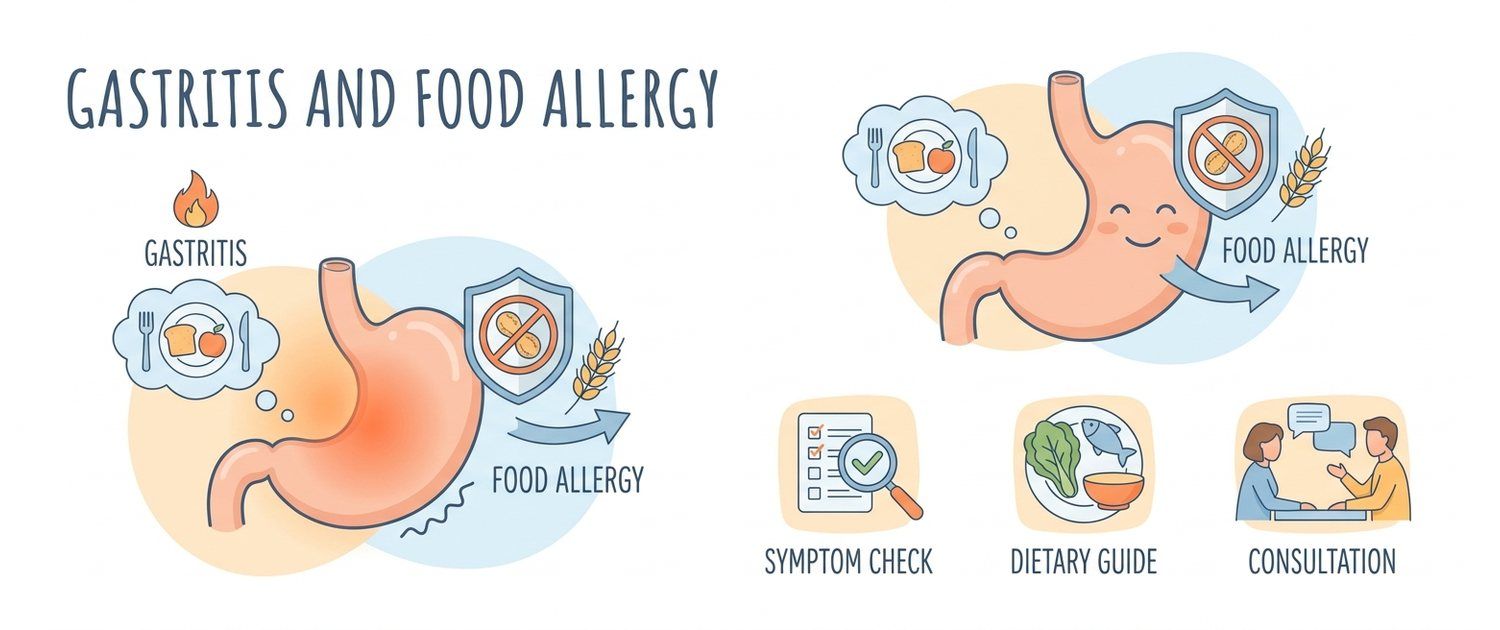
"We bought hypoallergenic food and it did not help" is the commonest sentence on this topic. The problem is not the food but that it replaced the diagnosis. Food allergy in animals is confirmed by a procedure, not by a purchase: a strict elimination diet followed by a challenge. Here is how feeding works with gastritis and food allergy — and how to tell one from the other.
How Gastritis Differs From Food Allergy
Two different mechanisms that look alike from the outside.
| Gastritis and gut inflammation | Food allergy | |
|---|---|---|
| What happens | Mucosal inflammation from irritation, infection or immune disease | An immune response to one specific protein in the food |
| Main signs | Vomiting, loose stool, rumbling, weight loss | Itching, red skin, ear infections — sometimes plus gut signs |
| Response to a food change | Improvement within days | Improvement over weeks, and only on a strict diet |
| How it is confirmed | Examination, tests, ultrasound, sometimes biopsy | Elimination diet plus challenge |
A separate case is food intolerance: a reaction with no immune system involved — lactose, or a piece of food far too fatty. It gives diarrhoea without itching and resolves as soon as the item leaves the bowl.
What Is Ruled Out Before the Food Changes
A diet prescribed instead of a diagnosis treats the wrong disease and costs weeks. Before switching, it is sensible to exclude:
- parasites — giardia and worms produce exactly the same picture; a faecal test is mandatory;
- a foreign body — especially in young dogs, see vomiting in dogs;
- the pancreas — fat is restricted seriously in pancreatitis, see feeding with pancreatitis;
- the aftermath of poisoning — if it started abruptly the logic differs, see feeding after poisoning;
- systemic causes in cats — kidneys and thyroid also cause vomiting and weight loss, see a cat losing weight.
Feeding a Dog or Cat With Gastritis
Four principles do the work here, not a particular brand:
- frequency — four or five small meals instead of two large ones;
- low fat — fat lingers longest in the stomach and provokes vomiting;
- high digestibility — a simple protein and carbohydrate source, minimal ballast;
- consistency — no new flavours or supplements until it is clear what helps.
When the large bowel dominates, fibre changes the picture: in a controlled trial, dietary management of acute colitis in dogs outperformed an antibiotic. The symptom itself is covered in diarrhoea in dogs.
Cats bring their own trap: chronic vomiting in cats is blamed on hairballs for years. Vomiting more than twice a month is neither normal nor fur — it is a reason to investigate the gut; see also why a cat is not eating and cat blood test.
The Elimination Diet: Diagnosis Through Food
An elimination diet is not "allergy food" but a diagnostic tool. Its logic: remove every protein the animal has ever eaten and see whether the signs disappear.
- Pick one protein source the pet has never met, or a hydrolysate — protein cut into fragments too small for an immune response.
- Run it for six to eight weeks. Skin signs fade more slowly than gut signs: vomiting and stool often settle within two weeks, itching only by the end of the second month.
- Strict means strict. No treats, no flavoured chews, no flavoured tablets or supplements, no table food, no raiding the other pet's bowl, no scavenging outdoors.
- Keep a diary: what was eaten, when vomiting occurred, how bad the itching was. Without notes the result cannot be judged.
Points three and four decide the outcome. A diet broken once a week gives no answer — it gives the impression that "it did not help".
The Challenge: Why the Old Food Comes Back
The most frequently skipped step. Improvement on a diet proves nothing by itself: it may coincide with the season, with skin treatment or simply with the treats stopping. The diagnosis is made when the previous food returns and the signs return with it. In most animals the flare appears within days, sometimes within a couple of weeks.
After confirmation comes the pleasant part: single proteins are reintroduced one at a time to find those tolerated. Instead of a lifetime of "special food" the owner ends up with a clear list of what is allowed.
Why a Blood Test for Food Allergy Does Not Work
Blood and saliva tests for "food allergens" are sold widely, but their accuracy has been measured: in healthy animals with no signs at all they return positives against dozens of ingredients. In plain terms, such a test cannot separate a sick animal from a healthy one, so a diet must not be built on it.
What is genuinely worth testing in chronic cases is covered below — and it concerns inflammation and absorption, not "allergens".
Feeding a Cat With Food Allergy and Handling the Itch
In cats food allergy usually shows on the skin: scratching around the face and neck, miliary dermatitis, belly licked bald. Gut signs occur but less often than in dogs.
The procedure is the same — six to eight weeks with a challenge. The difference is in execution: a cat may refuse the new food, and a starving cat is more dangerous than an unfinished trial. So the switch is slow, and if the cat has barely eaten for two days the trial stops and the vet is called.
Worth remembering: itching in cats and dogs is caused more often by fleas and atopy — a reaction to pollen and house dust mites — than by food. The diet tests only the food hypothesis. If two honest months change nothing, that hypothesis is closed and the search moves on.
Which Markers Are Checked in Chronic Vomiting and Diarrhoea
| What is checked | Why |
|---|---|
| Total protein and albumin | Low values mean the gut is losing protein, which changes the plan |
| Eosinophils | May rise with parasites and some inflammatory bowel disease |
| Vitamin B12 and folate | Show where absorption is failing |
| Specific lipase | Separates the pancreas from the intestine |
| T4 in cats | Hyperthyroidism also causes vomiting and weight loss |
| Faecal parasite testing | Mandatory before any diet |
Gut wall structure and lymph nodes are shown by abdominal ultrasound for a cat. When diet and treatment give no answer, biopsy is the next step, and the vet decides.
When to See a Vet Rather Than the Pet Shop
- blood in vomit, or black stool;
- weight loss despite a normal appetite;
- diarrhoea lasting more than three days, or dehydration;
- a cat that has not eaten for over a day;
- itching that has broken the skin into sores and weeping patches.
If it is unclear where to start, the signs can be described in a cat symptom review or a dog symptom review, which suggests what to discuss with the vet. A finished form is explained by pet results interpretation, and how that differs from a consultation is described in online vet results review.
On therapeutic ranges and how they differ from ordinary food, see therapeutic pet food; on choosing an everyday diet for a healthy pet, see choosing cat food.
This article is informational. Diagnosis and treatment of your pet are the job of a veterinarian.
For informational purposes only
This article is for informational purposes only and does not constitute medical advice, diagnosis, or treatment. Please consult a healthcare professional for medical guidance.