Diseases of Rabbits, Tortoises and Rodents: When to Test
Reviewed by the LabReadAI medical team
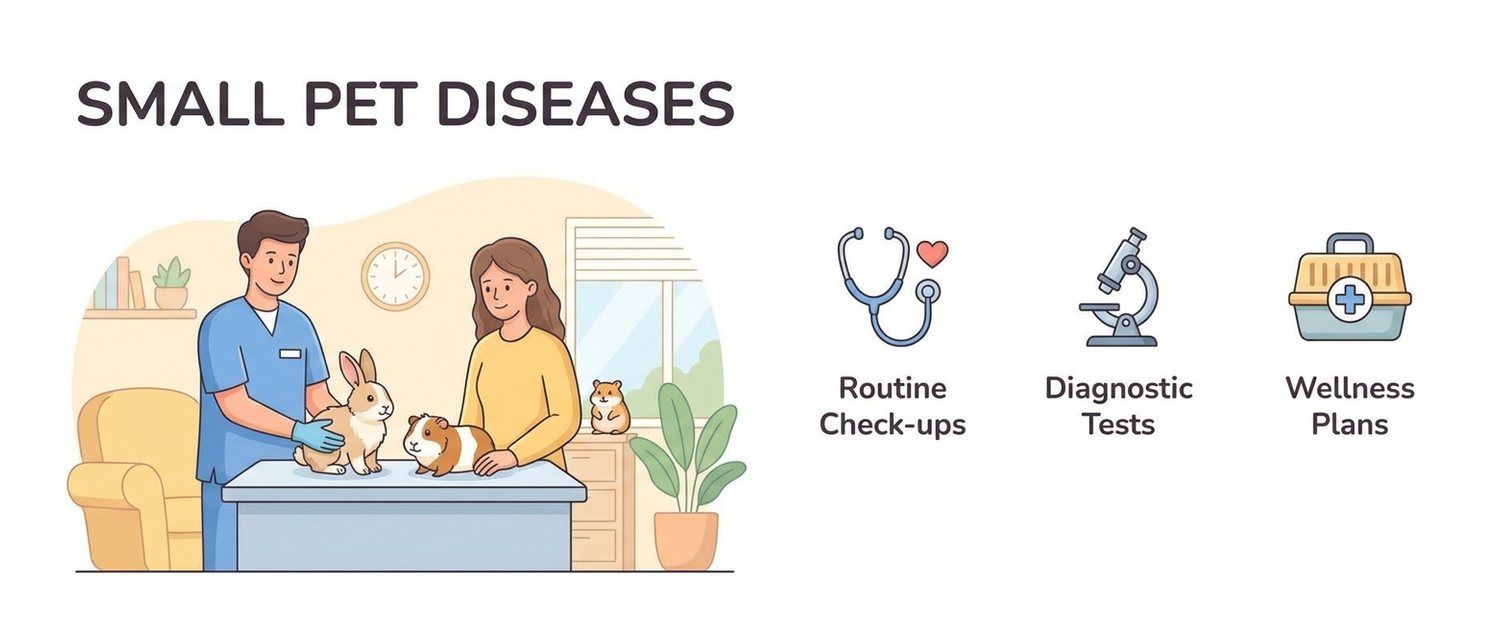
With a cat or a dog the sequence is familiar: draw blood, get a form, read it. With a rabbit, tortoise, hamster, rat, guinea pig or parrot it works differently. These species are tested far less often — not because owners care less, but because drawing blood from an animal weighing 30 to 800 grams is itself a procedure with risk. So the diseases of rabbits, tortoises and rodents are usually recognised from signs, with lab work brought in for specific questions.
Why Small Pets Are Rarely Blood-Tested
Three limits, all physical.
Volume. About 1 % of body weight can be taken safely. In a 2 kg rabbit that is around 20 ml and there is room to work. In a 40 g hamster it is under half a millilitre, and half the panel simply does not fit.
Restraint and sedation. Reaching a vein in a rodent or a reptile often means sedating the animal. For a weakened patient that is a separate risk to weigh against the value of the result.
Reference ranges. For cats and dogs they are decades old and stable; for a fancy rat, a Mediterranean tortoise or a budgerigar they are far softer and depend on species, season and sampling site. In reptiles a subcarapacial sample is often diluted with lymph, shifting the whole picture.
The practical consequence: in a small pet a precise description of the sign is worth more than in a cat, and an isolated number is worth less.
Rabbit Diseases: Gut Stasis and Teeth
Gut stasis. The rabbit stops eating, droppings shrink and disappear, the abdomen distends, the animal sits hunched. This is not a hairball — it is arrested motility that leads to dehydration and death within a day or two if it waits. A rabbit that has not eaten for 12 hours goes to the clinic today.
Teeth. Rabbit teeth grow throughout life and are worn down by coarse fibre. A ration of grain mixes and treats instead of hay produces uneven wear, sharp spurs, cheek ulcers and drooling. Diagnosis here is visual and radiographic rather than laboratory: see imaging in small pets.
A separate topic is pasteurellosis, a common bacterial infection of rabbits with sneezing and nasal discharge; the same organism inflames human bite wounds, covered in Pasteurella multocida infection.
Guinea Pigs and Hamsters: What Is Visible Without Tests
- Guinea pigs cannot synthesise vitamin C and depend on the diet for it; deficiency brings lethargy, an unsteady gait and painful joints. Dental disease and ileus follow the rabbit pattern.
- Hamsters arrive most often with wet tail, tumours and fall injuries. Diarrhoea in a hamster is an hours-scale problem.
- Rats are mostly airways and tumours: chronic respiratory infection with audible clicking, and mammary masses in females. You can hear the chest across the room, which beats any tube of blood.
A Sneezing Rat: Chronic Respiratory Disease
Fancy rats generate more questions than any other rodent, and nearly always the same one: the rat is sneezing. In this species sneezing is not a draught or a passing cold — it is the commonest chronic problem they have.
The condition is chronic respiratory disease, driven by mycoplasma. Most pet rats carry the organism, acquired from the mother, yet not every carrier falls ill and rarely all at once. What it looks like:
- sneezing — occasional at first, then a constant background;
- clicks and rattles on breathing — audible if you hold the rat near your ear, a sound like crackling paper;
- reddish-brown discharge around the nose and eyes, with dried crusts on the forepaws after grooming.
That last sign alarms owners most, and needlessly: it is porphyrin, a pigment from the Harderian gland. It resembles blood but is not blood. Its meaning lies elsewhere — porphyrin is a reliable marker of stress or illness, so a clear increase says the animal genuinely is unwell.
Mycoplasma is not cleared; the course is kept quiet instead, and housing drives it more than anything. Dusty bedding — fine shavings, softwood especially, and sawdust — irritates the airways mechanically all day long. Ammonia from a cage cleaned too rarely is a chemical burn to the lining: if you can smell it while leaning over the cage, the concentration at rat level is already high, because that nose sits ten centimetres above the bedding rather than a metre. Two things therefore change the picture more than most: dust-free bedding, and cleaning more often than "once it smells".
⚠️ It becomes urgent when the sneezing turns into laboured breathing: the rat breathes with visible effort through its flanks, neck extended and head raised, audible across the room, sitting hunched and ignoring food. A bluish tinge to paws and ears means oxygen is short. That is an hours-scale problem, not a week of watching. For contrast, the same sneezing in a cat usually points to an upper respiratory viral infection and is read differently — see a sneezing cat; how coughing is told apart from wheezing and dyspnoea is set out in a coughing, wheezing cat.
One more thing about this species: by two or three years of age rats very often develop tumours — in females mammary masses first, a soft mobile lump under the skin. This is not old age and not something to wait out: small nodes are far easier to remove than large ones, so any new lump is a reason to see a vet rather than watch it for months.
Tortoise and Reptile Problems Trace Back to Husbandry
In reptiles most trouble is a consequence of housing rather than an infection in itself. The parameters a vet asks about first:
| Parameter | Why it matters |
|---|---|
| Temperature gradient | digestion and immunity fail without warmth |
| UVB lighting | calcium is not absorbed without it |
| Humidity | dryness harms shedding and kidneys |
| Diet | calcium-phosphorus imbalance deforms the shell |
| Brumation cycle | a disturbed cycle causes months of anorexia |
A tortoise not eating is more often too cold or entering brumation than infected. The enclosure is assessed before the needle, and shell and bone mineralisation are judged on tortoise and reptile radiographs.
Parrot Diseases: Fluffed Up, Droppings, Breathing
Birds conceal weakness better than anything else. A fluffed parrot on the cage floor is a late stage, not an early one. What to watch:
- droppings: three components — faeces, urates and liquid; green or yellow urates are significant;
- breathing: tail bobbing in time with each breath, clicks, an extended neck;
- weight: weigh the bird on kitchen scales, and treat a 10 % loss as serious;
- behaviour: no talking, no preening, no response to a familiar voice.
Unlike hamsters, parrots can realistically be sampled and an avian panel is informative. Even so it follows the examination rather than replacing it.
When Symptoms Are Enough and When a Test Is Needed
Signs and an examination suffice for:
- one soft dropping in a rabbit with appetite preserved;
- a moult in a hamster or rat with no behaviour change;
- a tortoise refusing food in a clearly under-heated enclosure;
- one or two sneezes in a rabbit with no discharge and no dyspnoea.
Lab work genuinely changes the plan for:
- weight loss over 10 % without an obvious cause;
- anorexia beyond 24 hours in any species;
- prolonged diarrhoea or blood in droppings;
- pre-anaesthetic assessment in an older animal;
- suspected kidney or liver disease, common in rabbits and reptiles;
- a mass before surgery, to judge whether the animal will tolerate it.
If a form already exists, the pet results interpretation helps single out the meaningful lines; the reading principles are the same for every species and are set out in online vet reading.
Which Tests Are Actually Run in Rodents and Exotics
- Complete blood count — feasible in rabbits and guinea pigs; in hamsters often only a drop and a reduced panel.
- Biochemistry — kidneys and liver in rabbits, calcium and phosphorus in reptiles and birds.
- Faecal analysis — the cheapest and most underused test: parasites in rabbits, rodents and tortoises are found this way, with no blood at all.
- Smears and skin scrapes — mites appear under the microscope within minutes.
- Culture — for chronic nasal discharge.
Half that list needs no needle. Cats and dogs allow a wider panel, shown in cat blood test; large animals run their own scale, in horse blood test.
Signs That Mean Drive Now
- a rabbit with no food and no droppings for over 12 hours;
- any small pet lying on its side and unresponsive;
- open-beak breathing in a bird with an extended neck;
- blood in urine or droppings;
- prolapse, a fall injury, a bite from another animal;
- in a tortoise, nasal bubbles, swollen eyelids, an open mouth at rest.
Small animals decompensate fast: there is no reserve in a small body.
How to Describe a Complaint So It Can Be Read
Since the entry point here is the symptom, description quality decides almost everything. Record: species and exact age, weight today and a month ago, the diet in grams and by composition, cage or enclosure parameters, when the animal last ate and passed droppings, what changed in behaviour, and which other animals share the home. A structured symptom check accepts complaints about animals too.
The logic matches cats and dogs: description narrows the field, testing confirms it. The feline version is in why a cat is not eating and cat symptoms. Images and reports go to the pet imaging review, and what internal imaging shows in general is covered in ultrasound for dogs and cats. Diet in small species heals and harms more than medication does, and the principle of a targeted ration is in therapeutic pet food.
This article is informational. Diagnosis and treatment of your pet are the job of a veterinarian.
For informational purposes only
This article is for informational purposes only and does not constitute medical advice, diagnosis, or treatment. Please consult a healthcare professional for medical guidance.