Cat Breathing With an Open Mouth: Why It Is an Emergency
Reviewed by the LabReadAI medical team
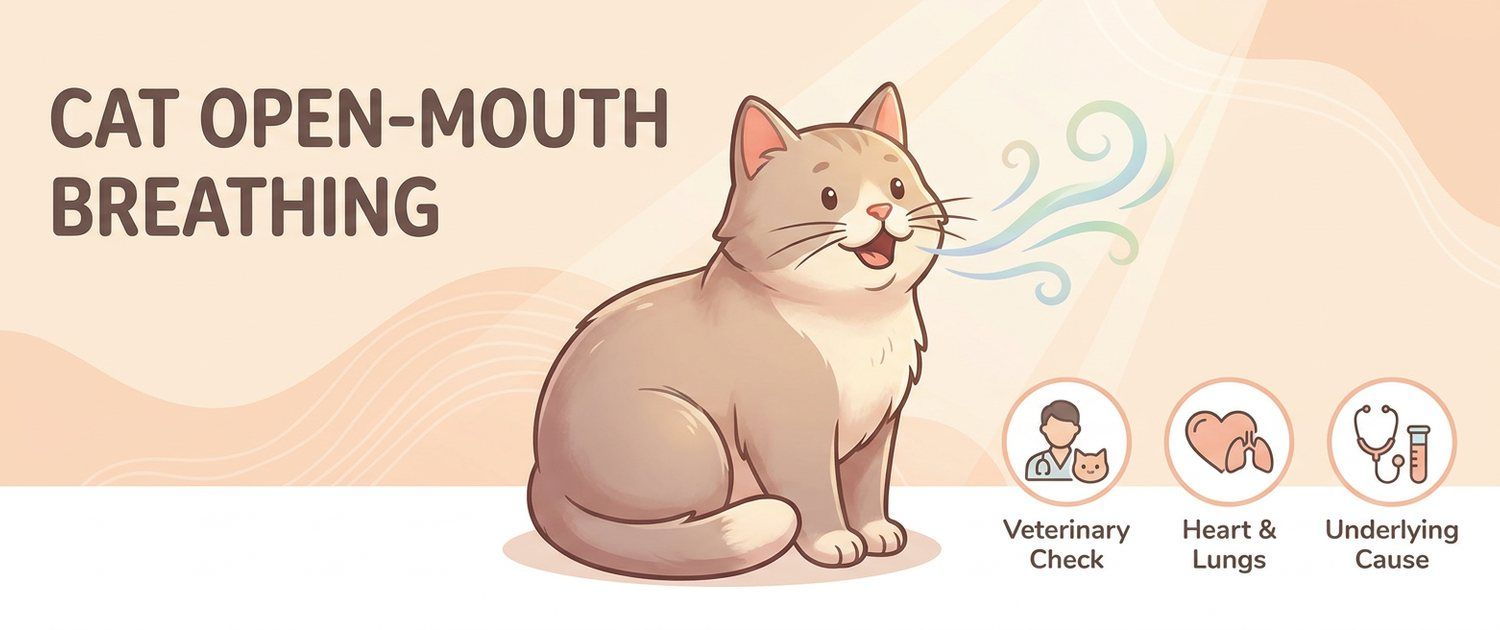
A dog opens its mouth to cool down — that is ordinary thermoregulation. A cat cannot do that. So an adult cat breathing with an open mouth at rest has almost never simply overheated: she is fighting for oxygen. This is a situation measured in minutes, not days.
What to Do Right Now
The sequence is short and does not depend on the cause, because the cause gets established at the clinic:
- Stop everything. Do not chase the cat around the flat or drag her out from under the sofa: the chase costs more oxygen than the disease does.
- Let her choose the posture. A struggling cat sits upright on her chest, elbows out, neck extended. That posture is not to be corrected.
- Use a carrier, ideally top-opening, so she can be lowered in rather than pushed through a narrow door. A soft mat inside, nothing else.
- In the car: quiet, cool, no loud music, no window blasting into the carrier. Keep the box level.
- Phone the clinic on the way. A cat in respiratory distress gets oxygen immediately, and a warned clinic has the space ready.
Go to the nearest 24-hour clinic, not to a favourite one across town.
Why an Open Mouth Means Something Different in Cats
In dogs, an open mouth and a lolling tongue evaporate moisture and shed heat. Cats cool themselves differently — through the paws, grooming and finding a cold surface. The mouth opens only once nasal breathing can no longer meet the demand for oxygen.
A short exception exists: a kitten after wild play, a cat after a hot car journey, a very frightened cat at the vet may open her mouth for a few minutes. The key words are a few minutes, and it fully resolves at rest. Beyond five to ten minutes, or repeating, or appearing without exertion, the exception is over.
Worrying companions worth naming plainly: the belly working harder than the chest, pale, grey or bluish gums, an extended neck, a cat that will not lie down or sleep, a muffled voice instead of a meow, unsteadiness.
Fluid Around the Lungs and Pulmonary Oedema
Two of the commonest causes in cats, and both are about water where air should be.
Pleural effusion compresses the lungs from outside. It accumulates in heart failure, in pus-forming infection, with tumours and sometimes with infectious peritonitis. The characteristic detail is rapid shallow breathing in a cat that will not lie down — often with no cough at all.
Pulmonary oedema is fluid inside lung tissue, most often a consequence of heart muscle disease. Feline cardiomyopathy runs silently for a long time: murmurs are not always audible, and the first event is often the sudden breathlessness itself. Sometimes heart disease announces itself through a clot: the cat screams, the hind legs stop working and go cold — an emergency covered in cat limping. What a cardiac study shows is described in dog heart ultrasound and ECG; the logic is the same in cats.
Feline Asthma and Airway Disease
Feline asthma is inflammation and spasm of the lower airways. The classic picture is coughing fits with the neck stretched out and the chest pressed low, wheezing, and a cat that looks perfectly healthy between attacks. A severe attack looks exactly like pulmonary oedema, and the two cannot be separated at home. Chronic coughing and wheezing are covered in cat coughing and wheezing.
The same group holds pneumonia, an inhaled foreign body, tumours, chest trauma and a diaphragmatic hernia after a fall from height.
Anaemia, Pain and Other Causes
- Severe anaemia — there is not enough blood to carry oxygen, so the cat compensates with rate. The gums look pale, nearly white. Anaemia shows on the very first blood count.
- Pain and shock — after trauma, with an acute abdomen, or with a blocked male cat: see blood in cat urine.
- Heat stroke — rare in cats, but it happens in a closed car or on a summer balcony.
- Poisoning — often alongside drooling: cat drooling.
- Systemic illness with general decline; the accompanying lethargy and food refusal are described in lethargic cat and why a cat is not eating.
How to Count the Resting Respiratory Rate
This is the best home indicator available without equipment, and it is worth learning before anything happens.
The cat must be asleep or lying quietly and not purring, since purring ruins the count. Watch the chest and count the rises — an inhale plus an exhale is one movement. Count for 30 seconds and double it.
- Under 30 a minute — normal for a sleeping cat.
- 30–40 — recount in an hour and keep watching.
- Over 40 at rest, consistently — go to the vet, even if the cat looks calm.
In cats with confirmed heart disease this count serves as a home monitor and the alarm threshold is lower: consistently above 30 while asleep is already a reason to call the cardiologist, without waiting for forty. A steady climb in sleeping rate precedes visible deterioration by days.
When to See a Vet Urgently
Immediately, at night, without waiting:
- open-mouth breathing at rest for more than a few minutes;
- the belly working harder than the chest;
- pale, grey or bluish gums and tongue;
- a cat that cannot lie down or sleep and sits with an extended neck;
- a resting rate consistently above 40;
- sudden screaming with hind legs giving way;
- open-mouth breathing after a fall, an impact or a bite.
Separately: if the cat also started drinking heavily, a shared systemic cause is possible — see cat drinking a lot.
What Not to Do at Home
- Do not wash, douse or wrap her in a wet towel. Stress and chilling make things worse, and a breathless cat does not need cooling.
- Do not force food or water. With laboured breathing, liquid easily goes into the airway.
- Do not give any medicine. Human antipyretics, painkillers and antihistamines are lethal to cats; any drug comes only on a veterinarian's prescription, and here that decision is made at the clinic.
- Do not turn the cat onto her back to inspect the belly, and do not restrain her in an awkward position — it can stop her breathing.
- Do not spend time on photos, videos or clinic reviews. The nearest 24-hour practice is the right answer.
- Do not wait for morning if the open mouth appeared at night.
What Imaging and Tests Will Clarify It
The order at the clinic is nearly always the same: oxygen and stabilisation first, investigation second — positioning a severely breathless cat for a film is itself risky.
- Chest radiographs — fluid around the lungs, oedema, pneumonia, heart size: cat X-ray.
- Point-of-care chest ultrasound — finds effusion within seconds and is done before any film; the principle of the method is described in cat abdominal ultrasound.
- Echocardiography — the only way to confirm cardiomyopathy.
- Complete blood count — anaemia and inflammation; the values are explained in cat blood test.
- CT — for tumours, trauma and complex cases: MRI and CT for pets.
Once the acute phase is over and a report is in hand, it can be uploaded to pet imaging interpretation and a blood panel to pet results interpretation; what numbers reveal before an appointment is shown in online vet reading. If you are unsure how urgent something is and want to describe it in words, there is a symptom check and the cat symptoms page. But with open-mouth breathing the clinic comes first and the reading afterwards.
This article is informational. Diagnosis and treatment of your pet are the job of a veterinarian.
For informational purposes only
This article is for informational purposes only and does not constitute medical advice, diagnosis, or treatment. Please consult a healthcare professional for medical guidance.