Dog Shivering: Cold, Fear, Pain, Fever or Poisoning
Reviewed by the LabReadAI medical team
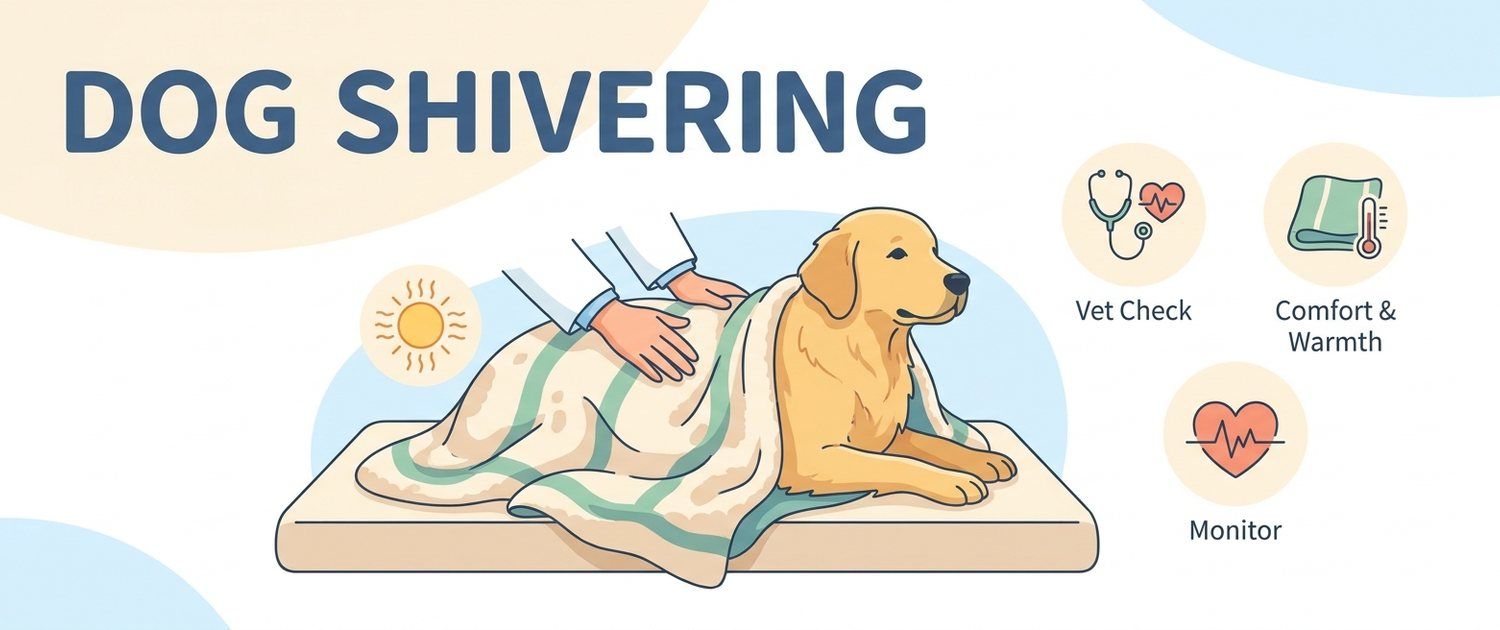
Shivering is a sign that means almost nothing on its own: a chihuahua in a draught, a labrador with back pain and a dog that licked something off the pavement half an hour ago all shiver the same way. Context supplies the meaning — the circumstances, how long it lasts and what travels with it. So the work is not about the shivering itself but about what else has changed.
When a Dog Shivers From Cold
The commonest and most harmless cause. Small breeds, puppies, smooth-coated dogs, thin and elderly animals lose heat fast: their surface area is large relative to their mass, and the insulating layer is thin. Shivering here is muscle work that produces heat — a normal physiological response.
It is easy to recognise: it really is cold (outdoors, wet coat after a bath, a draught, a car journey), the shivering starts with the cold and stops in the warm within 10–20 minutes, and the dog stays active and eats. If shivering has not resolved in half an hour of warmth, the cold version is closed and you look further.
⚠ Hypothermia is a separate case: after a long spell in the frost or a fall into cold water shivering first intensifies and then stops while the animal is still cold — that is deterioration, not improvement, and it needs a vet.
Fear, Stress and Excitement: Thunder, Fireworks and the Car
The second harmless branch is emotion. Fear-shivering is recognised by circumstance: a thunderstorm, fireworks, gunshots, a car journey, the consulting room, strangers in the house, being left alone. Flattened ears, a tucked tail, hiding under furniture or pressing against you, yawning, lip-licking and panting without exercise usually come with it.
Excitement is the mirror image: the dog trembles before a walk, before the bowl, when you come home — anticipation, and it ends the moment the event happens.
The practical difference between fear and pain is one thing: fear is tied to the situation and leaves with it, pain does not. If the dog shivers in a silent empty flat and an hour after the storm, the emotional explanation has failed. Noise phobia also worsens with age and is sometimes the first sign of pain or hearing loss — worth raising with a vet rather than writing off as character.
Shivering From Pain: Back, Abdomen and Joints
Pain is the commonest medical cause of shivering in dogs, and it is recognised by posture rather than by the tremor.
- Back and neck pain: the dog stands hunched, holds its neck low and rigid, refuses to jump or climb stairs, cries out when lifted, and shivers finely and continuously. In dachshunds, French bulldogs, pekingese and other chondrodystrophic breeds intervertebral disc disease is very common, and it can end in hind-limb paralysis. What spinal imaging shows is covered in MRI and CT in dogs and cats.
- Abdominal pain: the dog hunches or adopts the praying position — chest down, rear up; the belly is tense, it objects to being touched and refuses food. That is an alarming combination: pancreatitis, a foreign body and peritonitis all look like this.
- Joint and limb pain: shivering worsens after exercise and in damp weather, and the dog limps or stops jumping into the car — see dog limping, while what a joint film shows is described in dog leg and joint X-ray.
Dogs barely complain out loud: quiet shivering, reluctance to move and lost interest in ordinary things are often all that shows from outside. Shivering with dullness is worked through in lethargic dog.
Fever and Infection: Shivering as Rigors
When temperature rises a dog shivers for the same reason a person does: the body raises its thermostat setting, and until the new temperature is reached the muscles work to generate heat. Hot ears and groin, a dry nose (meaningless alone, meaningful in a set), lethargy, refusal of food and fast breathing come with it.
Causes are many: viral and bacterial infection, abscesses, inflammation after a bite or injury, immune-mediated disease. How the inflammatory picture reads on a form is explained in dog blood test. If shivering arrives with vomiting and loose stools, the thinking turns to gut infection or poisoning — both covered in vomiting in dogs and diarrhoea in dogs.
Low Blood Sugar in Small Breeds and Puppies
Puppies of small and toy breeds hold little glycogen in the liver while spending energy fast, so a missed meal, stress, chilling or a house move drops blood sugar easily. The picture is recognisable: the puppy first goes flat and drunk-looking, then shivers, staggers, stares blankly, and may progress to seizures and collapse.
⚠ This is an emergency. On a vet's instruction, something sweet is rubbed on the gums on the way to the clinic — as first aid in transit, not as treatment: the cause still has to be found. In an adult dog sudden hypoglycaemia is rare and points to a serious background, from a pancreatic tumour to severe infection.
Poisoning: Shivering, Drooling and an Unsteady Gait
⚠ This combination is worth memorising: shivering plus drooling plus staggering is probable poisoning, and you go now, without waiting for morning or watching until evening.
Tremor and muscle twitching come from a wide range of substances: insecticides and flea products not intended for dogs; human medicines picked up off the floor; nicotine; chocolate and caffeine; xylitol from chewing gum and sweets; some house and garden plants; rodent bait; mouldy food from the bin. The general portrait is restlessness, drooling, vomiting, shivering, staggering, dilated pupils and later seizures.
What matters practically: bring the packaging or the remains of whatever the dog might have eaten, and give the time. It changes what the vet does. Feeding once the animal is stable is covered in feeding after poisoning.
Shivering Hind Legs in an Older Dog
A separate common story: an old dog stands and its hind legs tremble finely. Usually this is pain and weakness rather than "just age".
- Osteoarthritis of hips and knees is the leading cause: muscles tire holding the posture and tremor appears.
- Chronic lower back pain, spondylosis, narrowing of the spinal canal.
- Muscle loss and general weakness on the back of chronic disease.
- Degenerative myelopathy in large breeds — here tremor comes with incoordination and worn claw tips.
The practical conclusion: trembling hind legs in an old dog call for an examination and a film, not a sedative. The same goes for a "senior" refusal to walk: pain that can be controlled is usually behind it.
Tremor, Seizures and Other Neurological Causes
Some conditions make shivering a neurological finding in its own right.
- Generalised tremor syndrome — typically young small-breed dogs, whole-body tremor that worsens with movement and excitement. It responds to treatment prescribed by a vet.
- Idiopathic head tremor — bobbing episodes in bulldogs, boxers and dobermans; the dog is conscious and responds to its name.
- Dyskinesias — episodes of abnormal movement without loss of consciousness, easily mistaken for fits.
- Seizures — here the dog loses contact, falls, the limbs move rhythmically, salivation and urination are common, and disorientation follows. Telling a fit from tremor, and what to do during one, is covered in seizures in dogs.
The key distinction for an owner: in shivering the dog stays conscious and responds to you, in a seizure it does not. If unsure, film it: for a neurologist that is the single most valuable piece of information.
When Shivering Needs a Vet Today
Immediately, without waiting for morning:
- shivering with drooling and an unsteady gait, or any suspicion the dog ate something;
- shivering turning into seizures, loss of consciousness, rhythmic limb movements;
- shivering in a small-breed puppy together with lethargy and a drunken gait;
- a tense painful abdomen, or the chest-down rear-up posture;
- the dog cries out when lifted, cannot stand, or drags its hind legs;
- shivering with high temperature, refusal of food and rapid breathing;
- pale or bluish gums, cold paws;
- shivering after overheating in the sun or in a car;
- shivering that does not settle in warmth and quiet for more than an hour.
Within a day or two — if shivering recurs in episodes, is tied to exercise or to the evening, affects the hind legs of an older dog, or comes with reluctance to jump and climb stairs.
What Not to Do at Home
- Do not give human sedatives or painkillers. Anything from the family cabinet is dangerous for a dog and blurs the neurological picture; medication is a vet's decision.
- Do not induce vomiting on your own: with some substances that causes extra harm, and the call belongs to a vet by phone or in person.
- Do not apply a hot water bottle to a dog that already has a fever: overheating makes things worse.
- Do not rub the back with alcohol or massage it when spinal pain is suspected: movement can worsen the damage.
- Do not force food or water into an animal that is shivering and unsteady: it can go into the airway.
- Do not wait until morning if drooling, vomiting or a disturbed gait sits alongside the shivering.
Which Tests and Scans Will Clarify the Cause
With shivering a vet measures temperature and blood sugar first and orders the rest afterwards:
| Study | Question it answers |
|---|---|
| Temperature and physical exam | Fever, painful areas, neurological status |
| Blood glucose | Hypoglycaemia, especially in puppies and small breeds |
| Complete blood count | Inflammation, infection, anaemia |
| Biochemistry and electrolytes | Liver, kidneys, calcium, pancreatitis |
| Spine and joint radiographs | Arthritis, spondylosis, injury |
| MRI or CT | Discs, spinal cord and brain |
| Abdominal ultrasound | The abdomen as a source of pain |
| ECG and echocardiography | Weakness and episodes of cardiac origin |
Order matters: temperature and glucose answer "is this an emergency?" in minutes, while cross-sectional imaging answers "what exactly" afterwards. What is examined on the heart is described in dog heart ultrasound and ECG. In rabbits, rodents and birds shivering reads differently and usually means pain or chilling — see diseases of rabbits and tortoises.
A finished lab form can go into pet results interpretation, and a radiograph or scan report into pet imaging interpretation: the service explains the wording and builds questions for your vet. If there are no studies yet, start by describing the symptoms — the circumstances and everything travelling with the shivering — and browse dog symptoms.
This article is informational. Diagnosis and treatment of your pet are the job of a veterinarian.
For informational purposes only
This article is for informational purposes only and does not constitute medical advice, diagnosis, or treatment. Please consult a healthcare professional for medical guidance.