Lethargic Dog: What to Check at Home First and When to Worry
Reviewed by the LabReadAI medical team
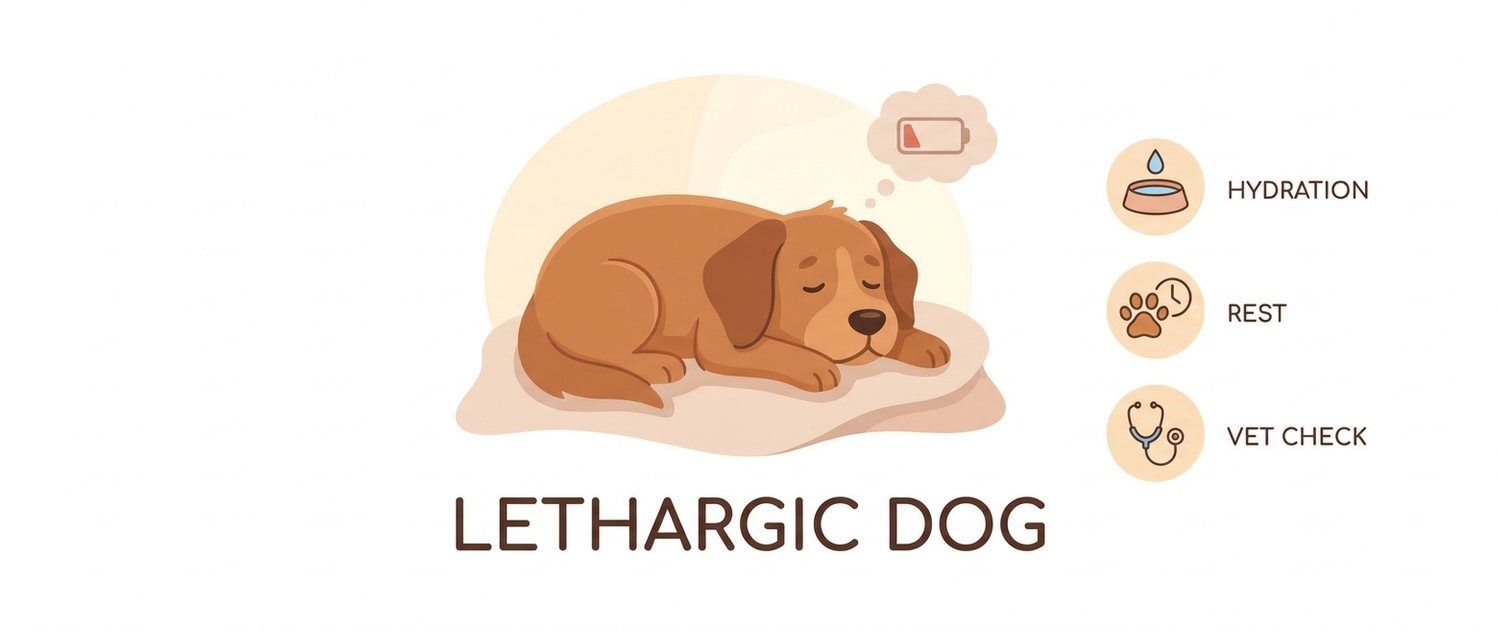
Lethargy is not a diagnosis and barely even a symptom. It is a message saying "I feel bad" sent with no return address: the dog moves less, sleeps longer, gets up reluctantly, stops coming to the door. Dozens of causes hide behind the same behaviour, from overheating to bleeding into the abdomen. So a lethargic dog is worked through by a fixed order, not by guessing.
Why a Dog Is Lethargic: Reading the Least Specific Sign
Any animal has a limited set of ways to signal trouble, and dropping activity is the cheapest of them. The body conserves energy identically in pain, fever, low oxygen, anaemia, nausea and poisoning.
It helps to split two scenarios straight away:
- Lethargy that developed over hours. Always more serious. The search is for acute causes: poisoning, heatstroke, bleeding, bloat, sudden pain, severe infection.
- Lethargy that grew over weeks. More often chronic: kidney and liver disease, the heart, hormonal disorders, joint pain, tumours, anaemia.
A separate pairing is lethargy plus refusing food. Food refusal has its own guide, dog not eating, and the combination of the two is a reason not to watch at home for more than a few hours.
What to Check at Home First: Gums, Breathing, Temperature
These observations cost nothing, take five minutes and match almost exactly what a vet will ask on the phone. Run them in the same order every time.
| What to look at | Normal | What is concerning |
|---|---|---|
| Gums | Pink, moist | White, grey, blue, yellow, brick red |
| Capillary refill | Colour returns in 1–2 seconds | Longer than 2 seconds |
| Breathing at rest | Even, effortless | Fast, open-mouthed, with flank heaving |
| Temperature | About 37.5–39.0 °C | Below 37.5 or above 39.5 °C |
| Belly | Soft, painless | Hard, distended, painful |
| Skin tent | Springs back instantly | Stays tented for seconds |
To take a dog temperature at home: an ordinary digital thermometer, rectally, tip lubricated, the animal held gently until it beeps. A single reading says little — it matters in combination with the rest.
Count the resting breathing rate separately: how many chest rises happen in a minute in a calm lying dog. Fast breathing in a lethargic animal is a reason not to wait.
Gum Colour and Dehydration: Two Home Tests
Gum colour is the single most informative sign available to an owner, because it reports on blood and oxygen at once.
- Pale, almost white gums — anaemia or blood loss, including internal loss you cannot see.
- Blue or grey — tissues are short of oxygen. This is an emergency.
- Yellow — jaundice: liver, bile ducts or destruction of red cells.
- Bright brick red — sepsis, heatstroke, carbon monoxide poisoning.
Dehydration is checked with a skin tent: lift the skin over the shoulders and let go. In a healthy dog it drops back instantly. If it stays up, the eyes look sunken and the nose is dry, fluid is short — usually after vomiting, diarrhoea or heat. Those two companions of lethargy are covered in vomiting in dogs and diarrhoea in dogs.
Pain as the Hidden Cause of Lethargy
This is what owners miss most often. A dog almost never whines from chronic pain — it simply stops doing whatever hurts. Signs worth translating into the word "pain":
- gets up slowly, especially after sleep, and sits down carefully;
- stopped jumping into the car or onto the sofa, though it used to;
- will not let you touch one particular spot, turns towards your hand;
- posture changed: a hunched back, an extended neck, the praying position with belly pain;
- became irritable, or on the contrary unusually quiet.
The source can sit anywhere: teeth, ears, spine, joints, abdomen. If lethargy comes with a changed gait, read dog limping; if with coughing and laboured breathing, dog coughing.
Fever, Anaemia and Poisoning: Common Internal Causes
Fever. Above 39.5 °C with lethargy means inflammation or infection. It should not be confused with overheating: fever makes a dog shiver, heatstroke does the opposite.
Anaemia. Blood stops carrying oxygen and the animal weakens visibly: pale gums, breathlessness on minimal effort, a racing heart. Causes vary — blood loss, destruction of red cells, bone marrow disease, tick-borne blood parasites.
Poisoning. Household chemicals, chocolate, xylitol in chewing gum, medicines from the family cabinet, antifreeze, rodent bait, toxic plants. Lethargy is often the first sign, with vomiting and trembling arriving later. What to feed once the acute stage is over is in feeding after poisoning.
Kidney and liver disease, diabetes, hypothyroidism and heart disease belong to the same circle. Many of them also show up as thirst — how to measure it is described in dog drinking a lot.
Heatstroke: Lethargy That Develops in Minutes
A dog cools itself mainly by breathing, and in heat that mechanism hits a ceiling. Heatstroke does not need a locked car: a long midday walk, a run beside a bicycle or a stuffy room without water is enough.
The picture: heavy panting with the tongue out, brick-red gums, unsteadiness, then lethargy and refusal to stand. Flat-faced breeds such as pugs and French bulldogs are especially vulnerable, as are overweight, heavily coated and cardiac patients.
Before the clinic, move the dog into shade and start cooling AT ONCE rather than on arrival: douse it generously with water — cool or cold — ideally the whole body, and keep air moving; offer water if the animal is conscious. The older "cool, never cold" advice has been revised: what decides the outcome is speed, not water temperature, and lost time does the harm. Wrapping and covering are what to avoid. Going in is necessary regardless: heatstroke damages organs even after the temperature returns to normal.
Bloat: When the Clock Runs in Hours
⚠ Every owner of a large or deep-chested dog — a great dane, shepherd, doberman, setter — should know this by heart. The stomach fills with gas and twists, the outflow closes and the blood supply fails.
The recognisable picture:
- a distended, drum-hard belly just behind the ribs;
- unproductive retching: the dog strains and only saliva comes up;
- restlessness, an inability to settle, then growing weakness and lethargy;
- pale gums, fast breathing, a staggering gait;
- most often shortly after a large meal or drink followed by activity.
This is not a watch-until-morning situation. Without surgery bloat is fatal within hours, and the diagnosis is made on a single radiograph — how that is taken is described in dog x-ray.
When a Lethargic Dog Needs an Urgent Vet Visit
Drive in immediately if any one of these is present:
- gums that are white, grey, blue or yellow;
- a hard distended belly with unproductive retching;
- the dog cannot stand, staggers, falls to one side or loses consciousness;
- temperature below 37.5 °C or above 40 °C;
- laboured breathing, or open-mouth breathing at rest;
- blood in vomit, stool or urine;
- known or likely contact with poison, medication, antifreeze or rodent bait;
- lethargy in a puppy, an old dog, a pregnant bitch or an animal with chronic disease;
- lethargy lasting more than a day, or worsening over a few hours.
What Not to Do at Home
- Do not give human painkillers or fever drugs. They are dangerous for dogs, and blunted pain hides the picture from the vet. Any medication is a vet's decision.
- Do not induce vomiting just in case: with some poisons and with bloat it does direct harm.
- Do not force water into the mouth of a dog that is lying down — it can go into the airway.
- Do not warm an animal with a heat pad when fever is suspected, or douse it in iced water when overheated.
- Do not wait until morning if the gum colour has changed: that is the sign clinics stay open at night for.
- Do not stop or change previously prescribed medication on your own.
Which Tests and Scans Will Clarify the Lethargy
The baseline for unexplained lethargy is almost always the same:
- complete blood count — anaemia, inflammation, platelets;
- biochemistry — kidneys, liver, glucose, electrolytes, enzymes;
- urinalysis — concentrating ability, infection, blood;
- abdominal ultrasound — free fluid, organs, masses;
- radiographs — chest and abdomen, bloat, foreign bodies;
- targeted tests when tick-borne infection is suspected.
How to read blood numbers is covered in dog blood test, and what ultrasound actually sees is in abdominal ultrasound for dogs. In cats the same sign reads differently because a cat masks illness longer — see lethargic cat.
A finished lab form can go into pet results interpretation and a scan or report into pet imaging interpretation: the service explains the wording in plain language and builds questions for the vet. If there are no studies yet, describe your symptoms and browse dog symptoms.
This article is informational. Diagnosis and treatment of your pet are the job of a veterinarian.
For informational purposes only
This article is for informational purposes only and does not constitute medical advice, diagnosis, or treatment. Please consult a healthcare professional for medical guidance.