Cat Constipation: How Long to Wait and What to Do at Home
Reviewed by the LabReadAI medical team
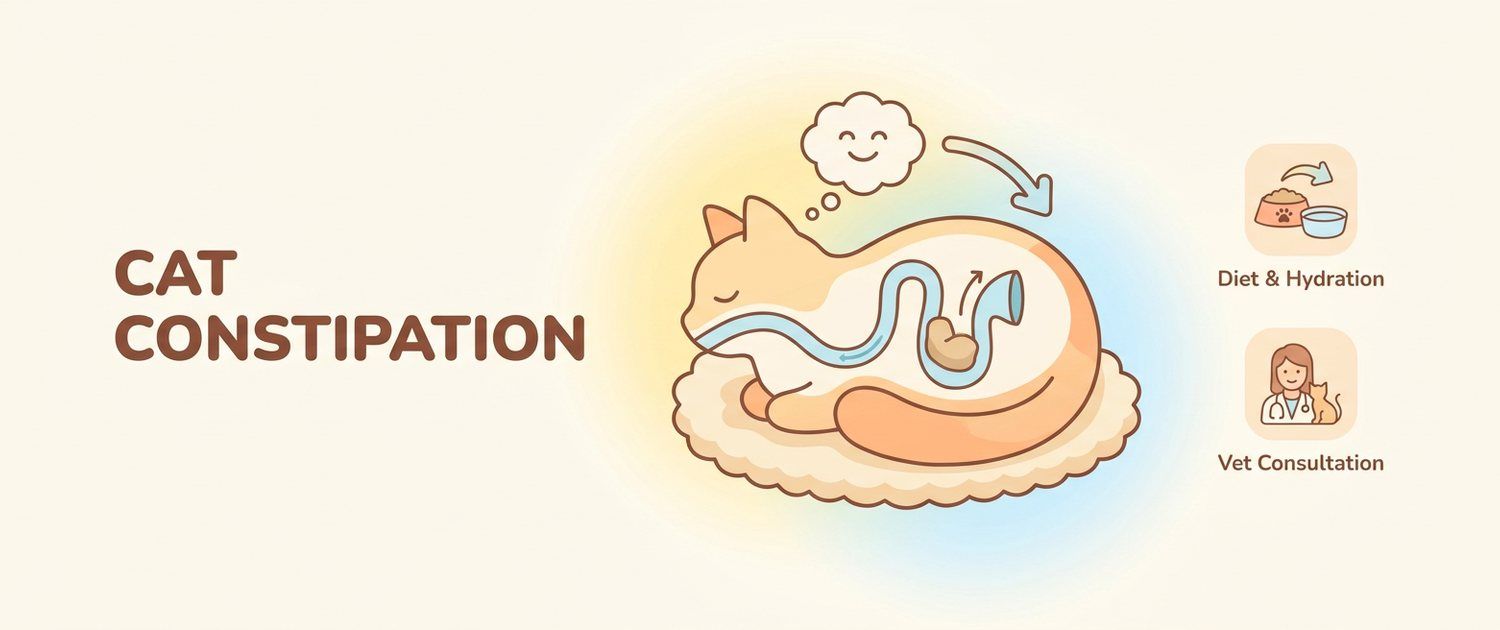
Cat constipation is rarely an accident. Cats conserve water extremely efficiently, so their stool is firm to begin with; any extra dehydration, any pain on defecation, turns normal into a problem fast. The real danger is that a neglected bout permanently changes the bowel itself.
How Long Can a Cat Go Without Pooping
The benchmarks are simple:
- A healthy cat passes stool once a day; once in two days is acceptable too.
- 48 hours without stool is the limit of calm observation.
- 72 hours or more means showing the cat to a vet, even if it is eating and behaving normally.
- A cat that is not pooping and not eating, or hiding, should not be watched at all.
Attempts count separately: if the cat visits the tray repeatedly, strains and produces little or nothing, the observation window shrinks from days to hours.
⚠️ Cat Straining in Litter Box: Constipation or Urethral Obstruction
This is the most important section of the article, and it concerns male cats.
A tom sitting in the tray, straining, crying and producing nothing looks exactly the same whether he is constipated or blocked. Owners almost always assume constipation, because the posture is identical. But a male cat's urethra is long and narrow, and it plugs with crystals, mucus and inflammatory debris.
Why this is an emergency:
- with a complete block urine cannot leave, and blood potassium climbs within hours, not days;
- without help the cat dies in roughly one to two days from cardiac arrest and kidney failure;
- posture cannot separate a block from constipation at home — a vet palpates the bladder in a minute: hard, large and painful when blocked, empty or ordinary when constipated.
The practical rule: any male cat straining with nothing produced goes to the clinic today. All the more so with blood in the urine, frequent trips or licking under the tail — the signs are set out in blood in cat urine. Waiting until morning costs far too much here.
Cat Constipation Causes, Ranked
- Dehydration — a dry diet with low water intake, hidden fluid loss in kidney disease.
- Pain on defecation — arthritis in older cats, an old pelvic injury, anal inflammation or fissures, anal gland problems.
- Hair in the gut — in long-haired and heavily grooming cats.
- Inactivity and excess weight.
- Stress and the litter tray — dirty litter, a tray in a busy spot, conflict with another animal; the cat holds on and the stool dries out.
- Metabolic and organ disease — kidneys, thyroid, low potassium.
- Mechanical obstruction — narrowing after pelvic trauma, a foreign body, a tumour.
- Neurological causes — impaired bowel innervation, including after tail injuries.
Cat Dehydration and Pain: Why Constipation Returns
These two mechanisms explain most recurrent cases, and both are easy to overlook.
Dehydration. A cat on dry food takes in little water and does not always drink enough to compensate. Add chronic kidney disease and fluid loss becomes constant, so the stool dries inside the colon — how that links to diet is covered in feeding a cat with kidney disease.
Pain. An arthritic cat does not complain — it simply visits the tray less and strains less. Over time the stool hardens, defecation hurts, the cat holds on harder, and the circle closes. Hidden lameness is poorly recognised in cats; the signs are in a limping cat. In senior cats both mechanisms usually run together — what to do about diet at that age is in feeding an older cat or dog.
Feline Megacolon and How It Starts Quietly
Megacolon is a persistent dilation of the large bowel in which the muscular wall is stretched so far that it can no longer contract effectively. The colon becomes a reservoir instead of a pump.
How it unfolds over time:
| Stage | What the owner sees | What happens inside |
|---|---|---|
| Single bout | One episode, resolved | The colon coped |
| Recurrence | A bout every few months | The wall starts stretching |
| Persistent | Help needed every time | Contractility drops |
| Megacolon | The cat cannot empty at all | Changes are irreversible |
The key point: at the final stage there is no way back — a stretched colon does not regain contractility, and in some cats it ends with surgical removal of most of the large bowel. That is why a third or fourth "ordinary bout" is not a domestic nuisance but the moment for a work-up rather than another home remedy.
Cat Hard Stool: What the Tray Tells You
- Small dry pellets — dehydration, an early stage.
- One large firm mass passed with effort — delay, but the colon still works.
- Mucus or spots of blood on the surface — a traumatised rectal lining.
- Liquid stool after several constipated days — not recovery: fluid is bypassing a firm plug. Getting this wrong costs time; the distinctions are in vomiting and diarrhoea in cats.
- Ribbon-shaped stool — possible narrowing after pelvic trauma, or a mass.
Constipated Cat: When to See a Vet Urgently
- A male cat straining and not urinating — likely urethral obstruction, a matter of hours.
- Over 72 hours without stool, or over 48 hours if the cat is not eating.
- Vomiting alongside constipation — a combination that cannot wait.
- The cat cries in the tray, hides, or will not let you touch its belly.
- A distended, tense abdomen.
- More than traces of blood in the stool.
- Not eating for over a day — fasting is dangerous in cats by itself, see why a cat is not eating.
- Constipation in a kitten — small patients dehydrate faster.
What Not to Do at Home
- No human medicines. Human laxatives, painkillers and fever drugs are lethal to cats. Any medication is a vet's decision only.
- No home enemas. Off-the-shelf enemas contain salts that cause severe poisoning in cats, and clumsy insertion tears the rectal wall. An enema for a cat is a clinic procedure, often under sedation.
- No oil off a spoon. Cats readily inhale it, and the resulting pneumonia is hard to treat.
- No milk "to loosen things up" — in adult cats it causes diarrhoea and dehydration rather than relief.
- Do not try to extract stool with a finger or an implement.
- Do not wait for Monday if a male cat is straining and not urinating.
What Is Safe to Do at Home
None of this is treatment; it is the set of conditions under which bouts recur less often:
- More water in the food. A wet diet is the simplest way to raise fluid intake; how to choose is covered in choosing cat food.
- Water in several places, away from food bowls and the tray; many cats prefer running water.
- Trays by the "one per cat plus one" rule, clean, in a quiet spot, with a low rim an older cat can step over.
- Brushing — especially long-haired cats.
- Movement and weight loss — slow, but they work.
- A diary: date, stool or no stool, what it looked like. A vet reads that in seconds.
What Tests and Imaging Clarify the Cause
- Examination with abdominal and bladder palpation — the first and decisive step, separating constipation from a urethral block.
- Abdominal X-rays — how much stool, how dilated the colon is, old pelvic trauma, foreign bodies. What a film shows is covered in cat X-ray.
- Abdominal ultrasound — the bowel wall, masses, kidneys and bladder; see cat abdominal ultrasound.
- Blood count and biochemistry — hydration, kidneys, potassium, thyroid in older cats; how to read the form is in cat blood test.
- Urinalysis — mandatory whenever the urinary tract is in question.
In small herbivorous pets gut stasis develops even faster and follows different rules — see diseases of rabbits, tortoises and rodents.
An existing lab form can be read in the pet results interpretation service, a scan or report in veterinary imaging review, and where nothing has been tested yet you can describe the situation and attach a photo to get likely causes and urgency.
This article is informational. Diagnosis and treatment of your pet are the job of a veterinarian.
For informational purposes only
This article is for informational purposes only and does not constitute medical advice, diagnosis, or treatment. Please consult a healthcare professional for medical guidance.