Female Infertility: Which Tests to Take and When to Start
Reviewed by the LabReadAI medical team
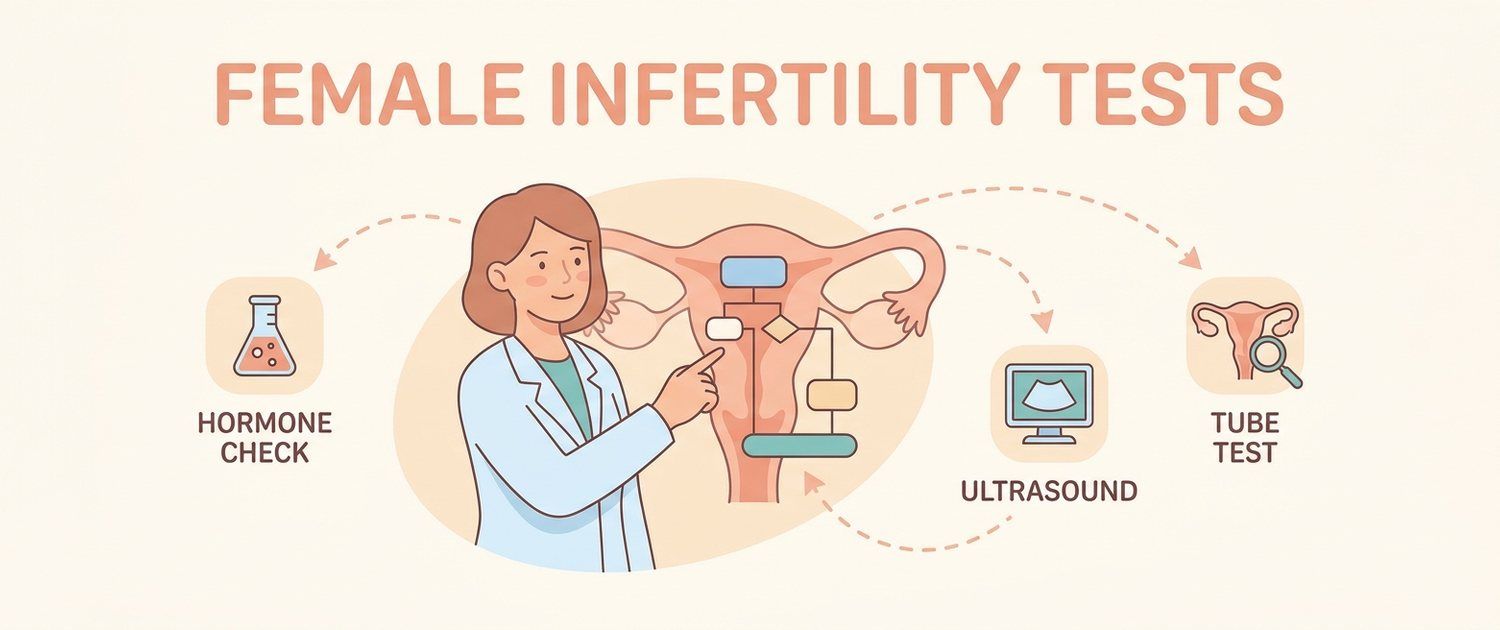
The word "infertility" sounds like a verdict, but in medicine it is simply a reason for a planned work-up, not a life sentence. Most couples are helped by a clear set of tests rather than chaotic "test everything". Let's sort out which tests are truly needed in female infertility, why many of them are tied to the days of the cycle, and when a couple should begin the work-up.
What Female Infertility Is and When to Start the Work-Up
Infertility is spoken of when pregnancy does not occur with regular intercourse without contraception over 12 months. It does not mean "never" — the cause is often found and fixed. A work-up is usually advised after a year of trying, and for women over 35 already at 6 months, because with age time matters more. The couple is always assessed: a male factor contributes in about a third of cases.
Hormones by Cycle Day: FSH, LH, Estradiol
Some hormones are informative only on certain days of the cycle. On days 2–5 (early cycle), FSH, LH and estradiol are checked — they reflect the work of the ovaries and pituitary. A high FSH early in the cycle can point to a reduced ovarian reserve. That is why timing matters: a result taken off the "right" cycle day is easy to misread.
Progesterone and Confirming Ovulation
To see whether ovulation occurs, progesterone is checked in the second half of the cycle — about 7 days before the expected period (mid-luteal phase). An adequate level indirectly confirms that ovulation happened. If the cycle is irregular, the timing is chosen individually. An irregular cycle is itself a common cause of difficulty conceiving, and it is worth sorting out — see the article on cycle changes and missed periods.
AMH and Ovarian Reserve
AMH (anti-Mullerian hormone) reflects ovarian reserve — the pool of eggs. Unlike early-cycle hormones, AMH changes little by day, so it can be taken on almost any day. A low AMH does not mean "pregnancy is impossible", and a high one does not guarantee easy conception — it is just one guide for a doctor when planning management.
TSH and Prolactin: Hidden Hormonal Causes
Trouble conceiving is often linked not to the ovaries but to the thyroid and pituitary. So the work-up includes TSH (thyroid) and prolactin: their abnormalities can disrupt ovulation and the cycle, and the good news is they often respond well to correction. By indication, other hormones are added, including when PCOS is suspected.
Ultrasound and Tubal Patency
Blood tests show the hormonal background but not the "mechanics". So the work-up is complemented by a pelvic ultrasound (ovaries, uterus, follicle count) and an assessment of tubal patency (special studies ordered by a doctor). Together, tests and imaging give a whole picture. If a hormone report is confusing, you can upload the report for decoding — the service explains the values in plain language.
How to Prepare and What to Do with the Results
The key to reliable results is the right cycle days and preparation (some tests are taken fasting, calm, without stress the day before). Do not diagnose yourself from one "bad" number: hormones are read together and over time. The final interpretation and plan are made by a doctor — a fertility specialist or gynecologist. A general checklist for those planning is also in the article on women's hormones after 35.
This article is for informational purposes only and does not replace a doctor's consultation. The set of infertility tests, their timing and interpretation are chosen by a specialist individually.
For informational purposes only
This article is for informational purposes only and does not constitute medical advice, diagnosis, or treatment. Please consult a healthcare professional for medical guidance.