H10 — Conjunctivitis in ICD-10: What the Diagnosis Code Means
Reviewed by the LabReadAI medical team
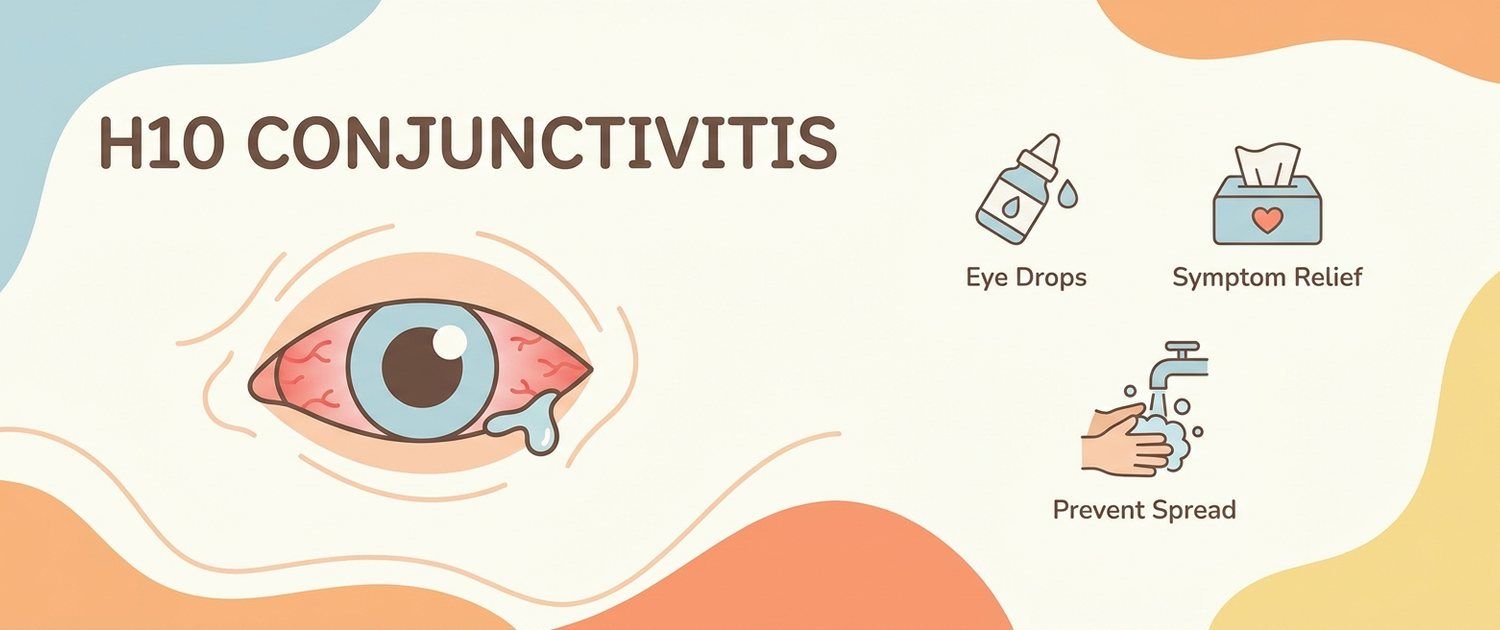
If the «Diagnosis» box on a certificate, an outpatient chart or a referral contains H10, behind that entry is one of the most common conditions in eye care. The code translates literally: H10 is conjunctivitis. Below we take it apart element by element, look at where it usually appears, explain why the code itself says nothing about the cause, and how H10 differs from the neighbouring codes often used for a similar picture.
What ICD-10 code H10 means
The official ICD-10 wording of category H10 is «Conjunctivitis». Element by element:
- H — the letter of Class VII: «Diseases of the eye and adnexa», codes H00–H59. It gathers everything related to vision: eyelids, tear ducts, conjunctiva, cornea, lens, retina, optic nerve, eye muscles and the optics of the eye.
- 10 — the category number inside the block H10–H13, «Disorders of conjunctiva». The conjunctiva is the thin transparent membrane lining the inner eyelids and continuing over the white of the eye. Its vessels dilate during inflammation, which is why the eye looks red.
- the digit after the point — the character and course of the inflammation: acute or chronic, purulent or allergic.
Put together, H10 records «inflammation of the conjunctiva». No more, no less.
It is worth noting what the code does not contain. H10 does not state the cause: a pollen reaction, a bacterial infection and irritation from lenses or dry air all live under it. Nor does it convey severity: mild redness clearing in three days and a stubborn chronic course look identical at code level. Everything substantive the doctor writes in words next to it — or specifies with the digit after the point.
One detail that regularly confuses people: the letter H serves two different classes in ICD-10 — VII (the eye, H00–H59) and VIII (ear and mastoid, H60–H95). That is why H66 is an ear infection rather than «an eye disease with a bigger number». Read the range, not just the letter.
Where you may have seen this code
H10 is an everyday primary-care code and appears in very ordinary documents:
| Document | Why H10 is there |
|---|---|
| Outpatient visit record | The administrative record of the visit: reason and diagnosis are coded in ICD-10 |
| Eye or GP report | The outcome of the examination: the code plus a description in words — which eye, what discharge, how long |
| Referral to a specialist | States a known reason: slit-lamp examination, allergy consultation |
| School, nursery or workplace certificate | Grounds for absence; with contagious forms, for temporary exclusion |
| Certificate of incapacity for work | H10 will not be there: sick notes carry no diagnosis at all, only a two-digit reason code |
| Insurance claim | The clinic reports the service delivered; the code justifies payment |
The practical conclusion is simple: on a referral or a visit slip the code describes the reason for the visit, while in a report it describes the outcome of the examination. Two different things behind an identical-looking entry.
Is conjunctivitis dangerous or not
Plainly, without either extreme. The overwhelming majority of conjunctivitis is benign and self-limiting: the eye reddens and waters, lashes stick together in the morning, and within a few days it settles. Uncomplicated conjunctivitis does not damage vision — the picture may blur through a film of mucus, but it clears after a blink.
There are, however, signs at which a red eye stops being «just conjunctivitis», and they are worth knowing by heart:
- pain in the eye, as opposed to grittiness and a foreign-body sensation;
- marked photophobia — the eye cannot stay open in ordinary light;
- reduced vision that does not clear after blinking;
- a cloudy patch on the cornea — the transparent front of the eye;
- redness forming a ring around the iris (ciliary injection) rather than spreading from the periphery;
- wearing contact lenses with a red eye;
- a history of injury or a foreign body;
- a newborn with purulent discharge from the eye;
- no improvement over several days, or worsening.
Any one of these means seeing an ophthalmologist without delay. The reason is anatomical: the cornea lies right next to the conjunctiva, and its inflammation (keratitis, category H16) is coded and managed differently, with more serious consequences for sight. This is not alarmism but a boundary: code H10 itself describes no threat — yet «red eye» is not always H10.
A second practical point is contagiousness. Viral and bacterial forms spread through hands, towels and shared objects, so a separate towel, no lenses or eye make-up while symptomatic and frequent hand-washing are not a formality. Allergic conjunctivitis is not contagious at all.
Neighbouring codes and how they differ
Inside category H10 the digit after the point specifies the character of the inflammation:
| Code | Wording | What stands behind it |
|---|---|---|
| H10.0 | Mucopurulent conjunctivitis | Thick discharge, lashes stuck together after sleep — the picture typical of bacterial inflammation |
| H10.1 | Acute atopic conjunctivitis | An allergic reaction: intense itching, swollen lids, both eyes at once |
| H10.2 | Other acute conjunctivitis | Acute inflammation not fitting H10.0 or H10.1 |
| H10.3 | Acute conjunctivitis, unspecified | The course is acute, the character is not stated |
| H10.4 | Chronic conjunctivitis | A protracted or recurring course over weeks and months |
| H10.5 | Blepharoconjunctivitis | The lid margins are involved too — red, with scales at the lash roots |
| H10.8 | Other conjunctivitis | Forms not covered by the subcategories above |
| H10.9 | Conjunctivitis, unspecified | A diagnosis is made, the character is not specified — the commonest entry on certificates |
Separately, there are codes that describe conjunctivitis yet live outside H10. These are what usually prompt the question «why does my chart show a different code»:
| Code | Meaning | Why not H10 |
|---|---|---|
| B30 | Viral conjunctivitis, including adenoviral | Coded by the pathogen, in the infectious diseases class, not by the organ |
| H16.2 | Keratoconjunctivitis | The cornea is involved as well — a different category |
| H11.3 | Subconjunctival haemorrhage | The eye is vividly red, but this is a burst vessel, not inflammation |
| H01.0 | Blepharitis | Inflammation of the lid margins without conjunctival involvement |
| P39.1 | Neonatal conjunctivitis | A separate category for the newborn period |
| H13.1 | Conjunctivitis in diseases classified elsewhere | The inflammation is part of an already named underlying illness |
Neighbouring Class VII codes that often appear in the same charts have nothing to do with inflammation: H52.1 is short-sightedness, a property of the eye's optics, and H25 is senile cataract, a clouding of the lens. A red eye relates to neither, and the shared letter H means nothing here.
Which examinations are usually ordered
The main tool is not a test but an examination. Conjunctivitis is diagnosed clinically: the doctor inspects the eye, if needed with a slit lamp, assesses the discharge, the cornea and the lid margins, everts the eyelid, and where corneal damage is suspected applies fluorescein staining. Everything else follows on indication.
What may be added:
- culture of the discharge with sensitivity testing — in a stubborn, recurring or severe purulent course, and in newborns;
- conjunctival swab or PCR — where a chlamydial or adenoviral origin is suspected and the usual course drags on;
- allergy work-up — with seasonality, itching and an accompanying runny nose: total and specific IgE, eosinophils, skin testing. How preparation works, and why testing is not done at the peak of a flare, is covered in the guide on allergy skin testing;
- examination of adjacent areas — nose, lids, tear ducts: isolated conjunctival inflammation is less common than people assume.
A distinct and very frequent story is seasonal allergic conjunctivitis. If the eyes itch and redden in the same weeks every year alongside nasal congestion and sneezing, hay fever is the likely explanation. The pollen calendar and the typical spring flare are covered in detail through the example of birch pollen allergy, and the general logic of allergy assessment in the allergy guide. When an allergy is recorded but not specified, the code T78.4 may appear alongside.
Another common background is a respiratory infection. Adenovirus produces red eyes and a runny nose together, and earlier documents often carry the code J06.9 in such cases. The combination «red eyes plus a cold» is itself a strong pointer to a viral origin.
While you are still at home deciding whether the course looks ordinary, it helps to set the complaints out in order: when it started, one eye or both, what the discharge is like, is there itching, is there pain and light sensitivity, has vision changed, was there contact with someone affected, do you wear lenses, and what preceded it — a cold, pollen, a new face product. That structured review can be done in advance so you arrive with a ready picture instead of reconstructing it from memory in the consulting room. It does not replace the examination, but it markedly sharpens it.
What to do next
A practical sequence:
- Ask which subcategory applies. Find out which digit follows the point and why: H10.0, H10.1 and H10.4 describe different scenarios and different expectations.
- Check yourself against the warning signs listed above. Pain, photophobia, persistently reduced vision, lenses, injury — see an ophthalmologist without waiting.
- Keep hygiene simple. A separate towel, no rubbing, no shared cosmetics, and no lenses or eye make-up while symptomatic.
- Track the seasonality. If flares repeat in the same weeks each year, write the dates down — that is the most valuable evidence an allergist can get: matching your own dates against the pollen calendar often answers the question of cause before any testing.
- Look at the wider picture. In atopic people conjunctivitis often travels with the skin: if the chart already contains atopic dermatitis, say so — the picture then reads differently.
- Come back if there is no improvement in a few days. A protracted course is not a reason to change drops on your own but a reason to revisit the diagnosis: the code in the chart may turn out to be a different one.
- Do not look for what is not in the code. H10 conveys neither cause nor prognosis. Meaning lies in the examination, the course, and the doctor who puts them together.
The short version
H10 is the ICD-10 code for conjunctivitis — inflammation of the conjunctiva, the thin membrane over the eye and inside the lids. It belongs to Class VII, the block of conjunctival disorders, and is refined by the digit after the point, from mucopurulent H10.0 to unspecified H10.9. The code names no cause and measures no severity: allergy, infection and irritation share the same entry. Most cases are benign and settle on their own, but pain, photophobia, persistently reduced vision or a red eye in a lens wearer change the picture and call for an eye examination.
For informational purposes only
This article is for informational purposes only and does not constitute medical advice, diagnosis, or treatment. Please consult a healthcare professional for medical guidance.