Alkaline Phosphatase (ALP): Normal Ranges and Interpretation
Reviewed by the LabReadAI medical team
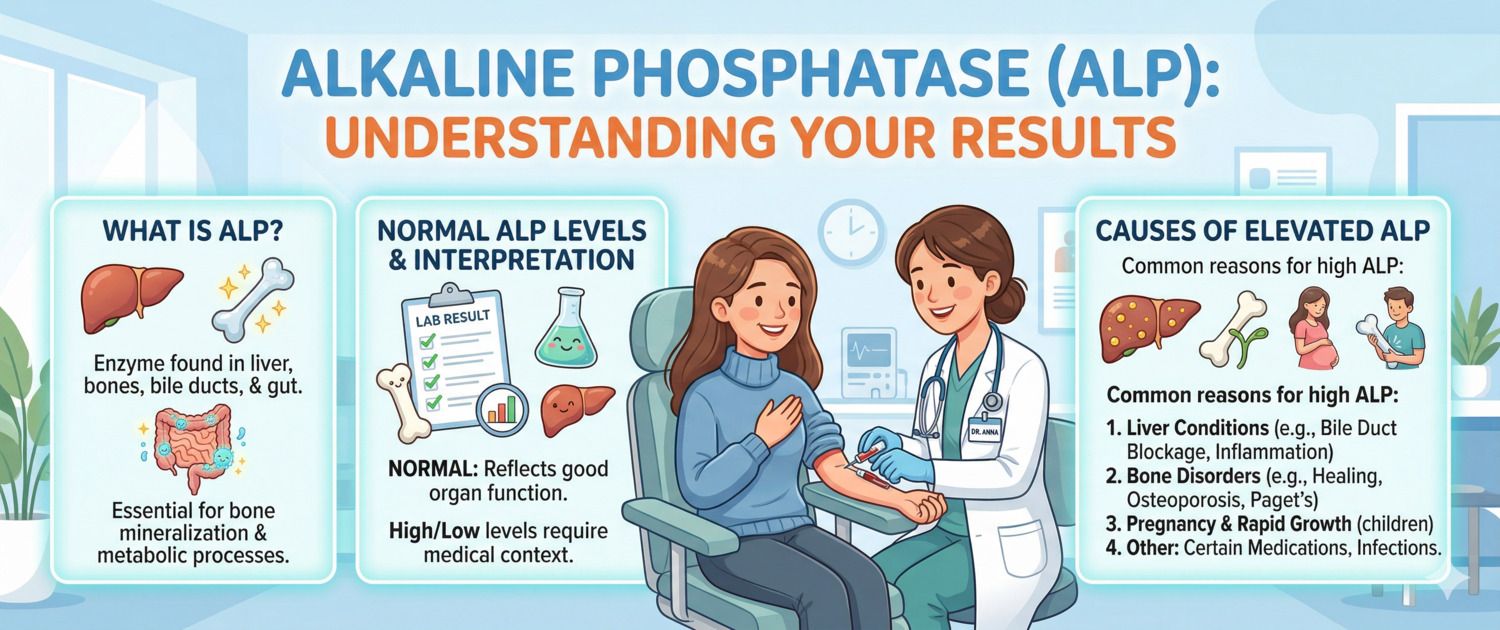
Alkaline phosphatase is one of those markers that is easily misread without context. In a teenage child, ALP three times the adult upper limit is completely normal. In a third-trimester pregnant woman, a twofold elevation is normal too. But in a non-pregnant adult, the same level can point to serious biliary or bone pathology. This is why ALP cannot be read without accounting for age, sex and physiological state — and without simultaneously looking at GGT. Here is how to do that correctly.
What Is Alkaline Phosphatase and Where Does It Come From
Alkaline phosphatase (ALP) is an enzyme that catalyses the removal of phosphate groups from various molecules in an alkaline environment. Unlike ALT and AST, which are predominantly cytoplasmic enzymes, ALP is membrane-bound. It is anchored in cell membranes and enters the blood when the cells carrying it are damaged or undergo accelerated turnover.
Critically: ALP in the blood is a mixture of several isoenzymes with different tissue origins. A standard laboratory test measures their combined activity without separating them by source.
Main ALP isoenzymes:
- Hepatic — produced by biliary duct epithelium; released when bile flow is obstructed (cholestasis)
- Bone — produced by osteoblasts during new bone formation; elevated with active growth, fractures and bone disease
- Intestinal — produced by small intestinal epithelium; accounts for a small fraction of total ALP in adults
- Placental — produced by the placenta; rises sharply in the third trimester of pregnancy
From this variety follows the central clinical task when ALP is elevated: determine which isoenzyme is raised — hepatic or bone. This is where GGT becomes indispensable.
Normal Alkaline Phosphatase Levels
ALP reference ranges vary considerably with age and physiological state — one of the features that sets it apart from most other biochemical markers.
| Group | Normal ALP, U/L |
|---|---|
| Adult men 18–50 years | 40–130 |
| Adult men over 50 years | 40–150 |
| Adult women 18–50 years | 35–105 |
| Adult women over 50 years | 35–130 |
| Children under 1 year | up to 250 |
| Children 1–10 years | up to 350 |
| Adolescents 10–18 years | up to 500 |
| Pregnancy (third trimester) | up to 250–400 |
Reference ranges at your specific laboratory may differ. Always use the values printed on your own lab report.
Why is ALP so high in children and adolescents? Bone is being actively formed: osteoblasts are working at full capacity, releasing the bone isoenzyme into the bloodstream. During the pubertal growth spurt (typically ages 11–15), ALP can reach 300–500 U/L — a completely physiological finding that requires no investigation in the absence of other abnormalities.
Why is ALP elevated in pregnancy? The placental isoenzyme rises from week 16 and peaks in the third trimester. After delivery, levels normalise within 4–6 weeks.
Postmenopausal women. After menopause, ALP reference values increase slightly — the bone isoenzyme rises as bone turnover accelerates with declining oestrogen.
How to Prepare for an ALP Blood Test
ALP is part of a standard liver function test panel and is measured from venous blood.
Fasting. Strictly fasting — last meal 8–12 hours before. After a fatty meal, the intestinal ALP isoenzyme transiently rises in people with blood groups B and O — an artefact that disappears within 2–4 hours.
Medications. A wide range of drugs affects ALP. Elevating: oral contraceptives, anabolic steroids, amoxicillin-clavulanate, antifungals, methotrexate, allopurinol. Lowering: clofibrate, some antacids, high-dose vitamin D.
Haemolysis. Unlike AST, ALP is not released from red blood cells — results are resistant to moderate haemolysis.
Sample stability. ALP is relatively stable in storage, but activity may rise at room temperature. Samples should be kept refrigerated.
Elevated ALP: Cholestasis or Bone Disease
When ALP is elevated, one question must be asked first: liver or bone? The logic for distinguishing them is straightforward.
If GGT is also elevated → the source is most likely hepatic (biliary ducts). GGT is not produced by bone tissue — its elevation reliably points to a hepatobiliary component.
If GGT is normal → the source is most likely bone. Osteoblasts release ALP without any accompanying GGT.
| Cause | ALP | GGT | ALT/AST | Bilirubin |
|---|---|---|---|---|
| Intrahepatic cholestasis (PBC, PSC, drugs) | ↑↑↑ | ↑↑↑ | ↑ or normal | ↑ or normal |
| Extrahepatic cholestasis (stones, bile duct tumour) | ↑↑↑ | ↑↑↑ | ↑ moderate | ↑↑ |
| Chronic hepatitis / cirrhosis | ↑ moderate | ↑ | ↑↑ | ↑ or normal |
| Liver metastases | ↑↑↑ | ↑↑↑ | ↑ or normal | ↑ or normal |
| Paget's disease of bone | ↑↑↑ (up to 10–20× ULN) | normal | normal | normal |
| Osteoporosis with active remodelling | ↑ moderate | normal | normal | normal |
| Fracture healing | ↑ moderate | normal | normal | normal |
| Bone cancer / bone metastases | ↑↑↑ | normal or ↑ | normal | normal |
| Primary hyperparathyroidism | ↑ moderate | normal | normal | normal |
| Pregnancy third trimester | ↑ up to 4× ULN | normal | normal | normal |
| Adolescence | ↑ up to 3–4× ULN | normal | normal | normal |
The table reflects typical patterns. Clinical presentations may combine multiple sources.
Paget's disease (osteitis deformans) deserves special mention — a rare condition in which ALP can exceed the upper limit of normal 10–20-fold with completely normal GGT. This is one of the highest ALP values encountered in clinical practice without liver involvement.
At the other extreme, primary biliary cholangitis (PBC) produces disproportionately high ALP, often 3–10 times the upper limit, with only moderate ALT elevation and normal or mildly raised bilirubin in early stages.
Low Alkaline Phosphatase: Hypophosphatasia and Other Causes
ALP below the lower limit of normal is less well known but clinically relevant.
Hypophosphatasia — a rare inherited condition with ALP deficiency that impairs mineralisation of bones and teeth. This is the only disease in which ALP is persistently below the lower limit of normal from birth.
Other causes of low ALP:
- Hypothyroidism — reduced tissue metabolic activity
- Zinc and magnesium deficiency — trace elements required for enzyme activity
- Pernicious anaemia — B12 deficiency reduces the activity of several enzymes
- Massive blood transfusions — dilutional effect and presence of stabilisers
Isolated mild ALP reduction in an otherwise healthy adult without accompanying changes is usually an incidental finding with no clinical significance.
ALP and GGT: The Key to Identifying the Source
The ALP + GGT combination is one of the most practical diagnostic tools in biochemistry. The logic is clean:
GGT, unlike ALP, is produced exclusively by the hepatobiliary system (liver, bile ducts, kidneys) and is absent from bone tissue. Therefore:
- ALP ↑ + GGT ↑ → hepatobiliary source (cholestasis, infiltrative disease, drug-induced liver injury)
- ALP ↑ + GGT normal → bone source (osteoblastic activity, Paget's disease, bone metastases, adolescent growth, pregnancy)
This distinction immediately directs the diagnostic search in the right direction — without expensive isoenzyme-specific ALP tests, which are not routinely available in most laboratories.
In comprehensive assessment, ALP is always evaluated within the full liver function panel — alongside ALT, AST, GGT, bilirubin and albumin. In osteoporosis and metabolic bone disease, ALP is reviewed together with calcium, vitamin D and parathyroid hormone.
When to See a Doctor Urgently
- ALP above 3× ULN with simultaneously elevated GGT and progressive jaundice — possible mechanical jaundice (bile duct stone or tumour); requires ultrasound and urgent specialist review
- ALP above 5× ULN with normal GGT in an adult — exclude Paget's disease and bone metastases; bone radiography and tumour markers
- Rising ALP on serial testing in a patient with known malignancy — possible liver or bone metastases
- ALP suddenly elevated after starting a new medication — possible drug-induced cholestasis; prompt consultation needed
On an elective basis: mild isolated ALP elevation (up to 2× ULN) without accompanying GGT elevation or other marker changes in an adolescent, pregnant woman or elderly person with active bone turnover is usually physiological. In an adult outside these groups, it warrants investigation.
This article is for informational purposes only. Interpretation of test results and diagnosis are the responsibility of a qualified physician.
For informational purposes only
This article is for informational purposes only and does not constitute medical advice, diagnosis, or treatment. Please consult a healthcare professional for medical guidance.