HBsAg Blood Test: Meaning of Positive and Negative Results
Reviewed by the LabReadAI medical team
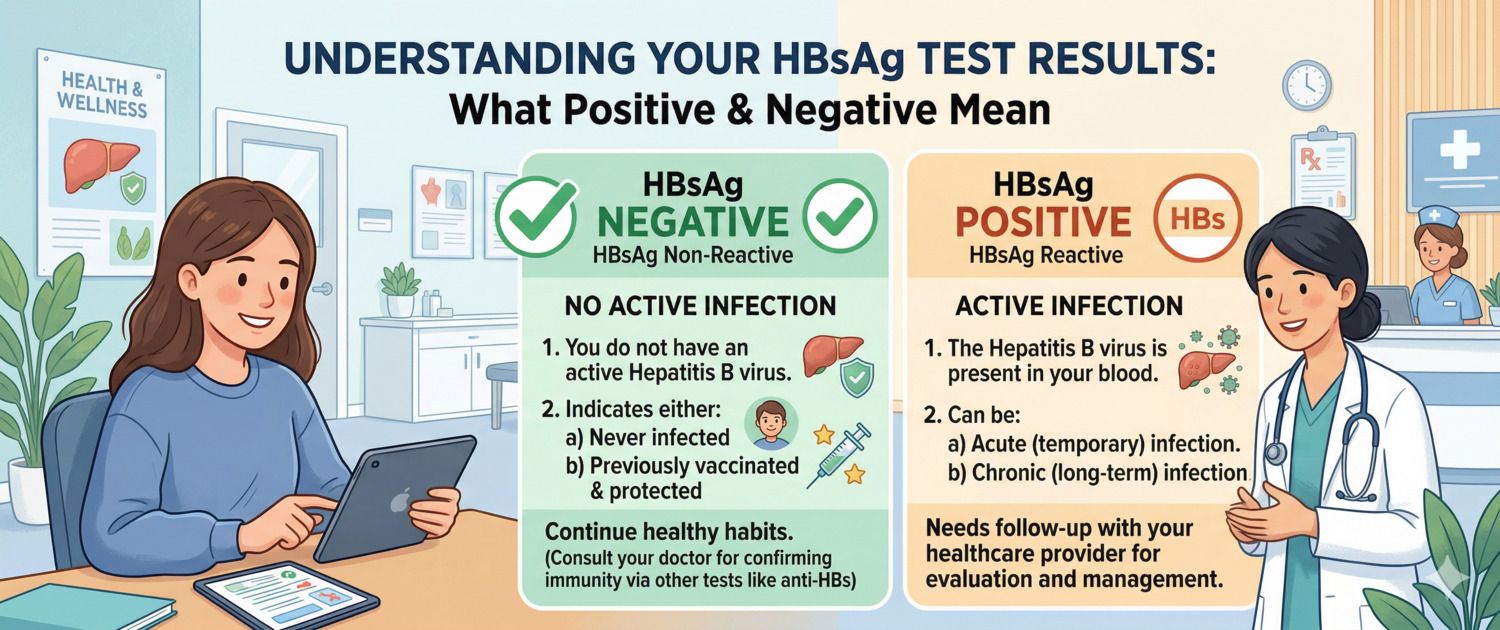
HBsAg (Hepatitis B surface antigen) is the outer envelope protein of the hepatitis B virus and the first marker to appear in the blood after infection — typically 2 to 6 weeks before symptoms develop. This makes the HBsAg blood test the cornerstone of hepatitis B screening worldwide. Understanding what this test shows, how to interpret it, and what to do if the result is positive is essential for timely diagnosis and prevention of liver damage.
What HBsAg Is and Why It Is Tested
HBsAg is a protein located on the surface of the hepatitis B virus (HBV). Infected liver cells produce vastly more surface antigen than is needed for viral particle assembly — hundreds of times more. The excess HBsAg circulates in the blood as empty spherical and filamentous particles, and it is precisely these that laboratory assays detect.
Clinical significance of HBsAg:
- Marker of current infection — the presence of HBsAg in blood means the virus is in the body right now
- Screening test — ordered during routine check-ups, before surgery, during pregnancy, and for blood donation
- Chronicity criterion — if HBsAg persists in blood for more than 6 months, the hepatitis B is classified as chronic
HBsAg should not be confused with anti-HBs — antibodies to the surface antigen that appear after recovery or vaccination and indicate immunity to the virus.
When HBsAg Testing Is Ordered
The HBsAg test is indicated in a wide range of clinical scenarios:
- Routine screening during preventive health check-ups
- Pre-hospitalisation and pre-surgical evaluation
- Pregnancy (mandatory in the first trimester)
- Blood and organ donation
- Contacts of confirmed hepatitis B cases
- Unexplained elevation of ALT or bilirubin
- Clinical signs of hepatitis: jaundice, fatigue, right upper quadrant discomfort
- Monitoring patients with chronic hepatitis B
- Before starting immunosuppressive therapy (risk of viral reactivation)
How to Prepare for the Test
The HBsAg test requires minimal preparation, but a few guidelines ensure reliable results:
- Blood is drawn from a vein, preferably fasting (last meal 8–12 hours prior)
- Plain water is allowed
- No special diet is needed
- Medications do not affect HBsAg detection — but inform your doctor about any drugs you are taking
- The result is unaffected by time of day or physical activity
Turnaround time: typically 1 business day for qualitative testing, 2–3 days for quantitative.
Interpreting Results: Positive and Negative HBsAg
A qualitative HBsAg test yields one of two outcomes:
| Result | Meaning | Next steps |
|---|---|---|
| HBsAg negative | Hepatitis B virus not detected in blood | Screening passed; if clinical suspicion persists, repeat in 2–4 weeks |
| HBsAg positive | Hepatitis B surface antigen present in blood | Confirmatory test + extended serological panel |
Important: a single positive result is not a final diagnosis. The laboratory must perform a confirmatory assay (repeat testing in duplicate, neutralisation). Only a confirmed positive carries clinical weight.
False-negative HBsAg can occur in several situations:
- Early infection period (first 1–4 weeks) — the "serological window"
- Mutant HBV strains with an altered HBsAg structure
- Very low viral load in latent infection
Quantitative vs Qualitative Testing
| Parameter | Qualitative test | Quantitative test |
|---|---|---|
| What it measures | Presence or absence of HBsAg | HBsAg concentration in IU/mL |
| When ordered | Screening, initial diagnosis | Monitoring chronic hepatitis B, assessing treatment response |
| Result format | Positive / Negative | Numeric value (e.g., 2500 IU/mL) |
| Clinical value | Fact of infection | Prognosis, disease stage, treatment response criterion |
Quantitative HBsAg is particularly important in chronic hepatitis B:
- HBsAg > 1000 IU/mL — high replicative activity, often correlates with high viral load (HBV DNA)
- HBsAg 100–1000 IU/mL — moderate activity
- HBsAg < 100 IU/mL — low activity; a persistently low level carries a favourable prognosis
- Declining HBsAg during therapy — positive treatment response
- HBsAg seroclearance (disappearance from blood) — functional cure, the most favourable outcome
Vaccination and HBsAg
The hepatitis B vaccine contains recombinant HBsAg — a purified protein, not a live virus. In response, the body produces antibodies (anti-HBs) that confer protection.
A critical point: vaccination does not cause a positive HBsAg test. Modern assays detect the "natural" viral antigen and do not react to the vaccine protein. If HBsAg is positive after vaccination, it indicates infection — not a vaccine reaction.
After a complete vaccination course, the level of anti-HBs is measured to assess immunity:
- Anti-HBs > 10 mIU/mL — protective antibody level achieved
- Anti-HBs < 10 mIU/mL — immunity not established, revaccination needed
What to Do If HBsAg Is Positive
A confirmed positive HBsAg is not a verdict, but it requires mandatory further evaluation. The recommended pathway:
- Extended serological panel: anti-HBs, HBeAg, anti-HBe, anti-HBc IgM and IgG — to determine the stage and activity of infection
- Quantitative HBV DNA (PCR) — measures viral load and replicative activity
- Biochemical panel: ALT, AST, bilirubin, alkaline phosphatase — assessing liver function and injury as part of a liver function test panel
- Co-infection screening: anti-HCV (hepatitis C), HIV antibody
- Liver and spleen ultrasound
- Fibrosis assessment: liver elastography or calculated indices (FIB-4, APRI)
- Consultation with an infectious disease specialist or hepatologist
Not all patients with a positive HBsAg require antiviral therapy. The decision to treat is based on viral load, ALT level, degree of fibrosis, and the clinical situation.
When to See a Doctor
Seek medical attention in the following situations:
- You have received a positive HBsAg result — even without symptoms
- Jaundice, dark urine, or pale stools have appeared
- You have had contact with a person confirmed to have hepatitis B (post-exposure prophylaxis is most effective within 48 hours)
- Liver enzymes are elevated on routine testing
- You are planning or have confirmed a pregnancy — to address prevention of mother-to-child transmission
Hepatitis B is a manageable infection. Modern antiviral drugs can suppress viral replication and prevent disease progression. The critical step is timely diagnosis — and the HBsAg test is its foundation.
This article is for informational purposes only and does not replace professional medical advice. If your HBsAg result is positive, consult an infectious disease specialist or hepatologist.
For informational purposes only
This article is for informational purposes only and does not constitute medical advice, diagnosis, or treatment. Please consult a healthcare professional for medical guidance.