TIBC Blood Test: Normal Range, Low and High Levels Explained
Reviewed by the LabReadAI medical team
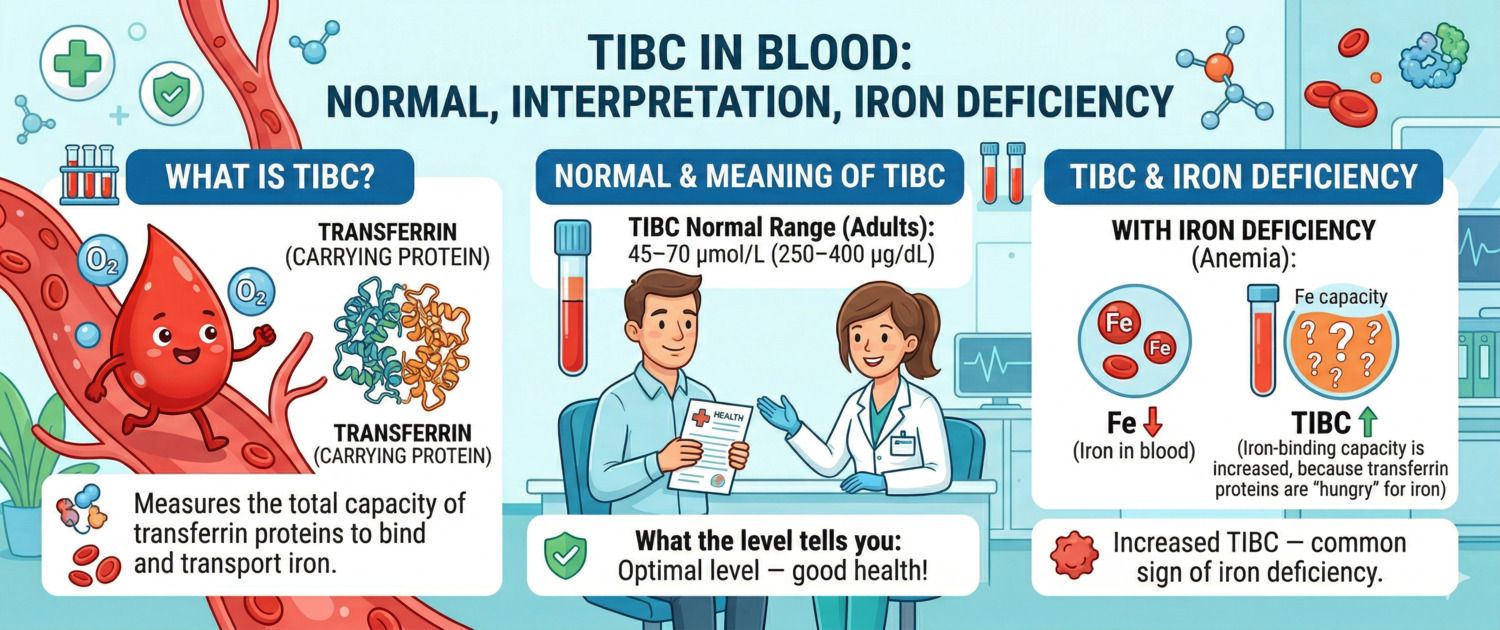
Most patients who receive a result labelled "TIBC" are not sure what it means. TIBC — Total Iron-Binding Capacity — measures how much iron transferrin, the main iron transport protein, could theoretically carry. When TIBC levels are abnormal, understanding what they indicate is essential. It is essentially the mirror image of serum iron: when iron is scarce, TIBC rises; when iron is excessive, it falls.
What TIBC Measures and How It Relates to Transferrin
Iron does not travel freely in the blood — it is carried bound to transferrin. Each transferrin molecule can hold two iron atoms. Under normal conditions, only 25–35% of these binding sites are occupied — the rest remain empty, waiting.
TIBC measures the total capacity of these binding sites: the maximum amount of iron the serum transferrin could accept. The more empty sites there are (i.e. the less iron in the blood), the higher the TIBC — the body effectively expands its transport fleet to capture every available iron molecule.
A related value often calculated alongside TIBC is UIBC (Unsaturated Iron-Binding Capacity): the difference between TIBC and current serum iron — literally "how much more iron would fit right now".
TIBC Normal Range in Adults
Reference values are similar for men and women:
| Category | Normal Range (μmol/L) | Normal Range (μg/dL) |
|---|---|---|
| Adults (men and women) | 45–75 μmol/L | 250–425 μg/dL |
| Pregnant women (3rd trimester) | up to 90 μmol/L | up to 500 μg/dL |
Reference ranges vary slightly between laboratories — always use the range printed on your own report.
Transferrin Saturation: How to Calculate and Interpret It
Transferrin saturation (TS%) is one of the most important calculated parameters in anaemia diagnosis. The formula is straightforward:
TS (%) = Serum Iron ÷ TIBC × 100
| TS% | Interpretation |
|---|---|
| < 16% | Iron deficiency |
| 16–45% | Normal |
| > 50% (men), > 45% (women) | Iron overload (suspect haemochromatosis) |
TS above normal alongside normal or high ferritin is characteristic of haemochromatosis, which requires genetic confirmation.
Causes of Elevated TIBC
High TIBC means transferrin is "hungry" — many binding sites are empty and iron is scarce.
Iron deficiency anaemia — the primary cause of elevated TIBC. In iron deficiency anaemia, the body synthesises more transferrin to capture every available iron atom. TIBC rises in parallel with falling serum iron and ferritin.
Pregnancy — physiological TIBC elevation, most pronounced in the third trimester, reflects the sharply increased iron demand for the foetus and placenta.
Oral contraceptives — oestrogens stimulate hepatic transferrin synthesis, causing moderate TIBC elevation.
Causes of Low TIBC
Low TIBC means transferrin is saturated or there is simply less of it.
Chronic inflammation and infection — during inflammation, the liver shifts production from transferrin to acute-phase proteins. Less transferrin → lower TIBC. Serum iron is also low, while ferritin is normal or elevated. This is the classic picture of anaemia of chronic disease.
Haemochromatosis — hereditary iron overload. Transferrin is maximally saturated with iron → TIBC falls. Serum iron and ferritin are both markedly elevated.
Liver cirrhosis and severe liver disease — reduced transferrin synthesis due to loss of functional hepatic tissue lowers TIBC regardless of iron stores.
Nephrotic syndrome — transferrin is lost in urine → TIBC falls.
Hypoproteinaemia — severe protein deficiency reduces synthesis of all proteins, including transferrin.
TIBC With Serum Iron and Ferritin: Interpretation Table
None of these markers works in isolation. Only the combination — with each value explained in context — gives a diagnosis:
| Condition | Serum Iron | TIBC | Ferritin | TS% |
|---|---|---|---|---|
| Iron deficiency anaemia | ↓ | ↑ | ↓ | < 16% |
| Anaemia of chronic disease | ↓ | ↓ or N | ↑ or N | N or ↓ |
| Haemochromatosis | ↑ | ↓ | ↑↑ | > 50% |
| Normal | N | N | N | 16–45% |
This is why TIBC is always ordered as part of the iron panel, not as a standalone test. Abnormal TIBC levels are best explained alongside serum iron, ferritin and transferrin saturation.
How to Prepare for the TIBC Test
TIBC is measured from the same venous blood sample as serum iron, so preparation rules are identical:
- Strictly fasting — 8–12 hours without food
- Optimal time: before 10:00 am (daily iron fluctuations affect calculated parameters)
- Stop iron supplements 5–7 days before the test
- Do not test during acute infection or inflammation — inflammation suppresses TIBC and distorts the picture
- Wait at least one week after a blood transfusion
Results are typically available within one business day. A physician interprets the result in the context of the full clinical picture.
When to See a Doctor
See a GP or haematologist if TIBC is elevated alongside weakness, pallor, breathlessness and low ferritin — this may indicate iron deficiency anaemia requiring treatment. Low TIBC with high ferritin and transferrin saturation above 50% is a reason to exclude haemochromatosis: early detection prevents liver and cardiac damage.
This information is for educational purposes only. Diagnosis and treatment are provided exclusively by a qualified physician.
For informational purposes only
This article is for informational purposes only and does not constitute medical advice, diagnosis, or treatment. Please consult a healthcare professional for medical guidance.