Agoraphobia: What It Is and Why the Circle of Life Narrows
Reviewed by the LabReadAI medical team
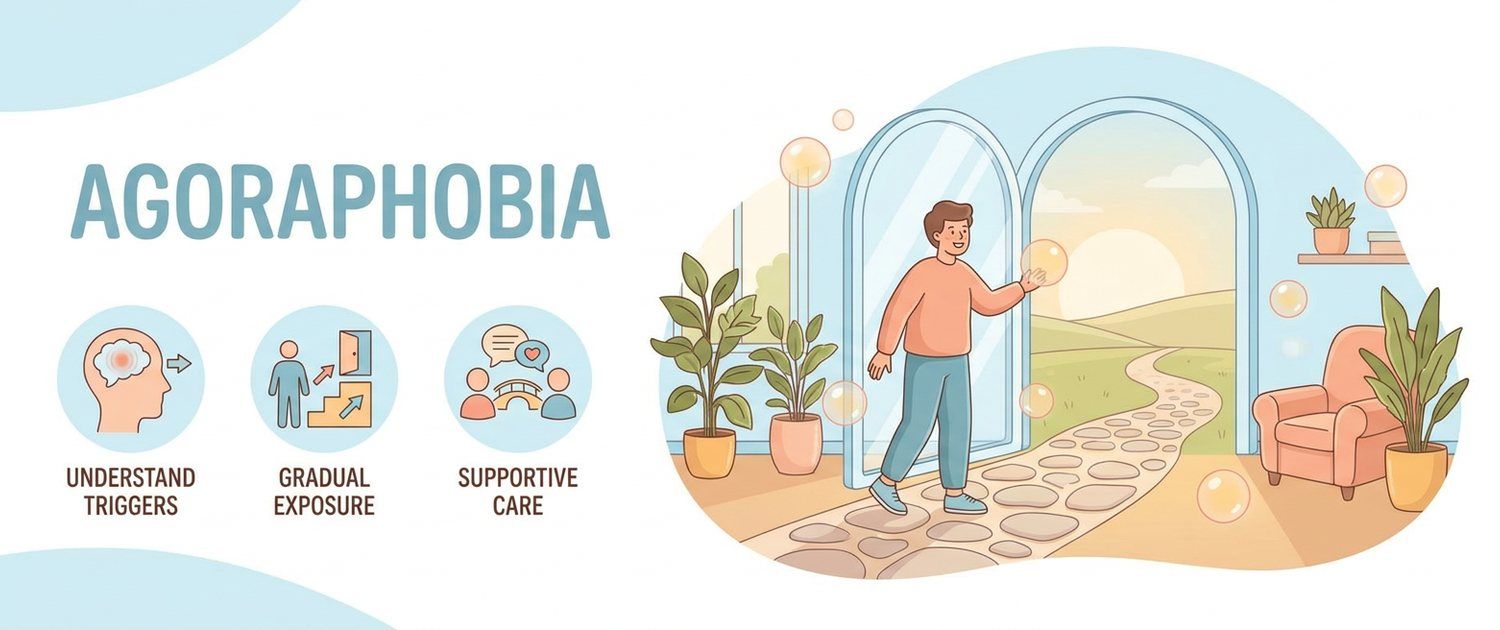
The word agoraphobia is usually translated as "fear of the marketplace", and that translation misleads almost everyone. Open space has nothing to do with it. The fear is a different one — far more recognisable and far more common.
Agoraphobia symptoms: what is actually feared
What is feared is not the place but being unable to get out if things go wrong. The question a person asks before leaving sounds roughly like: "If I feel ill there, can I leave quickly? Will anyone help? Will I be on display?"
Hence the list of situations, which diagnostic manuals divide into five groups:
- public transport — underground, bus, train, plane;
- open spaces — bridges, car parks, wide squares;
- enclosed spaces — shops, cinemas, lifts;
- queues and crowds — places you cannot simply leave without drawing attention;
- being outside the home alone.
The criteria require fear of at least two of these five, a duration of about six months, and a real cost in life. In ICD-11 agoraphobia is a diagnosis in its own right (6B02), not an appendix to panic.
Where the fear of leaving the house comes from
Most often after panic attacks. The sequence is almost always the same:
- An attack happens in a particular place — on the underground, in a queue, in stationary traffic.
- The brain links place and horror: not "I felt terrible, and it coincided with the underground" but "the underground is dangerous".
- The person starts routing around that place. The anxiety of routing around drops.
- The brain concludes: I went around and nothing happened, so going around works, so the danger was real.
From there it spreads by itself. First one place, then neighbouring ones, then "similar" situations, then distance from home. No new bad events are needed — repeated relief from avoidance is enough.
Less often agoraphobia starts without panic attacks: after fainting, after severe nausea in a crowded place, after an episode of palpitations or blood-pressure trouble.
Just-in-case measures are the main engine
This is the most underrated part of the picture, because it looks sensible.
- a bottle of water and a pill in the bag;
- a seat near the exit in a carriage, a café, a hall;
- a route that passes a pharmacy "just in case";
- going out only with someone;
- the phone in hand rather than in a pocket;
- giving up coffee, exercise, heat, saunas — anything that speeds the heart.
Every such measure lowers anxiety right now — and that is exactly why it works against the person. The brain gets its confirmation: it went well because there was water; I coped because I sat by the exit. In its picture the danger stays real, while the list of necessary conditions grows.
From which something important follows: a circle can narrow very fast, and widening it has to be deliberate, because it will not widen on its own.
How agoraphobia differs from neighbouring states
- Social anxiety. There it is other people's judgement that frightens, not the impossibility of leaving. A simple check: if it would be easier among strangers than among people you know, it is about judgement.
- Specific phobia. Fear of a lift as a lift (the enclosed space itself) is claustrophobia. Fear of a lift as a place you cannot get out of if you feel ill is agoraphobia.
- Panic disorder without agoraphobia. The attacks are there, but the circle of life has not narrowed and the routes have not changed.
- Depression. People stop going out here too, but for another reason: not frightening, just pointless and beyond one's energy.
What a clinician checks
It is worth closing the bodily part once, because faintness on transport is not always anxiety: TSH and free T4, a full blood count with ferritin (anaemia produces faintness in a stuffy carriage very convincingly), fasting glucose, an ECG if there are palpitations, and a separate cardiac assessment for fainting. If results are in hand, the service can read the panel whole.
What helps
Cognitive-behavioural therapy with a gradual return to avoided situations has an evidence base; medication prescribed by a clinician is added where needed. No specific drugs are discussed here.
What matters about the mechanics of coming back:
- The step must be genuinely small. Not "ride the whole line" but "walk into the station hall and out again". Too big a step confirms the fear rather than disproving it.
- Without just-in-case measures. Riding one stop with a bottle of water in hand is not the same experience: the brain will record that the water helped.
- Stay until it subsides rather than leaving at the peak. Leaving at the peak fixes the conclusion "it got easier because I left".
- Regularity beats intensity. A little every day works better than one heroic attempt a month.
- A companion is removed gradually and deliberately — otherwise they become a necessary condition.
These are simple rules, but they are better done with a professional: solo attempts often take too big a step and end in a setback.
What sits next to agoraphobia
A narrowing circle almost never arrives alone. Next to it usually stands whatever started it, and whatever keeps it in place.
- Night-time panic attacks — if the attacks also come in your sleep — that changes both the routine and what you avoid.
- Generalised anxiety disorder — if the worry runs in the background even without travelling.
- The old vascular label — if that old label is what your record says.
- Neurosis in plain words — if «neurosis» was the explanation and nothing followed it.
- The psychiatric register myth — if fear of a «register» is what stops you from asking for help.
If you want to see where the picture adds up, the anxiety and panic attacks test scores avoidance and just-in-case measures separately and shows whether the panic branch meets its criteria. Neither it nor the free GAD-7 scale makes a diagnosis.
This article is informational and does not diagnose. It claims neither that you have agoraphobia nor that you do not: a clinician determines that in person. And separately: with a first-ever episode, chest pain with a cold sweat, fainting or breathlessness with blue lips, it is not a text that decides but the ambulance — call emergency services.
For informational purposes only
This article is for informational purposes only and does not constitute medical advice, diagnosis, or treatment. Please consult a healthcare professional for medical guidance.