Health Anxiety: When Normal Results Do Not Reassure for Long
Reviewed by the LabReadAI medical team
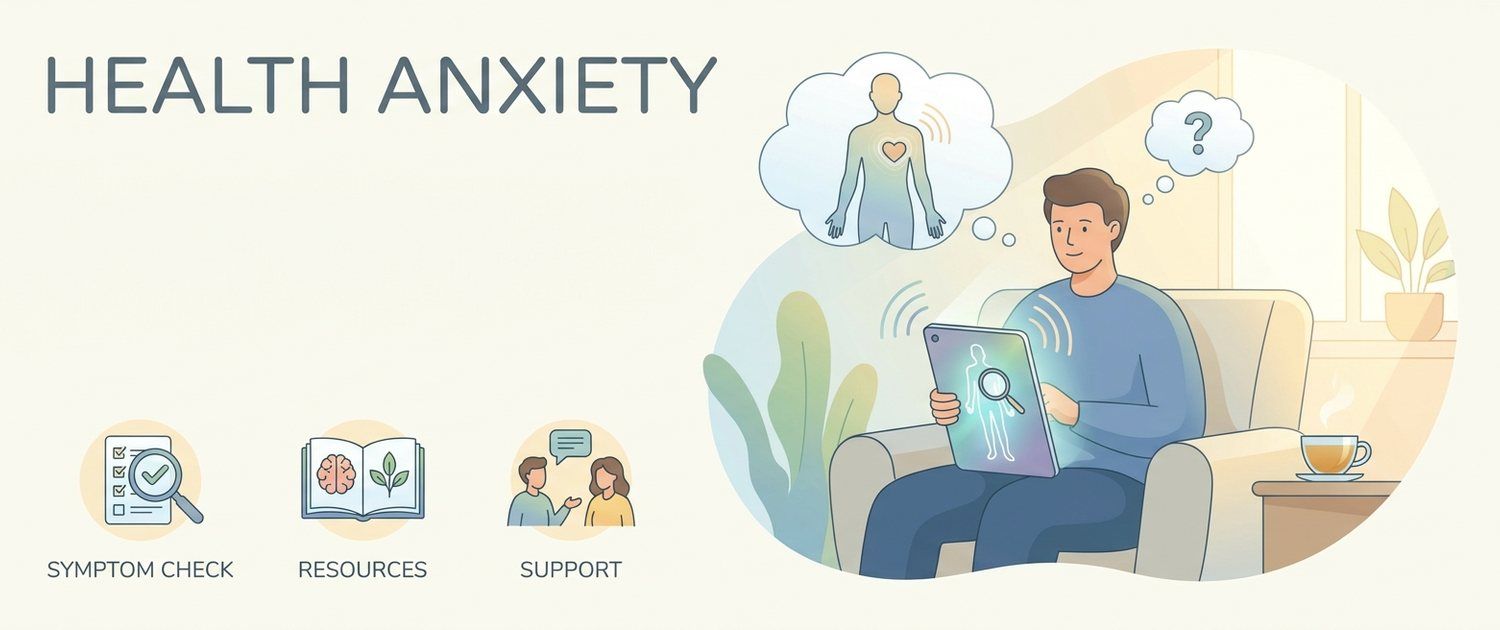
There is a state people almost always mention with a hint of mockery: "a hypochondriac". Yet this is one of the most exhausting pictures in the anxiety spectrum — and one of the most underestimated, because from outside it looks like someone fussing over their health.
Health anxiety: what it is and how it is defined
In ICD-11 this is rubric 6B23 — health anxiety. It is defined not by having symptoms but by a persistent preoccupation with having or developing a serious illness, lasting months and accompanied either by repeated checking or, conversely, by avoiding medicine altogether.
An important detail: the rubric sits not among the anxiety disorders but in the obsessive-compulsive and related group. That is not a formality — the mechanics here really are closer to OCD: there is an intrusive fear and there is an action that lifts the anxiety briefly.
The symptoms are real — the question is the interpretation
The main misunderstanding of the topic: people assume health anxiety means inventing symptoms. It does not.
The sensations are almost always real: palpitations, tingling, a lump in the throat, heaviness, a small lump under the skin, an odd mole, ringing in the ears. In most people such signals pass in the background and never reach awareness. Here they are noticed — and interpreted by the worst-case scenario.
Then comes the unpleasant physics of attention: the more you listen to the body, the more you find in it. Attention does not measure sensations, it amplifies them. So checking yourself does not calm you but increases the material for anxiety.
Health anxiety symptoms: the checking cycle and fear of illness
The mechanism is closed and accelerates by itself:
- Sensation. A twinge, a flutter, something that seemed off.
- Interpretation. "This could be serious."
- Checking. Google it, palpate, take your blood pressure or pulse, ask someone close, book an appointment.
- Relief. It arrives fast.
- Return. A day or a week later the doubt returns — because the check answered the anxiety rather than the question.
With each turn the relief lasts less and the threshold for the next check drops. Online searching deserves special mention: it feels like "working it out" and functions as a ritual. There is even a name for it — cyberchondria.
Why normal results do not help for long
This is the commonest complaint and the most logical thing in the world once you look at the mechanism.
An investigation answers a specific question at a specific moment: this is not present now. The fear, however, feeds not on missing data but on the possibility that something was missed, that the machine was the wrong one, that the doctor was inattentive, that an early stage is invisible.
No result can answer that possibility — it is unfalsifiable in principle. So the more investigations, the shorter the calm: a person gets used to receiving relief from outside, and the inner capacity to bear uncertainty weakens.
Hence a practical consequence that sounds unwelcome but saves years: the next investigation will not close the question. What closes it is working on the mechanism.
Two subtypes: seeking and avoiding
- Care-seeking — the recognisable version: many visits, many investigations, second and third opinions.
- Care-avoiding — the opposite: the person is so afraid of hearing something bad that they do not go at all, postpone screening and skip what was ordered.
The second subtype appears less often in descriptions but is more dangerous: real illness gets found later. If you recognised yourself in it, the most useful action is not to read on but to book a routine appointment.
How it differs from sensible caution
Sensible caution ends with a result: you get tested, you get an answer, you carry on. Health anxiety does not end: the answer arrived and the question stayed.
The second divider is cost. How much of the day goes on thoughts about health, on searching, on checking. And the third is selectivity: health anxiety usually does not stop the second pack of cigarettes and almost always stops ordinary life.
What a clinician does — once
Paradoxically, it is still worth starting with an investigation: close the bodily part once and properly, so as not to guess. The basic set for anxiety with bodily symptoms: TSH and free T4, a full blood count with ferritin, fasting glucose, vitamin B12 and vitamin D, and an ECG if there are palpitations. Plus age-appropriate screening by guideline — by the calendar, not by fear.
And agree with yourself in advance: this set is done once, not with every new sensation. If you already have the forms, the service can read them whole and say what the set is missing.
What helps
Cognitive-behavioural therapy aimed specifically at the checking cycle has an evidence base; medication prescribed by a clinician is added where needed. No specific drugs are discussed here.
What you can start yourself:
- Postpone the check rather than forbid it. Fifteen minutes of delay already breaks the automatism.
- Do not google the symptom. This rule works like a switch: searching amplifies the very thing it was started for.
- Do not ask for reassurance, and ask family not to answer repeated questions. Answering again and again is participation in a ritual, not support.
- Book the routine, not the urgent. Age-appropriate screening by the calendar takes some arguments away from the anxiety.
- Notice what is growing. If the relief from the last investigation lasted less than from the previous one, that is the signal that the issue is not the investigations.
The pictures next door
Health anxiety rarely stands alone: it sits beside whatever produces the bodily sensations, and beside whatever turns them into checking.
- Cardiac neurosis — if the anxiety is centred on the heart and confirmed by pain no doctor can find.
- Intrusive thoughts — if the thought of illness arrives uninvited and demands checking rather than thinking.
- Generalised anxiety disorder — if the worry does not keep to one subject and health is only one of them.
- The old vascular label — if the search has long been circling that old label from your record.
- The psychiatric register myth — if what stops you asking for help is not doubt but fear of the consequences.
If you want to see the whole picture, the anxiety and panic attacks test scores bodily symptoms, fear of illness and checking separately — and shows where the engine actually sits. Neither it nor the free GAD-7 scale makes a diagnosis.
This article is informational and does not diagnose. It claims neither that you have health anxiety nor that you do not, and it does not remove the need for investigation where investigation is indicated.
For informational purposes only
This article is for informational purposes only and does not constitute medical advice, diagnosis, or treatment. Please consult a healthcare professional for medical guidance.