Cardiac Neurosis: Chest Pain When the Cardiologist Finds Nothing
Reviewed by the LabReadAI medical team
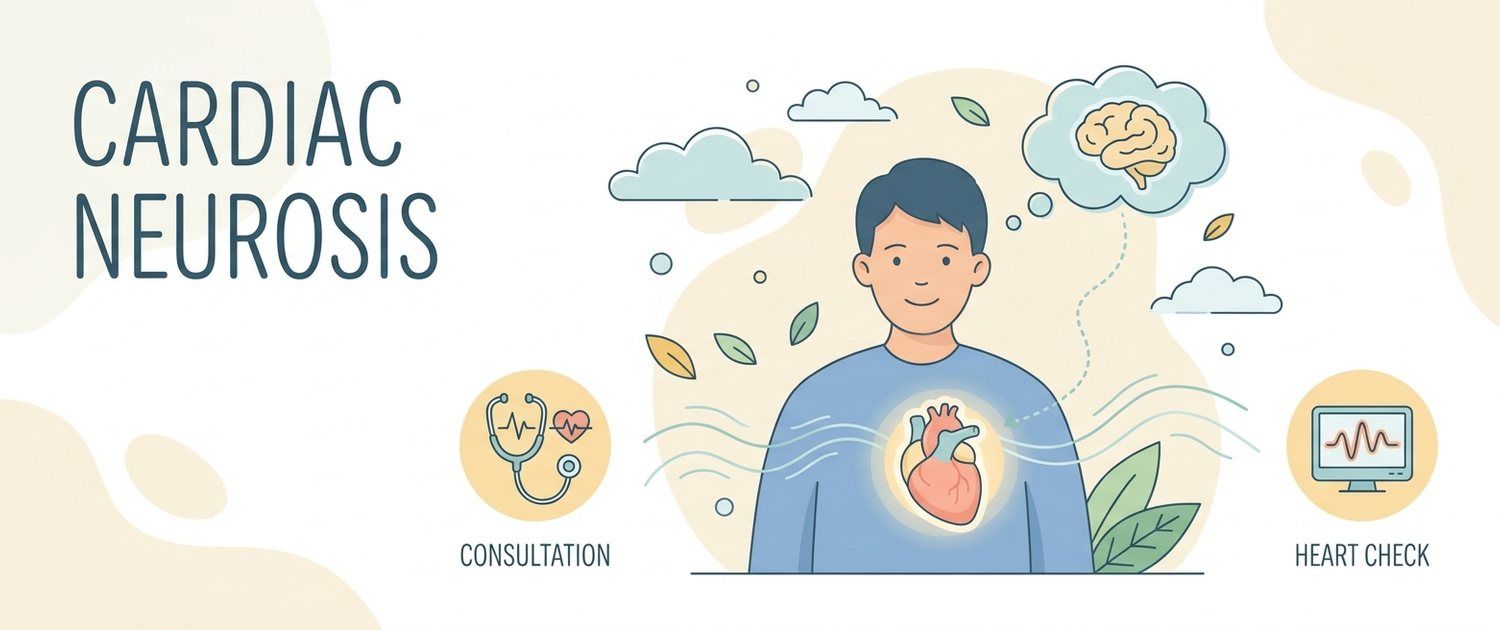
The scenario is recognisable in half a sentence: a stabbing in the chest, the heart "stalls", it is frightening. An ambulance was called or a cardiologist seen, a tracing made — everything is fine. A week later it repeats. The doctor says "cardiac neurosis", and the person is left with a label but no explanation.
Cardiac neurosis symptoms: what it actually is
It is not a heart disease. It is bodily anxiety whose main stage is the chest. In a medical record it is coded F45.30 — somatoform dysfunction of the autonomic nervous system, cardiovascular. Synonyms you may have heard: "heart neurosis", "neurocirculatory dystonia of the cardiac type", "anxiety-related cardialgia". When people say the heart aches from nerves, this is exactly what they mean.
None of these exists as a diagnosis in its own right in the classifications — they are variants of one description, covered in more detail in the article on the old vascular label.
Important from the outset: the cause not being in the heart does not make the sensations imaginary. The pain is real, the palpitations are real, and the fear even more so.
How this pain differs from angina
The differences are not absolute, and it is a clinician rather than a text that settles them. But they are real and useful to understand.
In cardiac neurosis the pain is more often stabbing and pinpoint, localised near the apex of the heart — below the left nipple. It lasts either seconds or hours. There is usually no link to exertion: a person can climb stairs without pain and feel it sitting on the sofa. It often eases with distraction, conversation or movement.
In angina the sensation is different: pressing, burning, behind the breastbone, "as if a slab had been placed there". It is predictably linked to exertion — appearing on stairs, on a fast walk, in the cold — and passing just as predictably at rest within a few minutes.
⚠️ There are situations where no distinguishing is needed at all: pain radiating to the arm, jaw or back with a cold sweat; fainting; breathlessness with blue lips; a first-ever episode. That is emergency care. More on the distinction in panic attack or the heart.
Ectopic beats and anxiety: why the heart seems to stall
A sense of a skipped beat is most often an ectopic beat — an extra contraction. In healthy people isolated ectopics occur constantly and in the overwhelming majority carry no significance. People simply do not notice them.
The same physics of attention applies here as in health anxiety: the more closely a person listens to their heart, the more they hear in it. Attention amplifies rather than measures. So the habit of constantly taking your pulse does not calm you but increases the material for anxiety.
Even so, a clinician should assess the ectopics: their significance is judged by number and character, using a tracing and monitoring rather than self-observation.
How the loop closes
The mechanism is short and always the same:
- Sensation. A twinge, the heart speeds up — from coffee, from stairs, from a stuffy room, from nothing.
- Interpretation. "This is my heart. This could be a heart attack."
- The body responds. Fear releases adrenaline, the heart speeds up further, breathing quickens.
- Confirmation. The sensation got stronger — so the interpretation must have been right.
- Closure. The circle completes within minutes, and the person is in an attack.
The loop breaks at the interpretation link, not at the sensation link. Which is exactly why "stop feeling it" is neither the aim nor the way out.
What to check — once
Before blaming nerves, the bodily part is closed:
- an ECG — mandatory, with monitoring if there are episodes of skipped beats;
- TSH and free T4 — an overactive thyroid brings palpitations and anxiety before anything else;
- a full blood count with ferritin — anaemia intensifies palpitations and breathlessness;
- fasting glucose;
- potassium and magnesium — deficiency is linked to ectopics;
- echocardiography where indicated.
Plus history: caffeine, energy drinks and pre-workout, alcohol withdrawal, heart-racing medication, short sleep. If you already have the forms, the service can read them whole and say what the set is missing.
And an agreement with yourself: this set is done once. A fourth tracing in a month answers not a medical question but an anxiety — and answers it ever more briefly.
What helps
- Understanding the mechanism. Knowing that a fast heartbeat follows from adrenaline rather than signalling damage removes the top link of the loop. This is not autosuggestion but a change of interpretation, and therapy is built on it.
- Working with the breath. A slowed out-breath, longer than the in-breath. Deep fast breathing does the opposite: it produces dizziness and chest tightness.
- Stopping the constant pulse checks. Hard, but one of the most effective changes.
- Bringing exertion back. Giving up sport out of fear locks the loop in: the heart stops receiving its familiar accelerations and each one becomes frightening. Exertion is best returned gradually and, with recurring complaints, after an examination.
- Caffeine. Reduce without stopping abruptly.
- Cognitive-behavioural psychotherapy has an evidence base in such states; medication prescribed by a clinician is added where needed. No specific drugs are discussed here.
The word «cardiac neurosis» comes from the same vanished group of diagnoses as «neurosis» itself, where what stands in the place of both words today is spelled out.
If you want to see where the engine of your sensations sits, the anxiety and panic attacks test scores bodily symptoms and fear of the sensations separately and shows a point on the "anxiety in the mind × anxiety in the body" map. It makes no diagnosis.
This article is informational and does not diagnose. It does not replace a cardiac examination: with chest pain, investigation is mandatory.
For informational purposes only
This article is for informational purposes only and does not constitute medical advice, diagnosis, or treatment. Please consult a healthcare professional for medical guidance.