Panic Attack or Heart Attack: How to Tell Them Apart
Reviewed by the LabReadAI medical team
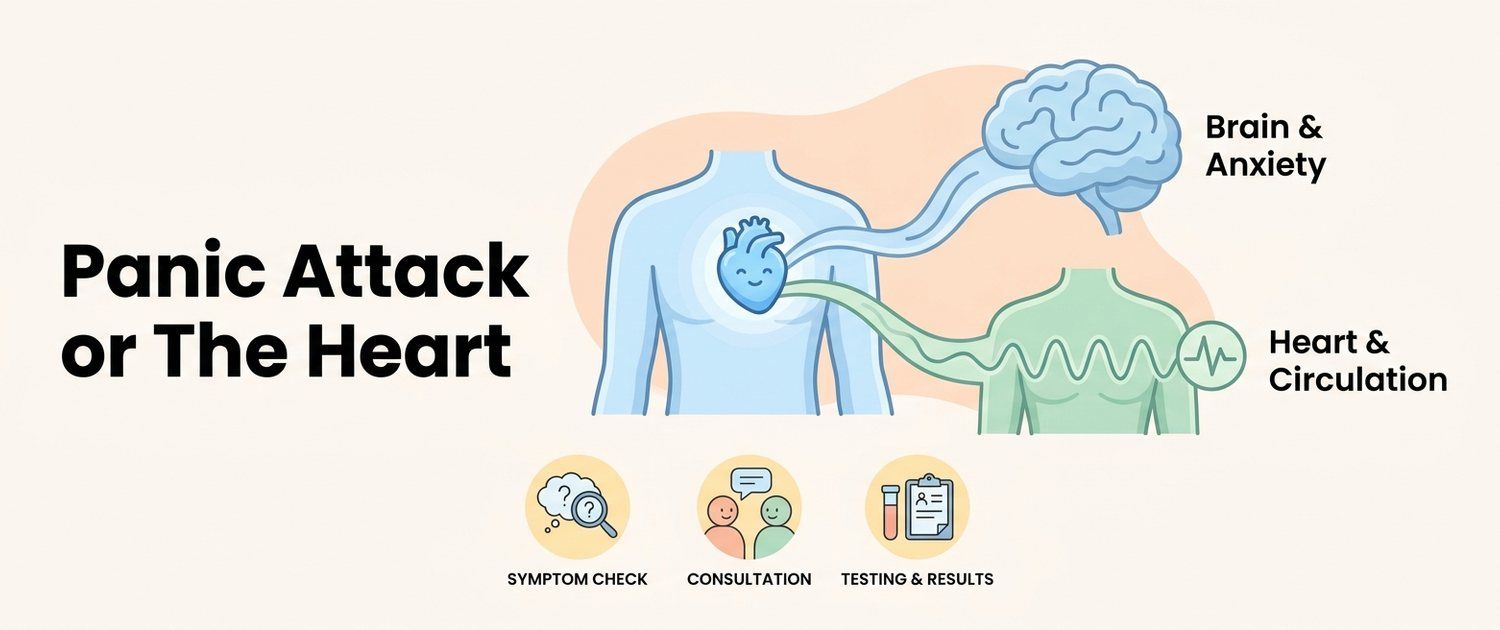
The question sounds the same for everyone who has been through it: "Was that my heart, or was it nerves?" The honest and uncomfortable answer comes first: by sensation alone, you cannot tell. What tells them apart is the shape of the episode over time, the circumstances, and an examination. And sometimes nothing tells them apart until an ambulance arrives.
First things first: when a text does not decide this
Stop reading and call emergency services if any one of these is present:
- this is the first episode of your life — especially after forty;
- chest pain radiates to the arm, jaw, neck or back and comes with a cold sweat;
- there was fainting, or something close to it;
- the pulse is steady and above 150 and holds rather than jumping about;
- breathlessness with blue lips, a cough or a fever;
- weakness in an arm or leg, a drooping face, slurred speech.
This is not over-caution. In their first minutes a heart attack and a rhythm disturbance can look like a panic attack, and the cost of erring in that direction is nothing like the cost of one unnecessary call.
The shape of the episode over time is the most useful sign
It does not give a hundred-percent answer, but it is the one thing a person can notice for themselves.
A panic attack climbs from "something is wrong" to its peak within one to ten minutes, holds there briefly and settles over twenty to thirty minutes. A residual shakiness can linger for hours.
Supraventricular tachycardia behaves differently: it starts and stops instantly, like a switch. People can often name the minute it began and the minute it ended. The pulse is even and very fast — 150 to 220 beats — rather than "jumping".
A heart attack does not settle by itself within half an hour. The pain or pressure persists, more often builds, does not pass at rest and does not depend on whether the person has calmed down.
What the body does during a panic attack
Diagnostic manuals list thirteen symptoms of an attack, and most of them are bodily: a pounding heart, sweating, trembling, shortness of breath, a sense of choking, chest pain or discomfort, nausea, dizziness, chills or heat, numbness and tingling, a sense of unreality, fear of losing control and fear of dying.
Much of that follows directly from fast breathing. When someone breathes more than they need to, carbon dioxide in the blood drops, vessels narrow, and out of it come dizziness, numb lips and fingers, chest tightness and the feeling that the world is behind glass. This is explainable physiology, not a sign of damage. Understanding it does not cancel the fear, but it noticeably reduces it.
The error runs both ways
Panic disorder taken for the heart. In a classic emergency-department study (Fleet et al., 1996), panic disorder was found in roughly a quarter of patients presenting with chest pain — and in most cases the treating physician did not recognise it. The person leaves with a clean tracing and no explanation of what that was.
And the reverse: the heart taken for panic. In Lessmeier et al. (1997), two thirds of patients with confirmed supraventricular tachycardia formally met the criteria for panic disorder, and for a substantial share the rhythm diagnosis came years late. This happened to women especially often.
Both figures point the same way: you cannot settle on "it is just nerves" without an examination — and you cannot stay stuck on "it is definitely my heart" after a normal one.
What a clinician checks, and where to start
The minimum set for recurring episodes is short and inexpensive:
- an ECG — at least once, and always for a first episode;
- longer monitoring — when episodes are rare and a routine tracing catches nothing;
- TSH and free T4 — an overactive thyroid produces an indistinguishable picture;
- a full blood count with ferritin — iron deficiency intensifies palpitations and breathlessness;
- fasting glucose — a drop in blood sugar produces the same adrenaline surge.
Separately there is history rather than a test: how much coffee, energy drinks and pre-workout per day, whether alcohol or sedatives were stopped in the past few days, what medication is being taken (some speed the heart), how many hours of sleep, whether hormonal changes are in play. If you already have results in hand, the service can read the whole panel and say what it is missing.
Why the fear returns after a normal ECG
This is the most common and most galling part. An examination answers the question it was asked: the heart was fine at the moment of recording. The fear, however, feeds not on missing data but on the mere possibility that something was overlooked. So relief after a good result lasts days, then the question returns — and each further test buys an ever shorter calm.
That loop is broken not by another investigation but by working on the mechanism itself: on the fear of the sensations, and on the just-in-case measures that feel protective and in fact confirm to the brain that the danger was real. That work is done with approaches that have evidence behind them, and it is best taken up with a professional.
What to do in the first minute
- Slow the out-breath. Not "breathe deeper" — deep fast breathing intensifies the attack. Make the exhale longer than the inhale, calmly, without effort.
- Do not fight and do not flee. An attack has an upper limit and settles by itself; trying to "stop" it makes it longer.
- Anchor on the outside. Feet on the floor, a cool surface under the palms, objects around named out loud.
- Do not take your pulse. Checking raises sensitivity to whatever is checked and prolongs the episode.
- Note the time. An hour later that will be a useful fact: how long it took to climb and how long to settle.
The heart is checked — so what is it
The cardiologist found nothing and the episodes are still there. The question is no longer «heart or not» but which picture sits behind it: they differ, and they are worked through differently.
- The old vascular label — if that old label is what your record says and nobody explained what stands behind it.
- Cardiac neurosis — if the main complaint is pain around the heart: aching, lasting hours, not arriving as an attack.
- Night-time panic attacks — if it hits you in your sleep while the day is comparatively calm.
- What agoraphobia is — if the circle of places narrowed after the attacks: transport, queues, travelling alone.
- Generalised anxiety disorder — if between the episodes the worry never switches off and moves from subject to subject.
- A nervous breakdown — if this is not an attack but a state a long overload led to.
If you want to see where all this adds up, there are two different tools. The free GAD-7 scale is a short screener about one branch of anxiety. The paid anxiety and panic attacks test separates four pictures at once — worry, panic attacks, intrusive thoughts and bodily anxiety — and names separately what is worth ruling out with a doctor. Neither is a diagnosis.
This article is informational and does not diagnose. It claims neither that you have panic disorder nor that you do not: a clinician determines that in person. With the acute signs listed at the start, call emergency services.
For informational purposes only
This article is for informational purposes only and does not constitute medical advice, diagnosis, or treatment. Please consult a healthcare professional for medical guidance.