Oxidative Stress and Anxiety: Markers, Antioxidants and Lab Tests
Reviewed by the LabReadAI medical team
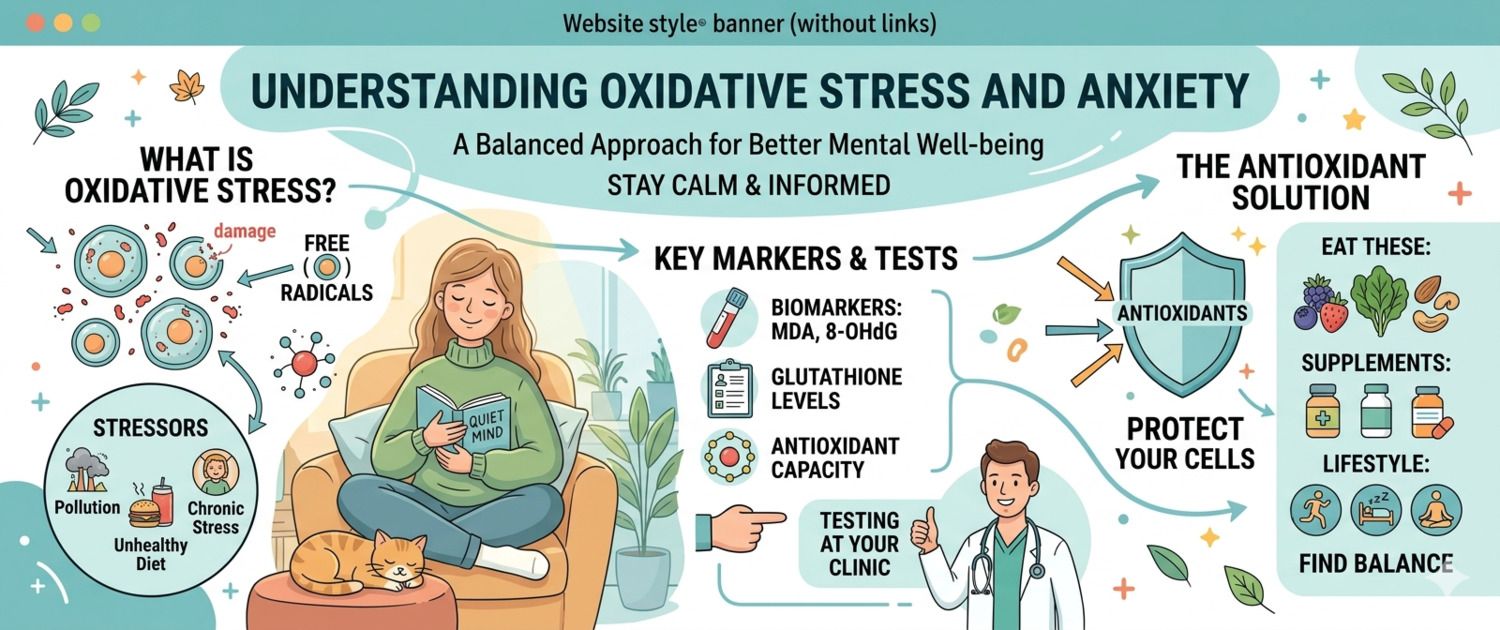
Oxidative stress is a state in which free radical production exceeds the body's antioxidant defenses. Most "marketing" antioxidant supplements don't work, but the oxidative stress phenomenon itself is real and linked to depression, anxiety, and neurodegenerative diseases. Here's which markers actually work, what the evidence base shows, and how it relates to mental health.
What Oxidative Stress Is and Its Symptoms
Free radicals are molecules with an unpaired electron, chemically extremely reactive. Normally they form as a byproduct of normal metabolism (especially in mitochondria) and are needed for immune defense and cell signaling.
Antioxidant defenses neutralize the excess:
- Endogenous antioxidants: glutathione, superoxide dismutase (SOD), catalase
- Cofactors: selenium, zinc, copper, manganese
- Vitamins: C, E, β-carotene
Oxidative stress arises from imbalance — when radicals exceed antioxidant defenses. Sources of excess radicals:
- Mitochondrial dysfunction
- Chronic inflammation
- Smoking
- Air pollution, heavy metal exposure
- Excess UV radiation
- Chronic stress with hypercortisolism
- Overeating (especially sweets) and metabolic syndrome
Chronic oxidative stress damages mitochondria, neuronal membranes, DNA — and long-term is linked to anxiety, depression, accelerated brain aging.
Oxidative Stress and Anxiety: The Biochemical Link
Modern neurobiological research shows links between oxidative stress and psychiatric disorders:
- Elevated oxidative stress markers (8-OHdG, isoprostanes, malondialdehyde) are found in patients with major depressive disorder, bipolar disorder, anxiety disorders
- Reduced brain glutathione (by magnetic resonance spectroscopy) is linked to depression
- Antioxidant capacity is reduced in treatment-resistant depression
- Mitochondrial dysfunction is one of the biological substrates of depression
Mechanism: oxidative damage to neurons reduces neurotransmitter synthesis, disrupts synaptic plasticity, activates neuroinflammation. This creates biochemical ground for persistent depressive-anxious states.
Important to understand: oxidative stress is a marker of biochemical disharmony, not a "diagnosis." Treatment is through eliminating sources and supporting the antioxidant system — not taking "antioxidant supplements."
8-OHdG, Isoprostanes and Glutathione: Oxidative Stress Markers
Most "lab measurement of oxidative stress" is marketing. What has real clinical value:
Evidence-based markers:
- 8-OHdG (8-hydroxy-2'-deoxyguanosine) in urine — marker of oxidative DNA damage. Used in research, gradually entering clinical practice.
- Malondialdehyde (MDA) — lipid peroxidation marker
- Isoprostanes — products of arachidonic acid peroxidation, gold standard for oxidative stress assessment
- Glutathione (GSH/GSSG) — ratio of reduced to oxidized glutathione; integral marker of antioxidant defense
Indirect evidence-based markers:
- C-reactive protein (hs-CRP) — oxidative stress often coexists with inflammation
- Homocysteine — rises with oxidative stress
- Iron kinetics — oxidized iron generates radicals
- Blood selenium and zinc — antioxidant enzyme cofactors
What is NOT informative:
- "Total antioxidant capacity" (TAC) — methodological problems
- Blood vitamin C levels — too rapid dynamics
- "Free radical analysis" — no validated methodology
- Marketing "antioxidant panels" with dozens of markers
For practical assessment, in most cases hs-CRP, homocysteine, vitamin D, and overall inflammation status via the anxiety causes panel are sufficient.
Antioxidants for Anxiety: What Reduces Oxidative Stress
Evidence base:
High effectiveness:
- Regular moderate exercise — paradoxically, training increases mitochondrial density and antioxidant enzyme activity; reduces oxidative stress long-term. High-intensity training without adaptation, conversely, raises it.
- Mediterranean diet — high in polyphenols, omega-3, low in pro-inflammatory foods
- Adequate sleep 7–9 hours — sleep loss raises oxidative stress
- Weight loss in obesity
- Smoking cessation
Moderate effectiveness:
- Omega-3 (EPA > 1 g/day) — anti-inflammatory and antioxidant action
- Curcumin — antioxidant with anti-inflammatory effect, but low bioavailability
- Vitamin D in deficiency
- Magnesium in deficiency
- Selenium and zinc repletion in deficiency
What does NOT work (or works at the placebo edge):
- Isolated high doses of vitamin C, E, β-carotene — meta-analyses showed no effect or harm (increased cancer and cardiovascular mortality with high-dose vitamin E and β-carotene)
- "Antioxidant complexes" with dozens of ingredients
- Most "superfoods" with marketing claims
- Glutathione tablets — poorly absorbed; precursors (NAC) more informative
The paradox: "take an antioxidant" works less well than "remove oxidative stress sources." This shifts the practical emphasis.
When to See a Doctor
To a primary care doctor / gastroenterologist for:
- Suspected chronic inflammation source
- Metabolic syndrome
- Chronic infections
To a psychiatrist/psychotherapist for:
- Treatment-resistant depression or anxiety unresponsive to standard therapy
- Suspected biochemical basis of mental state
To a functional medicine clinician (with caution) — for extended oxidative and metabolic status assessment. Many of their proposed tests aren't validated, so the approach requires critical evaluation.
For details on the inflammation-mind link see inflammation and depression: CRP. For mitochondria and longevity, discussed in how to live long and healthy.
This article is for informational purposes only and does not replace professional medical advice. High-dose "antioxidants" can be harmful; the strategy is removing oxidative stress sources.
For informational purposes only
This article is for informational purposes only and does not constitute medical advice, diagnosis, or treatment. Please consult a healthcare professional for medical guidance.