Progesterone and Anxiety in Women: PMS, Perimenopause and Tests
Reviewed by the LabReadAI medical team
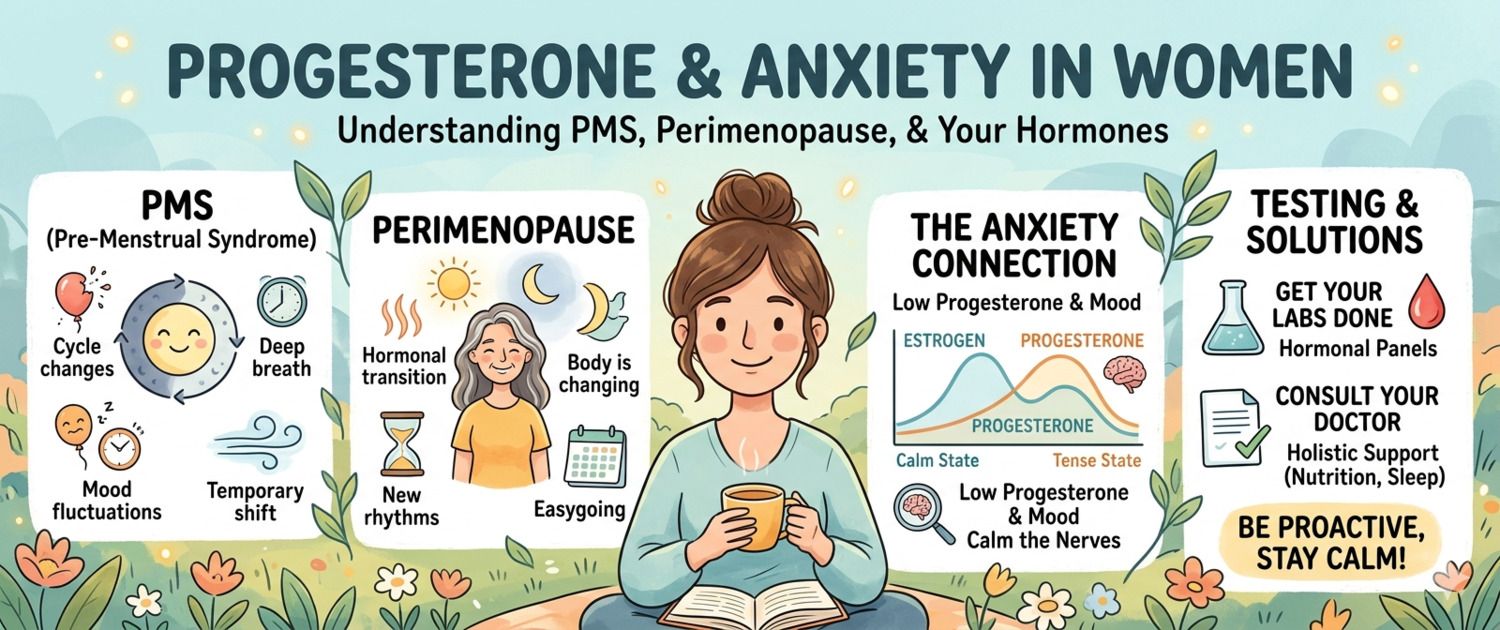
Anxiety in women is often tied to the menstrual cycle phase or perimenopause. 7–10 days before menstruation, during perimenopausal hormone fluctuations, postpartum — these are typical points where anxiety appears or intensifies. The biochemical basis is the fall in progesterone and its metabolite allopregnanolone, which acts on GABA-A receptors like a natural benzodiazepine. Without this "internal tranquilizer," the nervous system stays hyperreactive.
Progesterone as a Natural Tranquilizer
Progesterone is the second-phase menstrual cycle hormone, the principal pregnancy regulator, and at the same time a powerful neurosteroid. Its metabolite allopregnanolone (3α,5α-tetrahydroprogesterone) acts on the same GABA-A receptor as benzodiazepines — diazepam, lorazepam, alprazolam.
This means progesterone functions as an endogenous anxiolytic. When its level drops:
- The GABAergic inhibitory signal weakens
- The nervous system becomes hyperreactive
- Anxiety, emotional lability, insomnia appear
- Stress reactivity heightens
This connection explains several clinical phenomena:
- PMS anxiety — 7–10 days before menstruation, progesterone falls from its luteal peak → "withdrawal" of allopregnanolone → anxiety
- Postpartum anxiety/depression — sharp progesterone drop after birth from pregnancy levels
- Perimenopausal anxiety — progesterone fluctuations as ovulation declines
- Anxiety after hormone therapy withdrawal — if abruptly stopped
Understanding this mechanism allows the search for the cause of anxiety where it often actually lives — in the hormonal cycle.
PMS Anxiety: The Luteal Phase Link
The luteal phase is the second half of the cycle, after ovulation. Normally, on day 21 of the cycle, progesterone peaks (6.9–56.6 nmol/L), and allopregnanolone provides calmness and good sleep.
With luteal insufficiency, progesterone rises insufficiently or falls quickly:
- PMS symptoms appear 7–14 days before menstruation (rather than 1–2 days as in normal)
- The anxious-emotional component dominates: irritability, tearfulness, anxiety, insomnia
- Often short luteal phase (< 12 days)
- Premenstrual spotting 2–4 days before menstruation
- Painful, heavy menstruation
Causes of luteal insufficiency:
- Chronic stress — "progesterone steal" toward cortisol
- Hypothyroidism (TSH > 2.5)
- Hyperprolactinemia
- Polycystic ovary syndrome (PCOS)
- Vitamin D deficiency and low body fat
- Perimenopause
Perimenopause and Waves of Anxiety
Perimenopause begins on average 4–10 years before menopause (i.e., from 40–45 in most women). It is a period of hormonal fluctuations — cycles become irregular, estradiol swings, and progesterone progressively falls as ovulations decline.
Clinical picture:
- "Waves" of anxiety without obvious triggers — anxiety high for several days, then resolves
- Insomnia, especially with awakenings at 3–4 AM
- Mood swings, emotional lability
- Hot flashes (but not in everyone)
- Reduced stress tolerance
- Irritability, episodes of crying
Many women at this stage are diagnosed with "anxiety disorder" by a psychiatrist — and prescribed SSRIs. With a hormonal anxiety driver, SSRIs work partially but don't address the root cause. Laboratory testing at this stage is mandatory.
Progesterone Deficiency: Symptoms in Women
Emotional/nervous symptoms:
- Anxiety, especially in the second half of the cycle
- Insomnia and light sleep before menstruation
- Emotional lability, mood swings
- Irritability, tearfulness
- Reduced stress tolerance
- "Brain fog," distractibility
Somatic symptoms:
- Painful, heavy menstruation
- Short luteal phase (< 12 days)
- Premenstrual spotting
- Breast pain and engorgement
- Edema and premenstrual weight gain
- Infertility, recurrent pregnancy loss
Estrogen dominance symptoms (when progesterone is low relative to estradiol):
- Fibroids, adenomyosis, fibrocystic breast
- Endometriosis
- Endometrial polyps
- Endometrial hyperplasia symptoms
Which Tests to Take
Day-21 progesterone (or 5–7 days before expected menstruation) — luteal phase peak. Target for adequate function: > 25 nmol/L.
Day-21 estradiol — to assess the estradiol/progesterone ratio. Estrogen dominance is diagnosed when progesterone is low against normal or elevated estradiol.
Prolactin — hyperprolactinemia suppresses progesterone.
TSH + free T4 — hypothyroidism impairs corpus luteum function.
Cortisol morning and evening — chronic stress assessment as the cause of "progesterone steal."
Vitamin D — required for steroidogenesis.
Conveniently drawn via sex hormone panel extended with stress hormones (cortisol, DHEA-S) or together with the anxiety causes panel.
The full PMS-anxiety panel: progesterone, estradiol, prolactin, FSH, LH, TSH + free T4, ferritin, cortisol. In 60–70% of women with PMS anxiety, objective abnormalities are found that can be addressed.
When to See a Doctor
To a gynecologist-endocrinologist for:
- Confirmed luteal insufficiency (day-21 progesterone < 16 nmol/L in two cycles)
- Severe PMS with anxiety and/or depressive symptoms
- Infertility and recurrent pregnancy loss
- Perimenopausal anxiety symptoms
- Suspected estrogen dominance
To a psychotherapist/psychiatrist for:
- Persistent anxiety after correcting hormonal abnormalities
- Depressive episodes with suicidal ideation
- Severe social impairment in perimenopause
For more on the female anxiety approach see anxiety: which lab tests and how to lower cortisol in women (on stress and "progesterone steal").
This article is for informational purposes only and does not replace professional medical advice. Progesterone-containing medication is the gynecologist-endocrinologist's prescription.
For informational purposes only
This article is for informational purposes only and does not constitute medical advice, diagnosis, or treatment. Please consult a healthcare professional for medical guidance.