Dog Hair Loss: Shedding, Allergy or a Hormonal Cause
Reviewed by the LabReadAI medical team
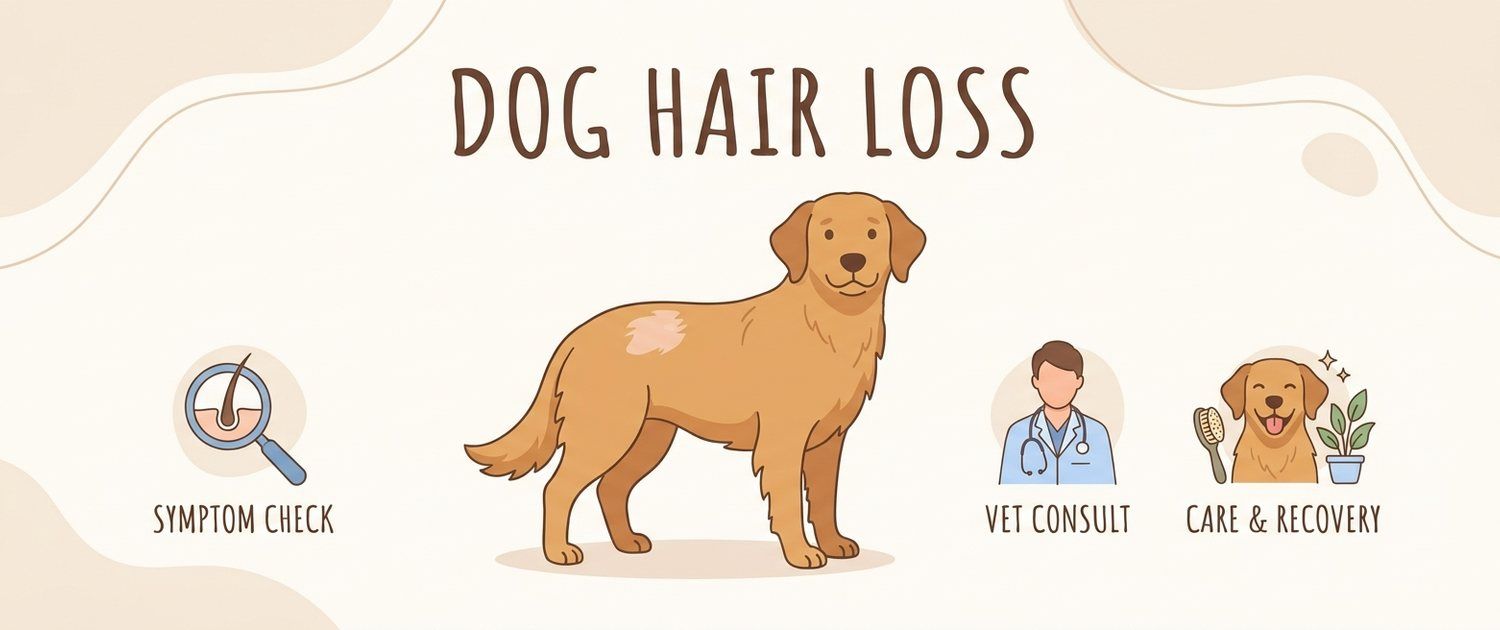
Hair on the sofa, on your clothes and in the air is the ordinary background of life with a dog, which is exactly why the start of disease slips past. The dividing line is not how much hair ends up in the house but the state of the skin beneath it, and whether the dog is removing the coat itself.
Normal Seasonal Shedding and What Counts as Disease
Healthy shedding looks like this: the coat thins evenly over the whole body, undercoat comes away in sheets, the skin beneath is clean and quiet, with no redness, crusting or smell, and the dog behaves as usual. It runs for two or three weeks in spring and autumn.
In breeds with a dense undercoat — northern types, shepherds, huskies — shedding can be dramatic: undercoat leaves in clumps and it looks as if the dog is going bald. As long as the skin under those clumps is normal and no bare patches form, that is normal. Smooth-coated breeds shed a little all year, and you notice it on your clothes rather than on the dog.
What shifts the cycle and makes shedding heavier: living indoors under constant light and heating (seasonality is lost), a season, whelping and nursing, or a major illness or surgery — after which the coat comes out all at once about six weeks later. Unpleasant, but reversible.
What is not normal: bald patches with defined edges, skin that is red, dark, thickened, scaly, crusted or smelly; hair that does not grow back; a dog that scratches, licks and rubs against furniture.
Falling Out or Chewed Out: the Question That Splits the List
Before working through diseases, answer one question: who is removing the coat.
- The dog removes it — scratching, chewing, licking, rubbing. Then itch is primary and the hair loss is secondary. Versions: fleas, allergy, mites, fungus, pain in that area.
- The coat falls out without the dog's help — it comes away on the brush and stays on the bedding, and the skin is calm. Versions: hormones, a hair-cycle arrest after illness, inherited traits.
That split does half the work. If there is itch, follow the skin branch, worked through in dog scratching. If there is no itch and the patches are symmetrical, go straight to the hormonal section. In cats the same split works less well: a cat licks in private, so apparent loss without itch is often hidden over-grooming — see cat hair loss.
Fleas and Flea Allergy Dermatitis: Cause Number One
Flea allergy dermatitis is still the most common skin disease in dogs, and the trap is that the fleas themselves are usually invisible. In allergy to flea saliva a few bites are enough: the parasite bites and leaves, while the reaction runs for weeks.
The portrait is recognisable: itch and hair loss over the lower back, the tail base and the backs of the thighs, the dog chewing its rump and tail, the skin there red, darkened and crusted. Look for the droppings rather than the fleas: comb the rump onto a damp white tissue — dark grains that spread into rusty stains are digested blood.
The practical conclusion: parasite treatment goes to every animal in the household, on a schedule set by a vet, not only to the itchy dog. Without that step, working through rarer versions is pointless — they simply sit on top of untreated flea dermatitis. Self-trauma easily turns into secondary skin infection; what a bacterial infection looks like is covered separately.
Atopic Dermatitis and Food Allergy
The second itchy branch is allergy. Dogs get two kinds, and they look alike from outside.
Atopic dermatitis is a reaction to pollen, moulds and house dust mites. It usually starts between six months and three years, often seasonally, and becomes year-round with age. Typical sites: the face, ears, paws (licked to a rusty brown), armpits, groin and belly. Recurrent ear infections that come back after every course are close to a calling card.
Food allergy behaves the same way but ignores the season and often comes with loose stools and more frequent defecation. The only working test is a strict elimination diet for six to eight weeks followed by rechallenge; blood allergy panels are not adequate for it. How such a diet is run is set out in gastritis and food allergy, and when a therapeutic ration is justified at all in therapeutic pet food.
Breed shifts the odds noticeably: retrievers, French and English bulldogs, West Highland white terriers, shar-peis and German shepherds are over-represented for atopy.
Symmetrical Bald Patches Without Itch Mean Hormones
This is the most recognisable pattern in canine dermatology. The coat thins symmetrically, mirrored on both sides — flanks, rump, neck, tail, the backs of the thighs; head and legs usually stay covered. The skin is not inflamed, the dog does not scratch, and hair does not regrow, or regrows dull and different to the touch.
A symmetrical, itch-free pattern is a hormonal one until proven otherwise. Symmetry is the key: parasites, fungus and allergy cannot distribute themselves in a mirror image. What distributes symmetrically is what arrives through the blood — a hormone. The remaining question is which one, and it is settled by blood work rather than by looking: dog blood test explains how such a form reads.
Hypothyroidism in Dogs: Coat, Weight and Lethargy
A shortage of thyroid hormone is the commonest endocrine cause of hair loss in middle-aged dogs, especially larger breeds.
- Symmetrical thinning over the flanks and tail (a "rat tail"), the coat dull, dry and easily pulled out.
- Weight gain on an unchanged diet and marked lethargy; the dog feels the cold and seeks warm places.
- Thickened skin, sometimes a "tragic" facial expression from skin swelling.
- Repeated ear and skin infections.
If thinning comes with dullness and weight gain, read this alongside lethargic dog: in hypothyroidism those two complaints almost always travel together. Diagnosis rests on thyroid hormones, with one caveat: levels also fall in other serious illness, so a single result out of context settles nothing — a vet interprets it.
Cushing's Disease: a Pot Belly and Thin Skin
An excess of the dog's own cortisol has its own set, and hair loss is only one item in it.
- Symmetrical bald patches on the flanks without itch.
- A sagging pot belly against thinning legs and back.
- Thin skin, visible vessels, slowly healing wounds, sometimes blackhead-like comedones.
- Sharply increased appetite and thirst, puddles indoors.
- Panting, weakness, muscle wasting.
Thirst is the earliest and most measurable sign here: how to count it is set out in dog drinking a lot. Confirmation comes from hormonal testing plus a look at the adrenal glands on ultrasound — described in abdominal ultrasound for dogs.
Less often symmetrical baldness comes from sex hormones (a testicular tumour in a male, ovarian cysts in a bitch), or from alopecia X in spitz-type breeds — a diagnosis of exclusion once everything else is closed.
Demodex in Young Dogs, Ringworm and Other Versions
Demodicosis is overgrowth of a skin mite that lives on every dog and is normally held in check by immunity. In puppies and adolescents it gives focal bald patches around the eyes, on the muzzle and the front legs, with reddened, sometimes scaly skin and often no itch at all. The localised form in a young dog often resolves on its own, but the generalised form is a disease needing prolonged treatment set by a vet. Sudden demodicosis in an adult means immunity is suppressed by something, and the vet will look for that background.
Other versions checked at the appointment:
- Ringworm — round scaly lesions; contagious to people, so it is excluded early.
- Sarcoptic mange — ferocious itch on elbows, ear margins and belly; the whole household of dogs itches at once.
- Pyoderma — pustules and crusts, usually secondary to any of the above.
- Seborrhoea and zinc-responsive dermatosis — in particular breeds.
- Psychogenic licking of one area down to bare skin — the last diagnosis on the list, only after pain and skin causes are excluded.
When Hair Loss Needs a Vet Quickly
Dermatology is rarely an emergency, but these should not wait:
- large moist, hot, painful areas of skin that appeared within a day;
- pustules, crusts, ulcers and a smell from the skin, with fever or refusal of food;
- itch severe enough that the dog cannot sleep and chews itself raw;
- hair loss together with lethargy, thirst, weight gain or weight loss — that is metabolism, not skin;
- bald patches in a puppy with redness and crusts around the eyes and paws;
- scaly lesions if there are children or immunosuppressed people in the household.
What Not to Do at Home
- Do not wash the dog with human shampoo or dry the skin with alcohol: canine skin has a different pH, and alcohol makes inflammation worse.
- Do not give human antihistamines or steroids. A steroid cream applied before the examination erases the picture; any medicine is a vet's decision.
- Do not buy an antifungal or anti-flea product at random: parasite treatment is matched to species, weight and age, and goes to every animal in the house.
- Do not change the food the week before the visit: an elimination diet is run by rules and judged at six to eight weeks, and random food swaps make that impossible.
- Do not clip or shave bald areas to make hair grow: in several breeds the coat regrows badly after clipping.
- Do not postpone the visit while lesions are spreading: risk of secondary infection grows with area.
Which Tests and Scans Will Clarify the Cause
Skin is the area where examination and simple tests deliver more than expensive imaging:
| Study | Question it answers |
|---|---|
| Skin scrapes and trichogram | Demodex, sarcoptic mites, hair and root condition |
| Cytology from skin and ears | Bacteria, yeast, inflammation |
| Dermatophyte culture, Wood's lamp | Ringworm |
| Blood count and biochemistry | Background, inflammation, liver, metabolism |
| Thyroid hormones | Hypothyroidism |
| Hormonal testing | Cushing's disease |
| Ultrasound of adrenals and abdomen | Adrenals, testicular tumour, ovarian cysts |
The usual order is parasites and infection first, then allergy, and hormones last — unless the picture is symmetrical and itch-free, in which case the order reverses. What forms can show before a visit is covered by online vet reading.
A finished hormone or biochemistry form can go into pet results interpretation and an ultrasound report into pet imaging interpretation: the service explains the wording and builds questions for your vet. If there are no tests yet, start by describing the symptoms — say whether there is itch and whether the patches are symmetrical — and browse dog symptoms. In cats the same sign reads differently — see cat scratching.
This article is informational. Diagnosis and treatment of your pet are the job of a veterinarian.
For informational purposes only
This article is for informational purposes only and does not constitute medical advice, diagnosis, or treatment. Please consult a healthcare professional for medical guidance.