Pelvic Ultrasound: What It Shows in Women and Men, and Results
Reviewed by the LabReadAI medical team
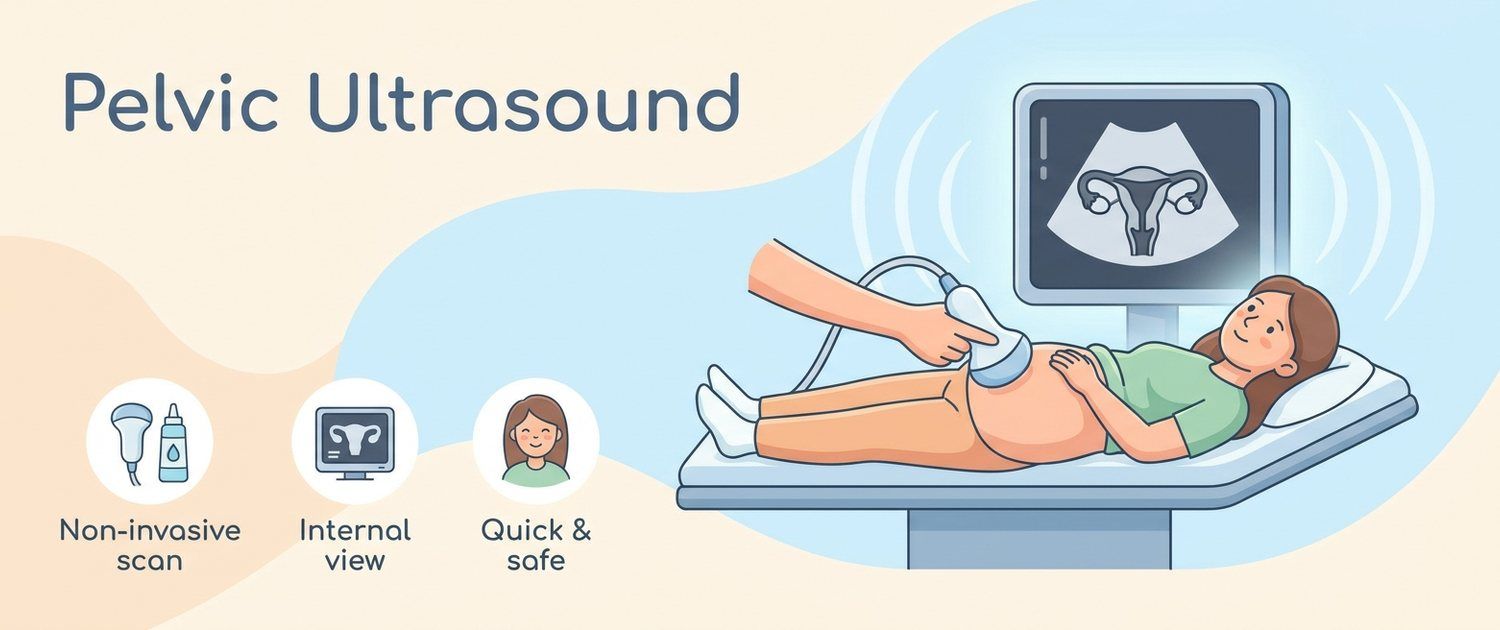
A pelvic ultrasound is the main way to look at the reproductive organs without radiation or pain. In women it shows the uterus, endometrium and ovaries; in men, the prostate and bladder. But the report hands the patient sizes, "endometrial echo", "follicles", "anechoic lesion" — with no sense of what is normal. Let's break down what a pelvic ultrasound shows, how to prepare and how to read the result.
What a Pelvic Ultrasound Shows and Which Organs Are Examined
In women, a pelvic ultrasound assesses:
- the uterus — size, position, the structure of the muscular wall (myometrium);
- the endometrium — thickness and structure of the uterine lining;
- the ovaries — size, follicle count, cysts;
- free fluid in the pelvic cavity.
In men, the bladder, prostate and seminal vesicles are examined. Like any ultrasound, the method shows structure but not hormone levels — so it is often combined with tests for oestradiol, FSH and other hormones.
Access Routes: Transvaginal, Transabdominal, Transrectal
- Transvaginal (TV) — the probe is inserted into the vagina. The most informative route in women: a clear picture of the uterus and ovaries. The bladder must be empty.
- Transabdominal — through the abdominal wall. Used in women who have not been sexually active, in pregnancy and for an overview. A full bladder is needed (it lifts the bowel out of the way).
- Transrectal — in men, for detailed prostate imaging.
Preparation depends on the route — clarify it in advance.
Preparation and Which Cycle Day to Choose
Preparation depends on the route: for transvaginal — an empty bladder; for transabdominal — drink 0.5–1 L of water an hour before and do not urinate. Reducing gas-forming foods for 1–2 days helps.
The cycle day is critical. The endometrium and ovaries change through the cycle, so the timing is chosen for the task:
- days 5–7 (right after menstruation) — standard exam of the uterus and ovaries, cyst assessment;
- mid-cycle — follicle tracking (monitoring the dominant follicle and ovulation);
- with an irregular cycle or in menopause — any day.
Without the cycle day noted, endometrial thickness cannot be interpreted — a common cause of false alarm.
Uterus and Endometrium: Norms by Cycle Phase
Endometrial thickness depends on the phase:
| Cycle phase | Endometrial thickness |
|---|---|
| Right after menstruation (days 5–7) | 3–6 mm |
| Mid-cycle (ovulation) | 8–13 mm |
| Luteal phase | 10–16 mm |
| Postmenopause (no HRT) | up to 4–5 mm |
The uterus often shows fibroids (myometrial nodules), endometrial polyps, adenomyosis. A thickened endometrium in postmenopause warrants further work-up.
Ovaries: Follicles, Cysts and Ovarian Reserve
The ovaries are assessed for size and antral follicle count — part of ovarian reserve assessment (together with hormones). Common findings:
- functional cyst (follicular, corpus luteum) — usually resolves on its own in 1–2 cycles;
- many small peripheral follicles — can be a sign of PCOS (interpreted with hormones and clinical picture);
- endometriotic cyst — may accompany endometriosis;
- a complex lesion — a reason for oncological caution and a CA-125 test, especially when ovarian cancer is suspected.
Pelvic Ultrasound in Men
In men, ultrasound assesses prostate volume and structure, residual urine in the bladder, and seminal vesicles. An enlarged prostate and residual urine are typical of benign hyperplasia (adenoma); nodules and heterogeneity warrant adding a PSA test and a urologist's review.
Common Findings and What They Mean
- "Anechoic lesion" — most often a cyst (a fluid-filled cavity), usually benign.
- "Free fluid behind the uterus" — a small amount can be normal (especially after ovulation).
- "Signs of uterine fibroids" — a very common benign finding; management depends on size and symptoms.
- "Multifollicular ovaries" — not the same as PCOS; the diagnosis is made on the whole picture.
The same phrase means different things depending on cycle day, age and symptoms — so a pelvic ultrasound is read together with hormones and the clinical picture.
When Hormones and a Doctor Are Needed: Limits of the Method
Ultrasound shows structure, but the cause of problems (for example a hormonal shift in menopause or cycle disorders) is revealed by blood tests. After ultrasound, the following are often needed:
- hormones (oestradiol, FSH, LH, and in pregnancy hCG);
- a gynaecologist or urologist;
- for complex lesions — MRI and tumour markers.
You can upload your ultrasound report and get a plain-language breakdown with the imaging and ultrasound interpretation service — it points out what is normal and what to take to a doctor, but does not replace an in-person visit.
This article is for informational purposes. Reading a pelvic ultrasound and the diagnosis are the doctor's job.
For informational purposes only
This article is for informational purposes only and does not constitute medical advice, diagnosis, or treatment. Please consult a healthcare professional for medical guidance.