Thyroid and Anxiety: Anti-TPO, Hyperthyroidism and Panic Attacks
Reviewed by the LabReadAI medical team
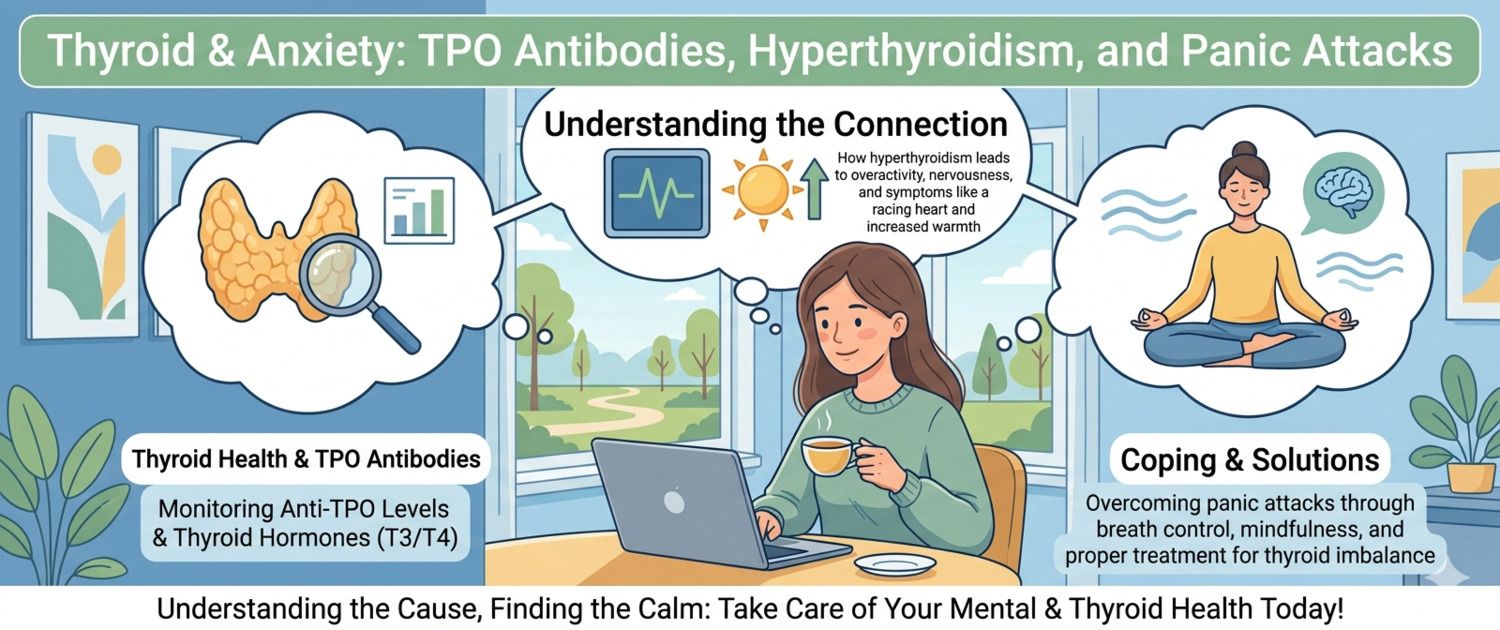
The thyroid gland is the most common endocrine cause of "new" anxiety that is regularly missed at the diagnostic stage. Hyperthyroidism and autoimmune thyroiditis cause palpitations, tremor, sweating, insomnia — a clinical picture nearly indistinguishable from panic disorder. So TSH + free T4 + anti-TPO is the mandatory minimum for any persistent anxiety. Here's how the thyroid affects the nervous system and which tests are critical.
Hyperthyroidism and Anxiety: The Biochemistry
Hyperthyroidism is a state in which the thyroid produces excess thyroid hormones (T3 and T4). These hormones make β-adrenergic receptors hypersensitive to catecholamines (adrenaline, noradrenaline). The result:
- Rapid heartbeat, the sensation of a "pounding" heart
- Fine finger tremor, hand shakiness
- Sweating, heat intolerance
- Insomnia, light sleep
- Irritability, emotional lability
- Weight loss with preserved or increased appetite
- Frequent stools
These symptoms are biochemically identical to a panic attack. So patients with hyperthyroidism are often treated for anxiety disorder with antidepressants and anxiolytics for months — until someone finally orders a TSH.
Forms of hyperthyroidism:
- Overt: TSH < 0.1 + T4/T3 elevated — clear clinical picture, mandatory therapy
- Subclinical: TSH suppressed, T4/T3 normal — milder symptoms, but real arrhythmia and osteoporosis risks
- Autoimmune (thyrotoxic phase) in Hashimoto's thyroiditis — transient, in 30–50% of cases transitions to hypothyroidism
Anti-TPO: What It Is and Why It's Tested
Anti-TPO — antibodies to thyroid peroxidase, an enzyme involved in thyroid hormone synthesis. Their elevation is a marker of autoimmune thyroid process. By prevalence:
- Anti-TPO is found in 8–10% of women and 2–3% of men
- Over age 50 — in 20% of women
What elevated anti-TPO indicates:
- Autoimmune thyroiditis (Hashimoto's) — even with normal thyroid function
- High risk of hypothyroidism within 5–10 years
- Possible anxiety and emotional lability from "fluctuating" thyroid function
- Link to other autoimmune conditions (celiac disease, type 1 diabetes, vitiligo)
A feature of autoimmune thyroiditis is fluctuating gland function. Early stages may have thyrotoxic episodes (with anxiety), then hypothyroidism (with apathy). This instability itself provokes anxiety.
The target anti-TPO level for anxiety patients — < 9 IU/mL (negative). The formal norm in most labs is < 35 IU/mL, but that's not "no problem" — it's "less than the upper limit." A level of 25–34 is a "gray zone" with increased disease risk.
Hypothyroidism and Anxiety: A Less Obvious Link
The classic hypothyroidism picture is apathy, depression, slowing, dry skin, hair loss. But in some patients hypothyroidism produces a mixed depressive-anxious picture, especially with fluctuating TSH or subclinical hypothyroidism with high anti-TPO.
The target TSH for psychoemotional well-being — 1.0–2.5 mIU/L. TSH 3–4 is formally "normal," but with anxiety symptoms is grounds for further workup.
Hypothyroidism-anxiety links:
- Low T3 disrupts serotonergic and noradrenergic system function
- Slowed metabolism produces brain fog and emotional lability
- Concomitant hypoglycemia worsens the anxious background
Which Tests to Take
Base block:
- TSH — target 1.0–2.5 mIU/L
- Free T4 — target middle third of range
- Anti-TPO — target < 9 IU/mL
Extended block for abnormalities or symptoms:
- Free T3 — to assess T4-to-T3 conversion
- Anti-thyroglobulin (anti-TG) — additional autoimmune marker
- Anti-TSH receptor (anti-TRAb) — for suspected Graves' disease
- Thyroglobulin — for suspected nodular goiter
In parallel:
- Cortisol — hypercortisolism suppresses T4→T3 conversion
- Ferritin — low iron worsens thyroid function
- Vitamin D — modulates autoimmune activity
- Selenium and iodine — thyroid hormone synthesis cofactors
Conveniently via the thyroid panel extended with stress markers or the anxiety causes panel.
When to See an Endocrinologist
Urgently — for:
- TSH < 0.1 — mandatory thyrotoxicosis workup (T4, T3, anti-TRAb, ultrasound)
- Resting tachycardia > 100 + signs of hyperthyroidism
- Thyroid nodules > 1 cm
Routinely — for:
- TSH > 4.0 + elevated anti-TPO — autoimmune thyroiditis, function assessment
- Anti-TPO > 100 IU/mL with normal TSH — re-evaluation in 3–6 months
- TSH 0.1–0.4 (subclinical hyperthyroidism) with anxiety symptoms
- Clinical hypo/hyperthyroidism signs with formally normal TSH
For details on the thyroid-anxiety link see the general article anxiety: which lab tests.
This article is for informational purposes only and does not replace professional medical advice. Thyroid disorder treatment is the endocrinologist's domain.
For informational purposes only
This article is for informational purposes only and does not constitute medical advice, diagnosis, or treatment. Please consult a healthcare professional for medical guidance.