Dog Scooting on Its Bottom: Anal Glands, Worms or Itching
Reviewed by the LabReadAI medical team
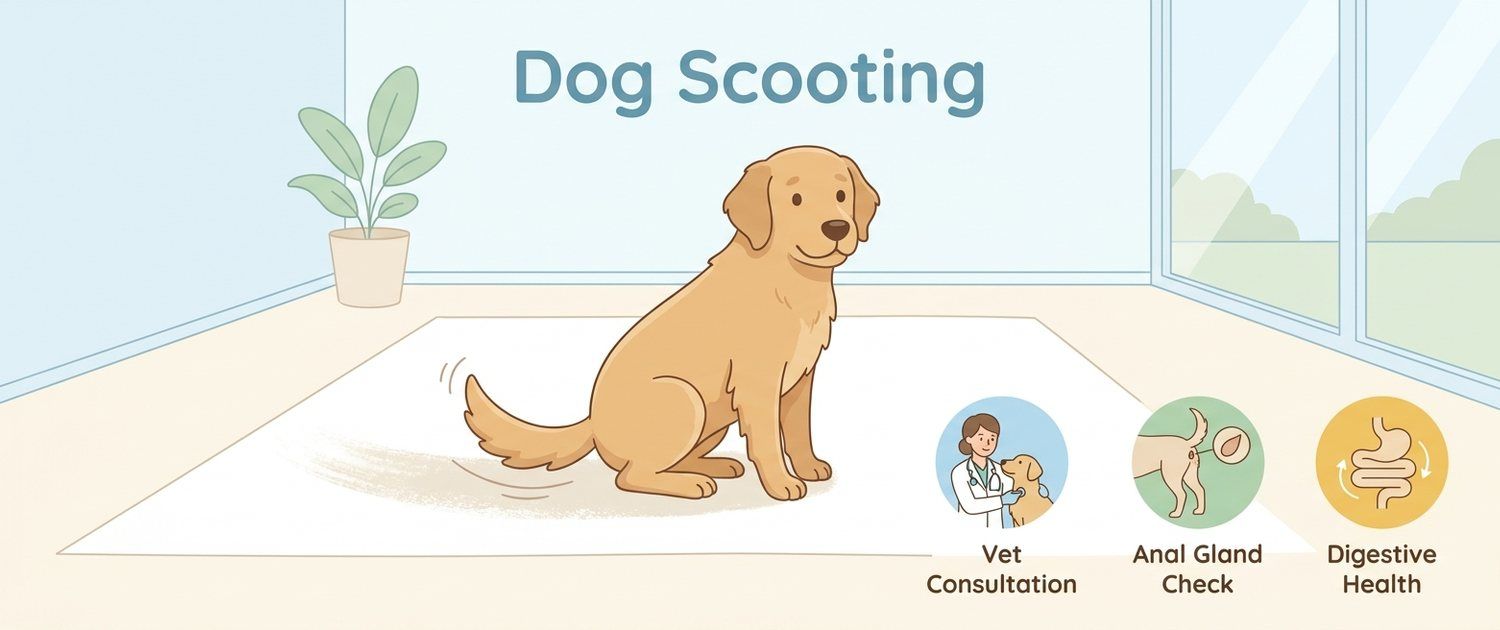
A dog drags its bottom across the carpet, and almost every owner reaches the same conclusion: worms. Understandable, and usually wrong. Most of the time the posture comes from the anal glands, and the difference matters: a deworming treatment will not fix a problem that lives in two small sacs beside the anus.
Anal Glands: What They Are and Why a Dog Scoots
On either side of the anus, roughly at the four and eight o'clock positions, sit two sacs the size of a pea or a bean. They fill with a thick secretion that has a sharp, unmistakable smell — dogs use it to mark territory and to sign their stools. Normally the sacs empty on their own with every bowel movement: firm faeces press on the walls and squeeze the contents out.
The system fails simply. The secretion thickens, the ducts block, the contents accumulate — the sac stretches and starts to itch and hurt. The dog does the only thing it can: it presses its rear to the floor and scoots on its bottom, trying to put pressure on the sore spot. The same drive produces licking under the tail, chewing at the tail base and sudden interest in its own rear.
Impacted anal glands are one of the commonest reasons for this complaint, especially in small breeds.
What You Can Notice at Home: Smell, Licking, Posture
Home observations are valuable here, because the sacs sit on the outside and the signs show.
- Scooting: the dog sits and pulls its rear along the floor, the carpet or the grass.
- A sharp fishy smell — the most recognisable sign: the bed, the sofa and sometimes the dog itself smell of it.
- Licking and chewing under the tail and at the tail base.
- A damp patch or a drop of cloudy secretion where the dog was sitting.
- The dog turns to look at its rear, jumps up, fidgets, is reluctant to sit.
- Sometimes discomfort when passing stools, straining longer than usual.
What Infection Looks Like and When It Is an Abscess
Impaction on its own is not yet infection. But stagnant secretion is a good medium for bacteria, and the picture then develops in steps.
- Impaction: itch, scooting, smell. The dog is otherwise well.
- Infection: the sac becomes infected, the skin to one side of the anus reddens and feels warm, the dog is clearly in pain, will not have its tail touched and may snap when approached from behind.
- ⚠ Abscess: a painful swelling beside the anus, from cherry to plum sized, the skin over it tight and purple; the dog is dull, refuses food, and may run a temperature. When an abscess bursts an opening appears with pus and blood — alarming to look at, though the pain usually eases from that point.
An abscess is no longer an expression job but surgical care: lancing, flushing and treatment prescribed by a vet. If dullness and refusal of food came with the swelling, read this alongside lethargic dog and dog not eating: a systemic response means the process has left the single sac.
A separate note on older dogs: any firm mass in the anal sac region of a dog over eight should be shown to a vet, even a painless one. Tumours occur here, and some of them raise blood calcium, so the story can begin with weakness and thirst rather than with itch.
Worms Are Version Two, Not Version One
Worms genuinely cause itching around the anus, and the version deserves checking. But it comes second rather than first, and that ordering matters: if the dog is scooting because of impacted glands, a deworming treatment changes nothing while time is lost.
What argues for parasites: no recent or regular parasite treatment; white mobile segments like grains of rice in the faeces or on the coat around the anus (tapeworm, picked up by eating a flea); fleas present; a dog that scavenges or hunts; alongside that, intermittent loose stools, a bloated belly, a dull coat, poor weight gain in a puppy.
Practically: deworming is done on a schedule set by a vet, matched to weight, age and lifestyle, and flea control runs alongside — otherwise tapeworm returns. A faecal test helps, but a negative result does not exclude parasites: eggs are not shed every day. How loose stools relate to parasites, and why they matter on their own, is covered in diarrhoea in dogs.
Soft Stool and Food Allergy: Why the Glands Stop Emptying
This is the part most often skipped, and it explains the relapses.
The mechanism: the sacs empty under the pressure of firm faeces. If stools are soft, pasty or liquid, there is not enough pressure, the secretion stays inside and thickens, and the cycle of filling, inflammation and expression repeats every few weeks. Chronic gland trouble is often a gut problem in disguise.
What makes stools soft: food intolerance and allergy, an abrupt diet change, excess fat and treats, unbalanced fibre, chronic intestinal inflammation, parasites. How the dietary version is tested, and why it needs a strict elimination diet for six to eight weeks, is set out in gastritis and food allergy; when a therapeutic ration is justified is explained in therapeutic pet food.
The conclusion is simple: if a dog scoots regularly, the task is not to express the glands more often but to make the stool firmer and remove the reason it is loose. Decisions about diet and fibre supplements belong to a vet.
Breeds, Weight and Other Causes of Itching Under the Tail
Breed and build shift the odds: in small and medium breeds — chihuahuas, toy terriers, spitz types, dachshunds, cocker spaniels, French bulldogs — the sacs block noticeably more often. Excess weight makes emptying worse, because a fat layer stops the muscles compressing the sacs. In puppies and young dogs parasites come first; in older ones, growths.
Other causes of itching and scooting:
- Flea allergy dermatitis and atopy: itch at the tail base is a classic site, and it rarely stays confined there. The skin versions are worked through in dog scratching.
- Dermatitis in the folds around the anus and perineum in overweight and wrinkled dogs.
- Soiling of the coat after loose stools, especially in long-haired dogs.
- Hair or grass wrapped around the anus.
- Lower back and tail pain — the dog rubs because it cannot reach any other way.
- Prostate problems in an entire male cause discomfort in the same region.
In cats the picture is less common and more often relates to constipation and painful defecation — see constipation in cats. In rabbits and rodents the area under the tail needs its own attention: soft droppings accumulate there and inflammation follows fast — see diseases of rabbits and tortoises.
When Scooting Needs a Vet Quickly
Do not put it off if:
- a painful swelling has appeared beside the anus — probably an abscess;
- there is an open wound, pus or blood in the area;
- the dog is dull, refuses food, or has a temperature;
- the animal will not let the tail be touched, cries out or snaps at an attempted examination;
- the dog strains and cannot pass stools;
- a dog over eight has a firm mass beside the anus, even a painless one;
- scooting comes with weakness, thirst and weight loss.
Routinely, within a few days — if the dog scoots, licks and smells but eats, stays active and shows no pain response.
What Never to Do at Home
- ⚠ Do not express the glands yourself. Squeezing from the outside with your fingers, copied from an internet video, is the commonest home mistake: it barely empties the sac while injuring its wall, turning impaction into infection and an abscess. A vet uses a different technique and decides from the state of the sacs whether expression is needed at all.
- Do not book "preventive" expression for a healthy dog: in a dog without complaints the sacs empty themselves, and unnecessary handling provokes inflammation.
- Do not give human painkillers or anti-inflammatories: they are dangerous for dogs and blur the picture. Medication is a vet's decision.
- Do not give parasite treatments at random: deworming is matched to weight, age and lifestyle.
- Do not lance or squeeze a swelling: an abscess is opened and flushed in a clinic.
- Do not smear ointments under the tail just in case: the dog licks them off, and the ingredients may be toxic to it.
Which Tests and Scans Will Clarify the Cause
Diagnosis here is simple, and the examination supplies most of it:
| Study | Question it answers |
|---|---|
| Examination and rectal palpation | State of the sacs, volume, pain, masses |
| Cytology of the secretion | Inflammation, bacteria, yeast |
| Faecal parasite testing | Worms and protozoa |
| Blood count and biochemistry | Inflammation, calcium, background in abscess and tumour |
| Abdominal and lymph node ultrasound | Spread of disease when a growth is found |
| Biopsy of a mass | The nature of a firm nodule in an older dog |
Calcium on the biochemistry panel is not there by accident: some tumours of this region raise it, and then thirst and weakness are the first symptoms. How such a form reads is explained in dog blood test, and what ultrasound covers in abdominal ultrasound for dogs.
A finished lab form can go into pet results interpretation and an ultrasound report into pet imaging interpretation: the service explains the wording and builds questions for your vet. If there are no studies yet, start by describing the symptoms — how often the episodes come, the smell and the consistency of the stools — and browse dog symptoms.
This article is informational. Diagnosis and treatment of your pet are the job of a veterinarian.
For informational purposes only
This article is for informational purposes only and does not constitute medical advice, diagnosis, or treatment. Please consult a healthcare professional for medical guidance.