Dog Breathing Fast and Heavily: Heat or an Emergency
Reviewed by the LabReadAI medical team
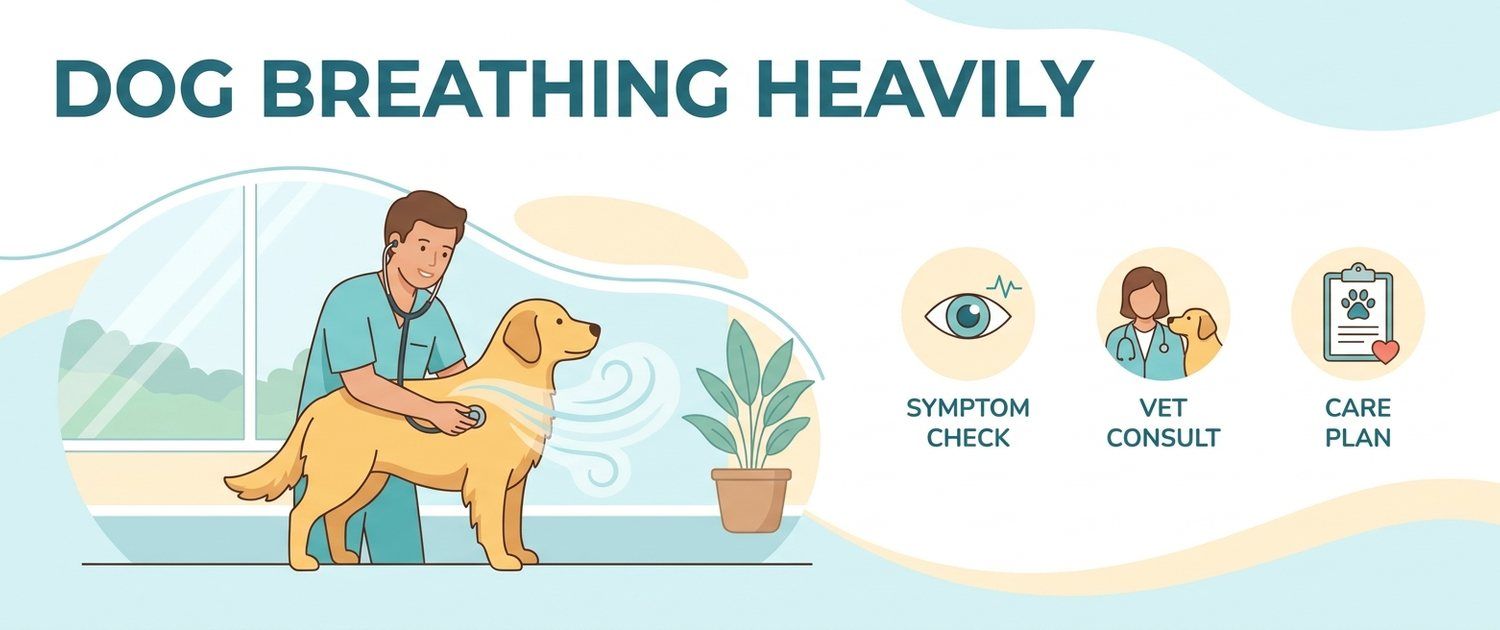
A dog cools itself by breathing, so a dog breathing heavily with the tongue out is an ordinary working mode rather than a sign of trouble. That is exactly why articles about canine breathlessness so often turn into panic: the owner starts counting normal behaviour as a symptom. Let us be honest about the split — first the signs that mean driving in immediately, then what is genuinely normal, and only then the causes.
Red Flags: When Heavy Breathing Is an Emergency
A dog breathing heavily at rest, in a cool room and after no exercise, is already a reason to act rather than watch. Go to a clinic immediately if any one of these is present:
- the tongue and gums are blue, grey or white — the tissues are short of oxygen or of blood;
- breathing with abdominal effort: the belly visibly pulls in and pushes out, the flanks heave;
- a posture with a stretched neck, elbows held out and a refusal to lie down — the dog sits or stands because lying down is worse;
- noisy, wheezing, rasping or snoring breathing that was not there before;
- a resting rate above normal that does not fall after ten or fifteen minutes of rest in a cool room;
- an open mouth, drooling, unsteadiness and a high body temperature after a walk in the heat;
- coughing with foam or pink fluid from the mouth;
- breathlessness together with weakness, collapse, a distended belly or fits — what to do about the last is in seizures in dogs.
Separately: breathlessness in a flat-faced dog — a pug, a french or english bulldog, a boxer, a pekingese — crosses from "it always breathes noisily" into an emergency faster than in other breeds. Their threshold is lower and their margin is smaller.
What Not to Do at Home
- Do not give human medicines — nothing for fever, nothing "for the heart", no sedatives, no diuretics. They are dangerous for dogs and blur the picture. Any medication is a vet's decision.
- Do not force the animal onto its side: a dog with laboured breathing picks the posture that helps it.
- Do not delay cooling an overheated dog and do not wrap it: cooling starts at once, before and during the drive. Dousing with cool or cold water and immersion work fastest — the old "never cold, it causes vessel spasm" advice has been revised, because delay to cooling harms the outcome more.
- Do not force water into the mouth of an animal that is struggling to breathe.
- Do not walk the dog to the car on a lead: carry it or use a blanket, since extra effort makes things worse.
- Do not wait until morning if the tongue colour has changed: that is the sign clinics stay open at night for.
When Fast Breathing Is Normal
A dog does not sweat and sheds heat by evaporation from the tongue and upper airway. Hence the normal situations:
- heat and stuffy air — rapid shallow breathing with the mouth open;
- after exercise — recovery takes from a few minutes to half an hour;
- excitement, fear, a car ride, a vet visit — stress breathing;
- short-lived pain — after a knock to a paw, for instance;
- sleep and dreaming — brief bursts of fast breathing in a sleeping dog;
- puppies and small breeds breathe faster than large adult dogs.
The marker of normality is simple: in a cool room at rest the breathing returns to baseline within ten or fifteen minutes, the tongue stays pink, and the animal is active and does not change posture.
How to Count the Rate in a Sleeping Dog
This is the one home number a vet will take seriously, and it costs an owner nothing.
- Wait until the dog is asleep or lying calmly in a cool room. Counting after a walk or in the heat is meaningless.
- Watch the chest and count the rises over 30 seconds, then double it. One rise and fall is one breath.
- The reference for a dog at rest is roughly up to 30 breaths per minute. Consistently above 35–40 at rest is a reason to be seen, even if the dog looks its usual self.
- Note the number in your phone every day: the trend matters more than a single reading, and it is especially valuable in dogs with heart disease.
A rising resting rate is in fact the earliest home sign that fluid is accumulating in the lungs. It comes before coughing and before lethargy.
Heatstroke: No Locked Car Required
Overheating does not need a car. A midday walk, a run beside a bicycle, a stuffy room without water or a carrier in the heat will do it.
Who is at risk: flat-faced breeds, overweight animals, heavily coated breeds, puppies and old dogs, and animals with heart or laryngeal disease.
The picture: heavy panting with the tongue out, brick-red gums, drooling, unsteadiness, then vomiting, lethargy and refusal to stand. How growing weakness looks is covered in lethargic dog.
Before the clinic: move into shade and cool air, wet the paws, belly and neck with cool water, keep air moving with a fan or an open window, offer water if the animal is conscious. Going in is necessary regardless: heatstroke damages the kidneys, the liver and blood clotting even after the temperature returns to normal.
Fluid in the Lungs and Fluid in the Chest
These are two different places where fluid collects, and both make a dog breathe heavily at rest.
- Pulmonary oedema — fluid inside the lung tissue, most often from left-sided heart failure. Typical in small breeds with mitral valve disease and in large ones with cardiomyopathy. Signs: a rising resting rate, night-time restlessness, coughing, later pink foam.
- Pleural effusion — fluid around the lungs that stops them expanding. The causes vary: the heart, trauma, inflammation, a growth. It gives a sitting posture with a stretched neck and rapid shallow breathing.
Coughing and breathlessness often travel together, and coughing has its own guide, dog coughing. The heart is assessed with ultrasound and ECG — how that is done is in dog heart ultrasound and ECG.
Airways: the Larynx, the Trachea and Brachycephalic Syndrome
- Laryngeal paralysis. Older large dogs, labradors especially: a noisy inspiration, a hoarse bark, poor tolerance of heat and effort, episodes of near-suffocation.
- Tracheal collapse. Small breeds: a goose-honk cough, attacks on excitement and on a collar.
- Brachycephalic syndrome. Narrow nostrils, a long soft palate, a narrow windpipe. The dog snores, breathes noisily in its sleep, chokes in the heat. Owners call it a breed trait for years, though it is an anatomical problem with a solution.
- A foreign body. Sudden choking, panic, attempts to cough it up — a matter of minutes.
Pain, Fever and Anaemia as a Cause of Fast Breathing
A dog speeds up its breathing for reasons other than the lungs.
- Pain. Rapid shallow breathing at rest, a tense posture, unwillingness to lie down. How hidden pain is recognised is in dog whining.
- Fever. Above 39.5 °C the rate rises predictably.
- Anaemia. Blood carries less oxygen, so breathing and pulse speed up and the gums pale.
- Hormonal causes. With excess cortisol a dog breathes faster and drinks a lot: how to measure drinking is in dog drinking a lot.
- Poisoning and dehydration after vomiting and diarrhoea also raise the rate — vomiting is covered in vomiting in dogs.
Bloat: a Belly That Gets in the Way of Breathing
⚠ In a large deep-chested dog, breathlessness together with a distended hard belly and unproductive retching means bloat. The gas-filled stomach presses on the diaphragm and the major vessels, so breathing speeds up, the gums pale and the dog cannot settle.
This is not a watch-and-see situation: without surgery bloat is fatal within hours, and it is confirmed on a single image — how that is taken is in dog x-ray.
Which Tests and Scans Will Clarify the Breathlessness
- Chest radiographs — the baseline: lungs, heart, fluid, foreign bodies.
- Echocardiography — contractility, valves, chamber sizes.
- Point-of-care ultrasound of chest and abdomen — fluid is found in minutes, before any film.
- Blood count and biochemistry — anaemia, inflammation, organs.
- Pulse oximetry and blood gases — how short of oxygen the animal really is.
- Laryngeal examination under sedation — when laryngeal paralysis is suspected.
- Chest CT — for an unclear picture and for hunting lesions; how the methods differ is in MRI and CT for pets.
- Abdominal ultrasound — when the cause may sit below the diaphragm; what it shows is in abdominal ultrasound for dogs.
How to read blood numbers is in dog blood test. In cats open-mouth breathing means something entirely different and is almost always an emergency: see cat open-mouth breathing.
A finished form can go into pet results interpretation and an image report into pet imaging interpretation: the service explains the wording in plain language and builds questions for the vet. If there are no studies yet, describe your symptoms and browse dog symptoms.
This article is informational. Diagnosis and treatment of your pet are the job of a veterinarian.
For informational purposes only
This article is for informational purposes only and does not constitute medical advice, diagnosis, or treatment. Please consult a healthcare professional for medical guidance.