Dog Whining: Pain, Anxiety or a Demand for Attention
Reviewed by the LabReadAI medical team
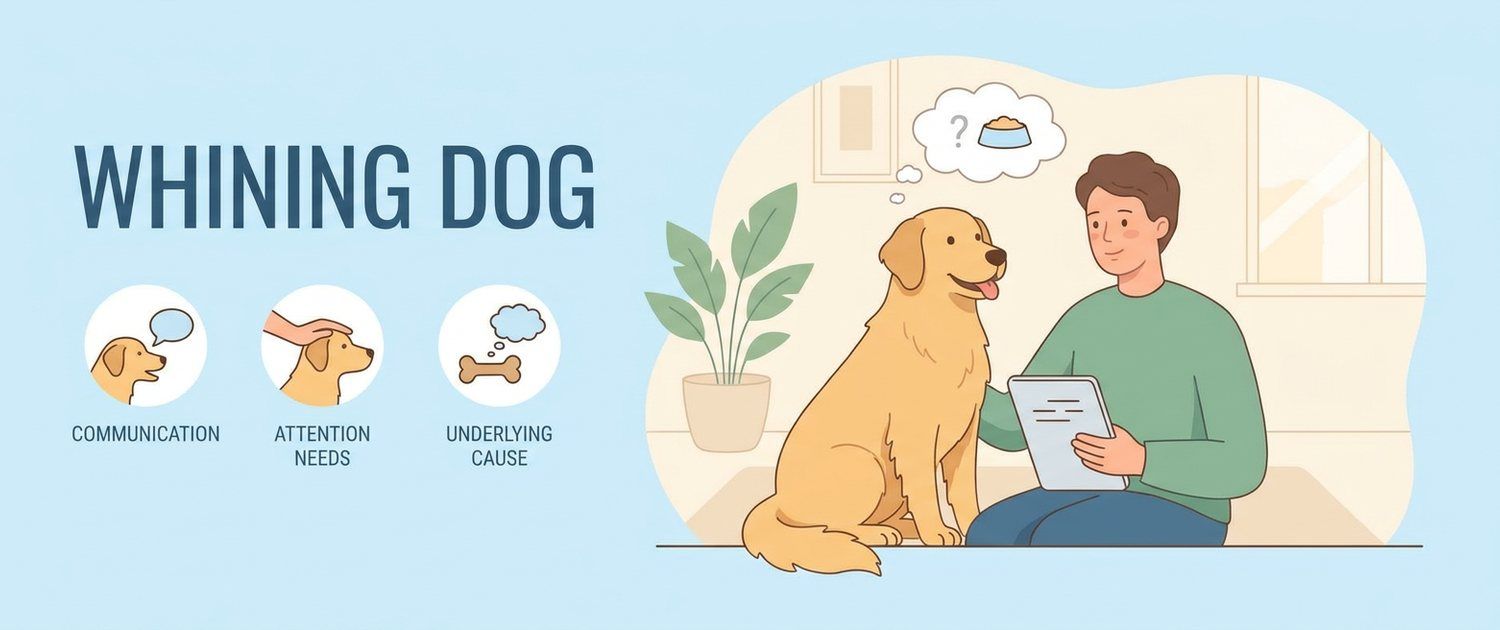
Whining is a sound, not a diagnosis. The same dog whines when it hurts, when it is bored, when it wants the door opened and when it dreads being left alone. The owner hears one thing, but two different worlds sit behind it — behaviour and medicine. You can separate them at home by ignoring the sound itself and watching four things: when the dog whines, in what posture, what stops the whining and what makes it worse.
Why a Dog Whines: Behaviour and Medicine Are Two Branches
Whining comes from puppy communication with the mother and stays a universal "pay attention to me" signal. An adult dog uses it both deliberately and involuntarily.
- The behavioural branch. A demand for attention, food or a walk; boredom; separation anxiety; excitement at the door; fear of thunder and fireworks; a habit the owner built themselves.
- The medical branch. Pain in the back or joints, belly pain, nausea, itching, failing eyesight, cognitive dysfunction in older animals, neurological disease.
The key is the audience. Behavioural whining is aimed at a person: the dog looks at you, gets louder when you react, and goes quiet once it has what it wanted. Medical whining is aimed at nobody: it does not depend on whether you are in the room, it is tied to a posture or a movement, and attention does not switch it off.
Whining as a Demand for Attention: Testing the Version
This is the commonest cause in a healthy adult dog and the most underrated one. The mechanism is simple: whining once produced a piece of cheese, an open door or a scratch behind the ear, and the behaviour stuck.
Signs that point to a demand for attention:
- the dog whines only when you are present and stops when you leave the room;
- the whining gets louder exactly as you look, speak or reach towards it;
- it stops instantly once the demand is met;
- it is tied to predictable scenes: you eat, pick up your phone, sit down to work, stand near the lead;
- between episodes the dog is bright, eats, plays and moves normally.
The test takes three or four days: every reaction to whining is removed, while attention, food and walks are given during quiet moments. Behavioural whining first gets worse on that test, then fades. Medical whining does not change at all — and that is the cheapest way to tell them apart.
Separation Anxiety, Boredom and Excitement
Separation anxiety looks different from a demand for attention. The whining starts a few minutes after you leave, runs together with howling, restlessness, drooling, damage by the door, sometimes puddles at the threshold in a dog that holds on perfectly well otherwise. The owner rarely hears it: the picture comes from a phone left recording.
Boredom and too little exercise produce evening whining by the door after a day alone. It disappears after a walk or a game and does not come back.
Excitement is the whining before a walk, at a greeting, in the car on the way somewhere good. That is emotion overflowing, not a complaint; the tail is working and the dog is bouncing.
What the whole behavioural branch has in common: appetite, gait, breathing and sleep are unchanged. If any one of those has shifted, the "just character" version drops out and the workup starts, much like the one described in lethargic dog.
A Dog Whining in Pain: Back, Joints, Belly
Worth knowing: dogs are more likely to go silent in pain than to whine. Chronic pain usually shows as refusing movements rather than as a sound. So when an animal genuinely whines from pain, it is either acute pain or the particular movement that provokes it.
How it looks:
- Back. Whining when getting up, lying down, jumping or being lifted under the belly; a hunched posture, a stiff neck, refusal to turn the head. In dachshunds and other long-backed dogs the first version is a disc.
- Joints. Whining after sleep and on the first steps, on stairs, when rising after a long rest. Limping is usually there too — how that is worked through is in dog limping.
- Belly. Whining with no trigger, an inability to settle, the praying position with the chest down and the rear up, a hard tense abdomen. Vomiting often joins in — its versions are collected in vomiting in dogs.
- Teeth and ears. Whining while chewing, refusing hard food, head shaking, a head tilt.
One picture owners regularly miss: a dog that whines and at the same time cannot find a comfortable spot, circles, lies down and immediately gets up again is showing pain, not a demand.
A Puppy Whining at Night: Its Own Story
In a puppy, night whining is almost always normal and has a simple explanation: it has just been separated from its mother and littermates. It lasts from a few nights to a couple of weeks and fades if the adults stay calm and predictable.
What else sits behind it besides loneliness:
- physiology — a puppy cannot hold on all night;
- hunger — small puppies eat often;
- cold or an uncomfortable bed — a draughty corner;
- fear of the dark and the silence — a bed next to yours helps for the first nights.
What is concerning is different: a puppy that whines and is also flat, off its food, with diarrhoea or vomiting. A puppy has little reserve and dehydrates within hours — how that looks is in diarrhoea in dogs, and what to do about refusing food is in dog not eating.
An Old Dog Whining at Night: Cognitive Dysfunction
This is the second night-time story and the mirror image of the first. In an older dog, night restlessness with whining is the classic picture of canine cognitive dysfunction, the dog equivalent of dementia.
Recognisable features:
- the dog wanders the flat at night, whines at nobody, gets stuck in corners;
- day and night swap places: sleep by day, activity in the dark;
- familiar commands and routes are forgotten, the dog "gets lost" at home;
- it stops meeting you at the door and asks for contact less;
- accidents indoors appear in a previously clean animal.
Important: in an old dog the same night restlessness also comes from joint pain, failing sight and hearing, high blood pressure and kidney disease with night-time thirst. How to measure drinking and what a rise means is in dog drinking a lot. So "it is just age" is a hypothesis to test with an exam and blood work, not a conclusion.
Itching, Nausea and Other Physical Causes
Some causes do not look like pain but keep a dog softly complaining all day.
- Itching. The dog whines, chews its paws, rubs against furniture, cannot fall asleep. The versions are in dog scratching.
- Nausea. Drooling, lip licking, swallowing at nothing, eating grass, whining just before vomiting.
- Needing the toilet. Whining at the door or in an awkward posture, repeated fruitless attempts — a reason not to wait, especially in male dogs.
- Trembling together with whining. A separate pairing with its own list of causes, covered in dog shivering.
In cats the same kind of signal sounds different and is handled separately — there pain, an overactive thyroid and age-related disorientation come first.
Four Observations That Separate Behaviour From Medicine
A vet will ask for these first, and an owner can collect them in advance.
| Question | More likely behaviour | More likely medicine |
|---|---|---|
| When it whines | With you present, in predictable scenes | Any time, including alone |
| In what posture | Normal posture, tail working | Getting up, turning, hunched |
| What stops it | Attention, food, a walk | Nothing stops it |
| What makes it worse | Your reaction | Movement, touch, a certain position |
Add a phone video to the table: thirty seconds of whining with the posture visible tells a vet more than ten minutes of description.
When Whining Needs an Urgent Vet Visit
Drive in without delay if the whining comes with any of these:
- a distended or hard belly with unproductive retching — in a large dog that is bloat, and the clock runs in hours;
- the dog cannot lie down, cannot settle, breathes fast and shallow;
- refusal to bear weight on a leg, a staggering gait, weak hind legs;
- whining at every touch to the back or neck;
- pale, blue or yellow gums;
- repeated fruitless attempts to urinate;
- whining that started abruptly in an older dog and does not settle;
- whining together with fits, disorientation or loss of consciousness — what to do then is in seizures in dogs.
What Not to Do at Home
- Do not give human painkillers or sedatives. They are dangerous for dogs, and blunted pain hides the picture from the vet. Any medication is a vet's decision.
- Do not punish whining: fear is added to the cause and the cause stays.
- Do not reward whining with food or attention "to make it stop" — that trains exactly the behaviour you want to lose.
- Do not massage or press a painful area, the back least of all: with a disc problem it makes things worse.
- Do not wait until morning if whining comes with a hard belly, weak legs or a change in gum colour.
- Do not change or stop previously prescribed medication on your own.
Which Tests and Scans Will Clarify the Whining
Once the behavioural version is out, the circle is narrowed with a standard set:
- complete blood count — inflammation, anaemia;
- biochemistry — kidneys, liver, glucose, pancreas;
- urinalysis — infection, crystals, concentration;
- radiographs of the spine, joints or abdomen — chosen by where the pain sits;
- abdominal ultrasound — organs, free fluid, the gut;
- MRI — when the picture is neurological: weak legs, neck pain, an altered gait.
How to read blood numbers is in dog blood test; what a joint image shows is in dog leg and joint x-ray; what abdominal ultrasound sees is in abdominal ultrasound for dogs. How MRI differs from computed tomography is something the vet will explain after the exam.
A finished form can go into pet results interpretation and a scan or report into pet imaging interpretation: the service explains the wording in plain language and builds questions for the vet. If there are no studies yet, describe your symptoms and browse dog symptoms.
This article is informational. Diagnosis and treatment of your pet are the job of a veterinarian.
For informational purposes only
This article is for informational purposes only and does not constitute medical advice, diagnosis, or treatment. Please consult a healthcare professional for medical guidance.