A Cat Meowing Constantly: Behaviour, Pain or Illness
Reviewed by the LabReadAI medical team
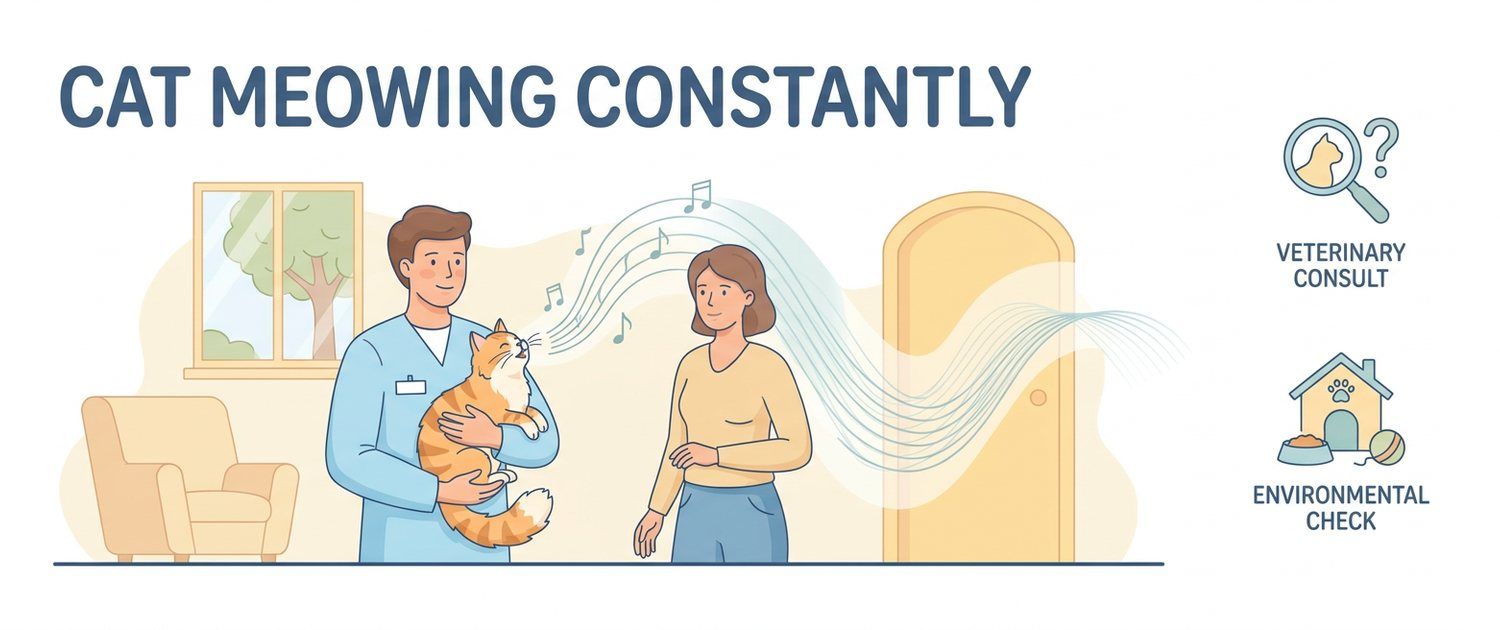
Meowing is a language cats developed specifically for people: adult cats barely use it with each other. So the question of why a cat is meowing constantly nearly always turns into a different one — what changed. A Siamese that has talked since kittenhood and a quiet twelve-year-old who suddenly started calling at night are two separate problems.
First Separate Behaviour From Medicine
Two or three days of observation are worth more than any theory. Write down four things: when (time of day), where (by the door, the bowl, the tray, the middle of the room), what stops the noise (food, attention, nothing) and what changed in the last month.
A cat meowing constantly rarely does so for one reason: in older animals the everyday and the medical usually stack. The rule of thumb is crude but works. If the calling is tied to an event and stops once the cat gets what she wants, behaviour is likelier. If it has no trigger, stops for nothing, started recently in an adult cat, or comes with changes in appetite, weight, gait or toileting, illness is likelier — and illness here is the more urgent branch. A video of an episode is the single most useful thing to bring to the vet — verbal descriptions diverge wildly from what is actually happening.
Everyday and Behavioural Reasons
- Demanding food. The commonest reason of all, and a textbook piece of learning: the cat calls, a human gets up and pours. A handful of repetitions locks it in for months. Splitting the daily ration across several meals often fixes it; what goes in the bowl is covered in choosing food for a cat.
- Boredom and loneliness. An indoor cat with no play and no vertical routes asks for interaction with her voice, especially in the evening.
- Greeting and conversation. Some cats are simply talkative, and it is breed or temperament: oriental breeds vocalise noticeably more.
- A changed environment: a house move, building work, a new person or pet, an owner away.
- A closed door, an empty water bowl, a dirty tray — the short list everyone forgets.
In Season, Unneutered, and the Mating Call
An unspayed queen in season sounds unrecognisable: a long drawn-out howl, rolling on the floor, exaggerated affection, crouching. It repeats in cycles every two to three weeks during the season and frightens owners hearing it for the first time.
An unneutered male who senses a female calls just as insistently, usually at night, and adds spraying. This is neither illness nor stubbornness but hormone-driven behaviour, and neutering settles it more reliably than any sedative. What changes in the bowl after the operation is covered in feeding a cat after spaying, and with age in feeding senior pets.
Pain: What a Hurting Cat Sounds Like
Cats conceal pain to the last, and vocalising is often the first outward sign. The useful clue is what the noise is tied to:
- Crying in the tray while straining. In a male cat this can mean a urethral blockage, lethal within a day or two — see blood in cat urine. Crying while trying to pass stool points instead at constipation in cats.
- Crying when jumping or when the back is stroked — typical of arthritis, far commoner in older cats than it is diagnosed: cat limping.
- A sudden loud scream with hind legs giving way — a vascular emergency; travel immediately.
- Crying while chewing, refusing dry food — dental and gum pain.
- Crying together with laboured breathing — see cat open-mouth breathing.
Hyperthyroidism and High Blood Pressure
Past the age of eight, excess thyroid hormone is one of the leading medical reasons for a suddenly talkative cat. She becomes restless and loud, especially at night, eats a great deal yet loses weight, and drinks more. The pairing of calling with weight loss on a good appetite justifies a single blood value; thirst is covered in cat drinking a lot and weight in cat losing weight.
Hypertension usually sits one floor up, on top of hyperthyroidism or kidney disease. Its cruelty is that the first noticeable event is often sudden blindness: wide pupils that do not constrict, a cat bumping into furniture, disoriented and calling. That warrants an urgent visit, because sight can sometimes be recovered if action is fast. Diet after confirmed kidney disease is covered in feeding a cat with kidney disease.
Senior Cats: Cognitive Dysfunction and Deafness
A distinct and very common scenario: a cat of twelve to sixteen behaves normally by day, then constantly walks the flat at night calling into empty rooms.
Cognitive dysfunction is an age-related brain change, the feline counterpart of dementia. The signs form a recognisable set: disorientation in a familiar home, altered interaction with people, a scrambled sleep-wake cycle, missing the tray, anxiety and night vocalising. It is diagnosed by exclusion — thyroid, blood pressure, kidneys and pain are ruled out first.
Deafness. A cat that has lost her hearing cannot hear her own voice and calls louder than before, usually at night when the house is quiet and there are no visual cues. It is easy to check: watch for a response to a sound made behind her, out of sight.
What genuinely helps with both: a night light in the hallway, a steady routine with the last meal late, beds reachable without jumping, a tray on the same floor as the sleeping spot, calm contact rather than being ignored. In older cats arthritis pain is nearly always part of the mix, and treating it changes the night more than anything else.
When to See a Vet Urgently
Do not postpone:
- crying in the tray while straining, especially in a male cat — hours, not days;
- a sudden scream after which the cat cannot stand or drags her hind legs;
- calling alongside open-mouth breathing, pale gums or unsteadiness — see lethargic cat;
- wide pupils, bumping into objects, disorientation and vocalising;
- crying when the back or belly is touched;
- calling with refusal of food for more than a day: why a cat is not eating.
A routine check within a week or two if an adult cat's voice changed for no clear reason, if she calls at night, is losing weight or drinking more.
What Not to Do at Home
- Do not punish or spray water. Calling driven by anxiety or pain gets worse under punishment and the cause is untouched. The only reliable outcome is a cat that fears you.
- Do not feed at the first night-time call. That is the most efficient way to teach louder and longer calling. If a night meal is needed, it goes on a schedule, not on demand.
- Do not give human sedatives or painkillers. They are lethal to cats; any medication, veterinary ones included, comes only on a veterinarian's prescription.
- Do not treat with valerian or catnip: they alter behaviour unpredictably and settle nothing.
- Do not write off night calling in an old cat as age. Age is not a diagnosis — it is the list of diseases that come with it.
What Tests Will Clarify It
The aim is to clear the medical causes first and work on behaviour second. The standard panel for an adult cat is short:
- Complete blood count and biochemistry — kidneys, liver, glucose, calcium. How to read them is shown in cat blood test.
- Thyroid hormone (T4) — mandatory past the age of eight.
- Blood pressure measurement and a fundic examination — when hypertension is suspected.
- Urinalysis — kidneys and urinary tract.
- An oral examination and joint assessment — the two most frequently missed sources of pain.
- Imaging if arthritis or a mass is suspected; what each modality shows is covered by pet imaging interpretation.
A finished report can be uploaded to pet results interpretation and explained against feline reference ranges — what numbers reveal before an appointment is shown in online vet reading. If there are no tests yet but there are observations and a video, start by describing the situation; other common complaints sit on the cat symptoms page.
This article is informational. Diagnosis and treatment of your pet are the job of a veterinarian.
For informational purposes only
This article is for informational purposes only and does not constitute medical advice, diagnosis, or treatment. Please consult a healthcare professional for medical guidance.