Types of ADHD: Inattentive, Hyperactive and Combined
Reviewed by the LabReadAI medical team
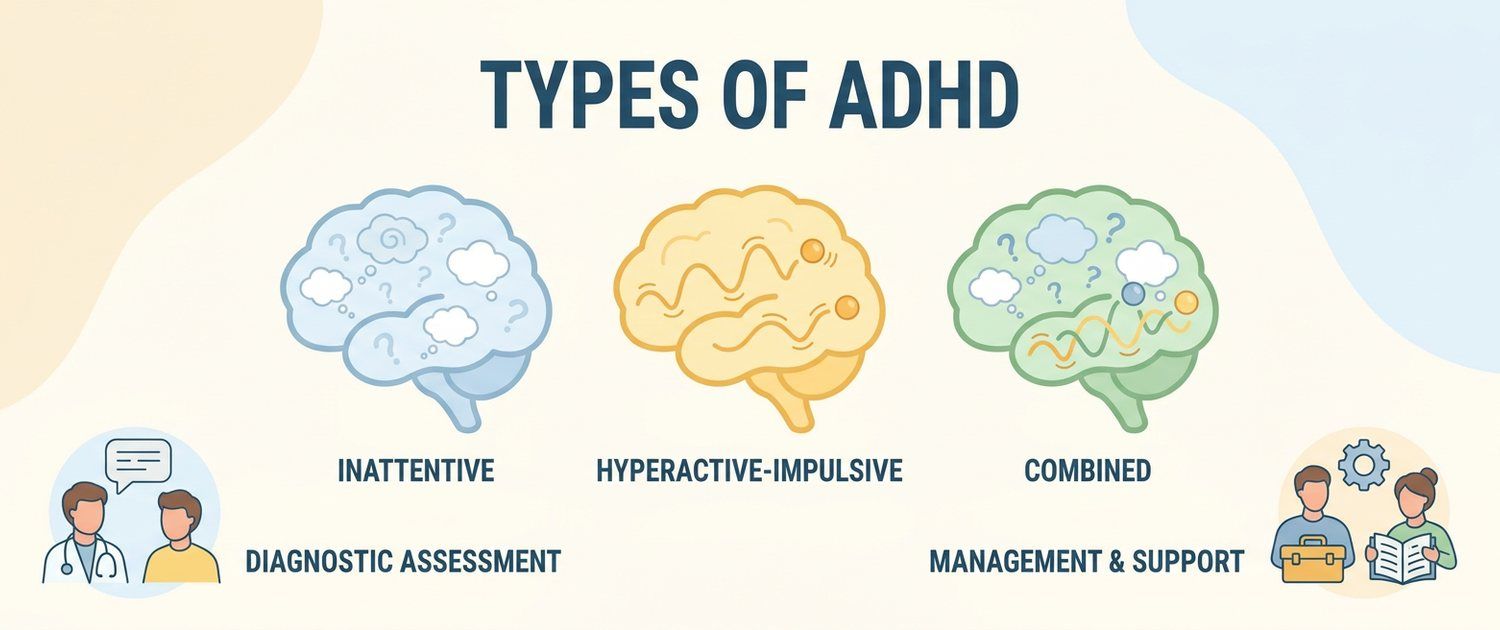
Three types of ADHD are distinguished: predominantly inattentive, predominantly hyperactive-impulsive and combined. The split follows which of the two clusters of signs reaches a sufficient count over the past six months. These are not three kinds of people and not three illnesses: in the same person the type can change as age and load change.
What types of ADHD exist
- Predominantly inattentive — enough signs in the inattention cluster but not in the hyperactivity-impulsivity one. An outwardly calm person inside whom the thought keeps slipping.
- Predominantly hyperactive-impulsive — the mirror picture: a motor, impatience and decisions running ahead of thought, with attention relatively intact. The rarest presentation in adults.
- Combined — enough signs in both clusters at once. The most common presentation in childhood.
What exactly counts as a sign in each cluster is unpacked in the article on the signs and symptoms of adult ADHD.
The criteria: what defines a type
The criteria come from DSM-5 and rest on counting, not on impression. An adult from 17 needs at least five signs in a cluster (a child needs six), lasting at least six months; several signs must be visible before the age of 12; manifestations must reach at least two areas of life, and all of it must genuinely interfere. The type is set by which cluster crosses the threshold.
An honest caveat matters here: the threshold is an agreement among specialists, not a boundary in nature. Someone with four signs is not measurably "healthier" than someone with five; the threshold exists so that a doctor's decision is reproducible. For the same reason our adult ADHD test shows not a "type" but a point on a map of two lines — and says so honestly when that point sits near a border.
How ADD differs from ADHD
In substance, not at all — they are terms from different generations. ADD (attention deficit disorder, without the H) was a separate diagnostic category in DSM-III and described the picture without visible hyperactivity. From DSM-IV onwards hyperactivity returned to the name, and the former ADD became the inattentive presentation of one condition. In everyday speech "ADD" and "quiet ADHD" still mean exactly this. The general frame of the term is in the article on what ADHD is.
ADHD without hyperactivity in adults
In adults the inattentive presentation is the most common and the most frequently missed. There are two reasons. First: visible motor hyperactivity moves inward with age, so from outside the person looks calm. Second: inattention interferes quietly — missed deadlines and abandoned tasks read as a character trait rather than a reason to see a doctor. Hence the skew by sex too: the inattentive profile is more common in women and is found later — here is why.
Does the type change over time
Yes, and that is not a mistake in the first diagnosis. The long-term MTA follow-up showed that for most people the course is wave-like: periods of remission alternate with symptoms returning, and fully stable remission is rare. Dominance shifts along with it: a childhood combined type often reads as inattentive in an adult. So the correct phrasing is "the type today", not "my type".
Hyperfocus: why it does not cancel the diagnosis
A frequent objection sounds like this: "what attention deficit, if I can spend six hours without looking up from something interesting". This is not a contradiction but the same mechanism: what fails is not the amount of attention but its switching and distribution. The walk-through is in the piece on hyperfocus. By the same logic the "disorder or difference" argument is treated separately — neurodivergence.
When it is not ADHD
Before choosing between types, it is more honest to check whether there is anything to discuss at all. The same picture is produced by sleep loss and apnoea, iron deficiency (low ferritin), lack of vitamin B12, hypothyroidism (a shifted TSH), depression and anxiety disorder — these are covered in the piece on what steals attention. If you already have blood work, the service will help you read the results. And how a type is determined at a real appointment is in the article on how adults are diagnosed with ADHD; what is done after a diagnosis is in can adult ADHD be cured; the short free entry point is the ASRS screening scale.
This article is informational and does not diagnose. The type of ADHD is determined by a doctor in person; no online test replaces that.
For informational purposes only
This article is for informational purposes only and does not constitute medical advice, diagnosis, or treatment. Please consult a healthcare professional for medical guidance.