Brain Fog: Causes of Poor Focus and What Tests to Take
Reviewed by the LabReadAI medical team
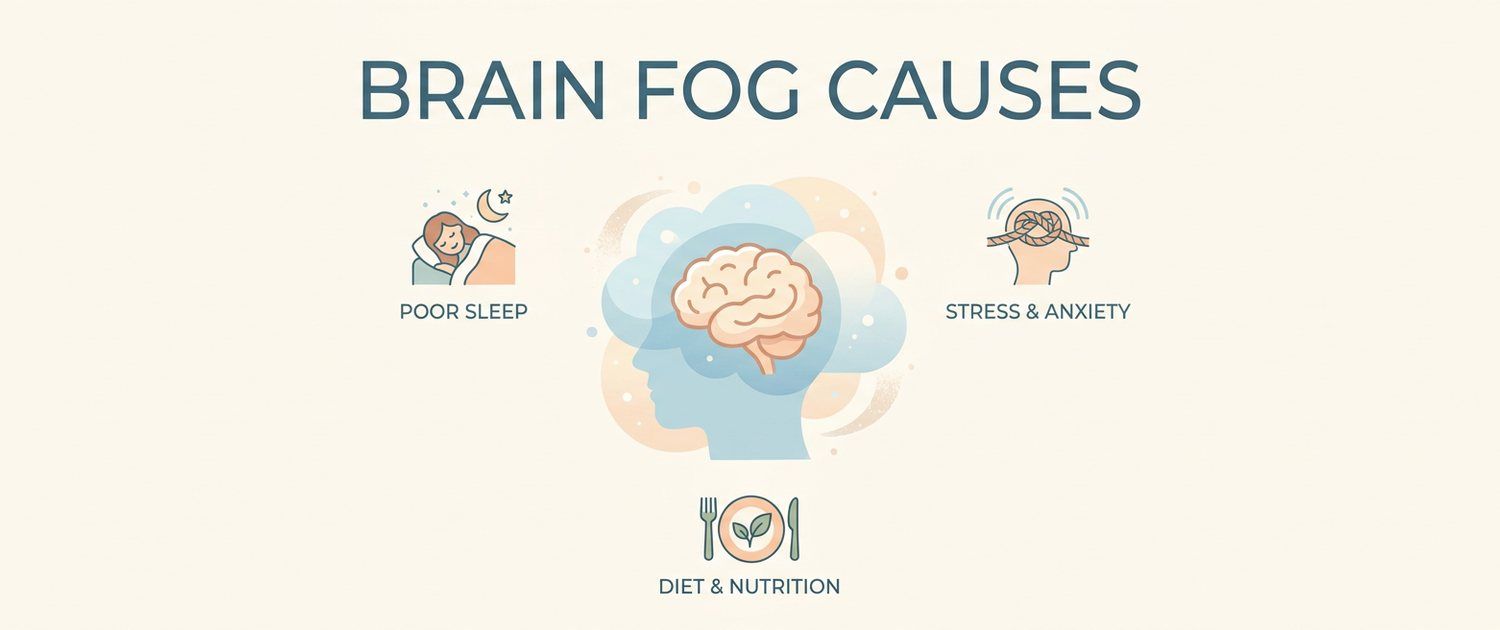
"Brain fog" is not a diagnosis but a description of a state: thought runs slower than usual, attention scatters, words come with a delay, yesterday's agreements will not surface. People call it different things — a cotton-wool head, mental fog, "I can't think straight", loss of focus. The good news is that this state has a short list of most common causes, and almost all of them can be checked.
What people call brain fog
Four different complaints usually hide under one word, and separating them is useful — it decides what to check:
- speed — "I can't think straight", slowed thinking;
- holding — I can't concentrate, I read the page three times, trouble with focus;
- memory — I forget everything, poor memory and absent-mindedness;
- clarity — no clarity in my head, mental clutter, a cotton-wool feeling.
If the loudest part is holding and starting tasks rather than speed or memory, it is worth looking at attention regulation as well — see the article on what ADHD is.
Sleep loss and sleep apnoea
The first cause by frequency and the last by attention paid to it. Chronic sleep loss hits sustained attention and working memory before it hits mood, and people usually write it off as age or character.
Sleep apnoea stands apart — breathing pauses during sleep. It is insidious because the person does not remember the awakenings and is sure they slept eight hours. Meta-reviews put the cognitive deficits in apnoea on a par with chronic sleep deprivation, affecting attention, memory and executive function. Typical hints: snoring, morning headache, daytime sleepiness, waking without feeling rested. More in the article on sleep apnoea and in the piece on the causes of insomnia and what to test.
Iron deficiency: ferritin lower than it looks
Iron is needed not only by red blood cells but by the brain — it takes part in dopamine synthesis. The key detail: the deficiency interferes before anaemia. Haemoglobin can be normal while ferritin sits at or below the lower border, and that is already enough for scattered attention, fatigue and irritability. In women with heavy periods it is the most frequent finding. How to read the result is in the piece on interpreting a ferritin test; the link between iron, dopamine and anxiety is in a separate article on iron and the nervous system.
Vitamin B12
B12 deficiency produces slowed thinking, forgetfulness and a cotton-wool head, and in advanced cases neurological symptoms: numbness, tingling in the fingers, unsteadiness. The risk is higher with vegetarian diets, after stomach surgery, with long-term use of certain medicines and with age. What the test shows and why "within range" does not always mean "enough" is in the article on vitamin B12 deficiency; the marker itself is covered on the vitamin B12 page.
The thyroid
Hypothyroidism is a classic cause of fog: slowness, sleepiness, feeling cold, puffiness, dry skin, weight gain. Attention suffers even in the subclinical form: a 2025 study showed impaired sustained attention in people with subclinical hypothyroidism. The starting marker is TSH; which other tests belong to the check is covered in the article on what tests check the thyroid.
What else steals attention
- Chronic stress and high cortisol — narrow working memory and break sleep; see the article on blood tests for chronic stress.
- Depression and anxiety disorder — produce both slowness and scattered attention.
- Burnout — tied to load, and it retreats when the load lifts.
- Dehydration, alcohol, undereating and harsh diets — banal, but they work.
- Age-related memory decline — a separate story, whose signs are covered in the article on dementia; unlike fog, what suffers there is not so much attention as the encoding of new information.
What tests to take for scattered attention
A sensible starting set that closes off most fixable causes: complete blood count, ferritin, vitamin B12, TSH, vitamin D, glucose. Sleep is assessed separately and by symptoms. If the complaint has lasted more than a few months, or if neurological symptoms have joined it, the doctor extends the set.
Our collections help assemble a list for a specific situation — for instance tests for employment check-ups. And the service will help you read results you already have in plain language: every marker with an explanation of what it means in your particular picture.
When it really is ADHD
The body explains fog that appeared — in a specific year, after childbirth, after six months of poor sleep, after a hard winter. It does not explain a picture that was always there.
It is worth looking towards ADHD if:
- something similar was there in the school years, not only now;
- the difficulties run across every area at once — work, home, money, relationships;
- blood work is fine and the picture does not change;
- alongside the scattered attention stand a lost sense of time, an inability to start and unbearable waiting — see the signs of adult ADHD and procrastination.
The adult ADHD test helps weigh this point by point — 60 statements, 16 facets and an honest checklist of the four conditions; the short free entry point is the ASRS screening scale. How these versions are told apart is in ADHD or burnout, anxiety, depression, and what happens next is in how adults are diagnosed with ADHD and can adult ADHD be cured.
Separately: if attention holds but gets stuck on the interesting, that is not fog but switching, and it is covered in the article on hyperfocus. What the variants of the condition look like is in the types of ADHD; why fog in women is more often about iron is in ADHD in women; the myths about the dopamine pit are unpacked separately; and the argument about words is neurodivergence.
What to do right now
- Sleep properly for a week — the cheapest diagnostic test in existence.
- Take the starting set of tests and look at ferritin and TSH specifically, not only at the "normal" column on the form.
- Check your sleep for snoring and breathing pauses — ask whoever sleeps next to you.
- Write down when it started. That one fact separates half the versions.
- If the picture was always like this — follow the attention line rather than the body one.
This article is informational and does not diagnose. Which tests you personally need is decided by a doctor.
For informational purposes only
This article is for informational purposes only and does not constitute medical advice, diagnosis, or treatment. Please consult a healthcare professional for medical guidance.