ADHD or Burnout, Anxiety and Depression: How to Tell Them Apart
Reviewed by the LabReadAI medical team
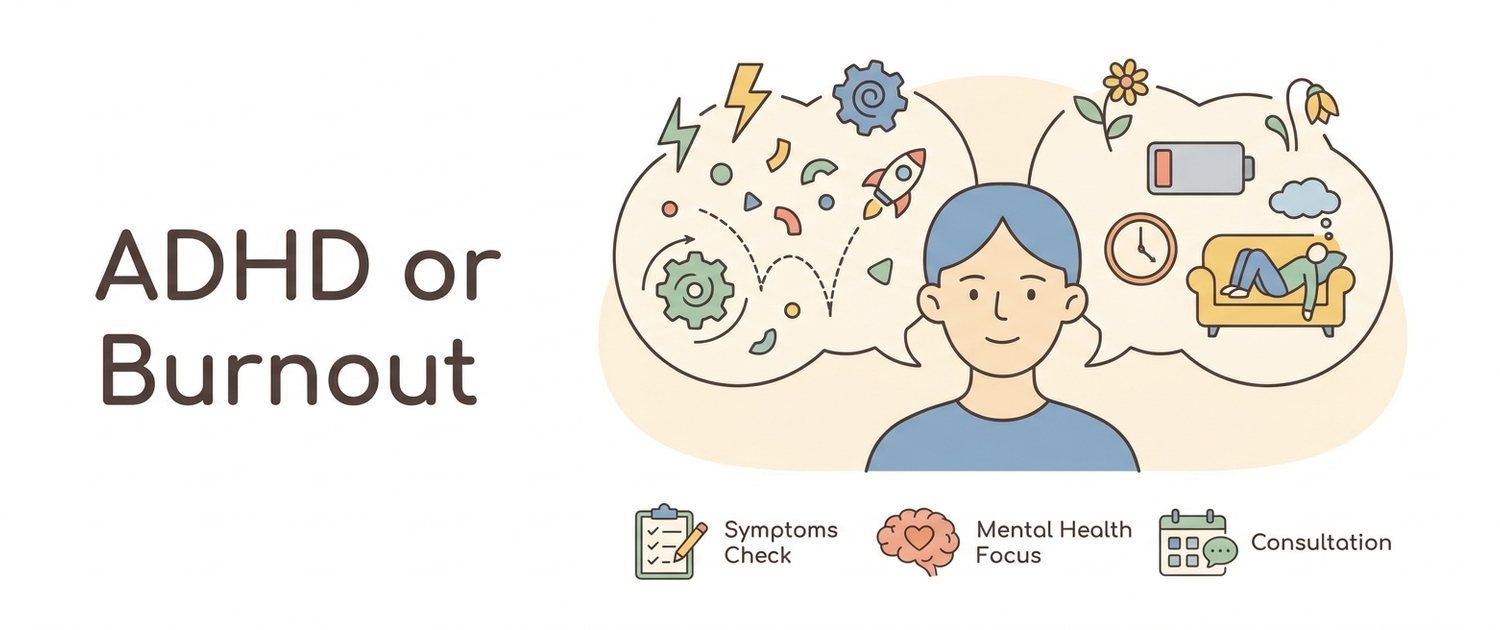
Inattention, an inability to gather yourself, forgetfulness and irritability are the shared language of several conditions at once. You cannot tell them apart by a single symptom: with ADHD, with burnout and with depression the person says the same thing — "I can't concentrate". What separates them is not the symptom but the course over time: when it started, whether it was always there and what it depends on.
How to tell ADHD apart: the main principle
One question rules out more than a whole questionnaire: was it always like this?
- ADHD — from childhood, continuously, across every area at once. It does not begin at thirty and does not lift on holiday. What counts among its signs is in the article on the signs of adult ADHD.
- The imitators — tied to a period or a circumstance: they appeared after a move, a birth, a change of job, six months of poor sleep or a hard winter.
The second question is what it depends on. If the state changes noticeably with load, holidays, season or sleep, the "ADHD only" version weakens.
ADHD or burnout
Burnout is a reaction to prolonged load, and it is tied to context: it forms around a specific activity, weakens when that activity stops, and usually brings cynicism and detachment from work, which ADHD does not.
| Marker | ADHD | Burnout |
|---|---|---|
| Onset | from childhood | after months of overload |
| On holiday | unchanged | noticeably lighter |
| Reach | every area of life | work first of all |
| Attitude to the task | interest intact, starting fails | interest and meaning gone |
What happens to the body under prolonged overload and which markers are worth looking at is in the article on blood tests for emotional burnout.
ADHD or depression
Depression is above all low mood and loss of interest and pleasure, with attention problems following behind. In ADHD the picture is reversed: interest in life is intact, and interesting things actually stick the person in place — what fails is starting and switching, not wanting.
They are separated on three points: course (depression is episodic, ADHD is continuous), the core complaint (loss of pleasure versus inability to start) and sleep (depression more often brings early waking, ADHD trouble falling asleep because the head will not stop).
Caution is needed in both directions: long-unrecognised ADHD leads to depression by itself, through accumulated failure and self-blame. Barkley and Brown described this separately: in adults presenting with other psychiatric complaints, ADHD is often the unrecognised background.
ADHD or anxiety disorder
With anxiety what blocks concentration is the content of the thoughts: the head is occupied with the future, with checking and with "what if". In ADHD attention scatters by itself, including in a calm and safe state where there is nothing to fear.
The second differentiator is what the person does with waiting. Anxiety makes waiting painful because the outcome is uncertain; in ADHD the waiting itself is unbearable, regardless of how it ends.
What is worth checking in the body during anxious states is in the article on blood tests for anxiety.
ADHD or bipolar disorder
They share impulsivity, surges of energy and talkativeness. What separates them is shape in time: in bipolar disorder these are defined episodes lasting days and weeks, with a changed need for sleep and a distinct shift of state. In ADHD the swings are short, tied to events and happen within a single day. More on the condition itself in the article on the signs of bipolar disorder.
ADHD or autism
Both belong to developmental conditions and frequently co-occur. What separates them is where the core difficulty sits: in autism it is social communication, the need for predictability and sensory sensitivity; in ADHD it is the regulation of attention and impulse. Hyperfocus occurs in both, but in autism it is more often tied to a stable narrow interest and in ADHD to novelty. In detail in the article on the signs of autism, and the shared umbrella over both concepts is unpacked in the piece on neurodivergence.
ADHD or laziness
"Laziness" is not a medical category but a judgement. The practical separator is the same as everywhere: with laziness there is neither wanting nor cost — the person does not act and does not suffer for it. With ADHD the wanting is there, the attempts are there, and the result costs disproportionate effort. The starting mechanism is unpacked in the article on procrastination — where you can also see why "just start" does not work.
Comorbidity: ADHD, anxiety, depression and alcohol together
Reviews of adult ADHD say it plainly: co-occurring disorders are the rule rather than the exception — anxiety, depression, addictions, sleep disorders. So the correct framing at an appointment is not "which of these" but "what is present here and what came first". A separate pairing is alcohol and substances: they often turn out to be an attempt at self-medication that makes everything worse, sleep included.
If the state worries you right now, you can start with clinical scales: the burnout test, the depression test or the short ADHD screening on the ASRS scale. A detailed picture across 16 facets plus a checklist of the four conditions is in the adult ADHD test; the history it gathers is convenient to bring to an appointment.
Conditions that mimic ADHD and show up in blood tests
Part of the separation is done not by conversation but by the laboratory. Apnoea and chronic sleep loss, iron deficiency (low ferritin), lack of vitamin B12, hypothyroidism (a shifted TSH) and chronically high cortisol produce the same inattention, the same irritability and the same cotton-wool head. The full walk-through is in the article on what steals attention. If you already have results, the service will help you read them in plain language.
How this is worked out at an appointment
The doctor goes through the signs against the criteria, looks for confirmation from childhood, weighs reach and cost and separately checks the alternatives — the order is described in the article on how adults are diagnosed with ADHD. The general frame is what ADHD is; what happens after a diagnosis is in can adult ADHD be cured; why the road is longer for women is in ADHD in women.
The burnout-or-depression fork is unpacked in more detail in a separate article — where the line actually runs, which also states honestly that science has not drawn it. And the signs of burnout themselves are laid out across three dimensions.
This article is informational and does not diagnose. Telling these conditions apart is a doctor's job; the tables here exist so you arrive with precise questions, not so you can skip the appointment.
For informational purposes only
This article is for informational purposes only and does not constitute medical advice, diagnosis, or treatment. Please consult a healthcare professional for medical guidance.