Adult ADHD Diagnosis: Who Makes It and How It Actually Works
Reviewed by the LabReadAI medical team
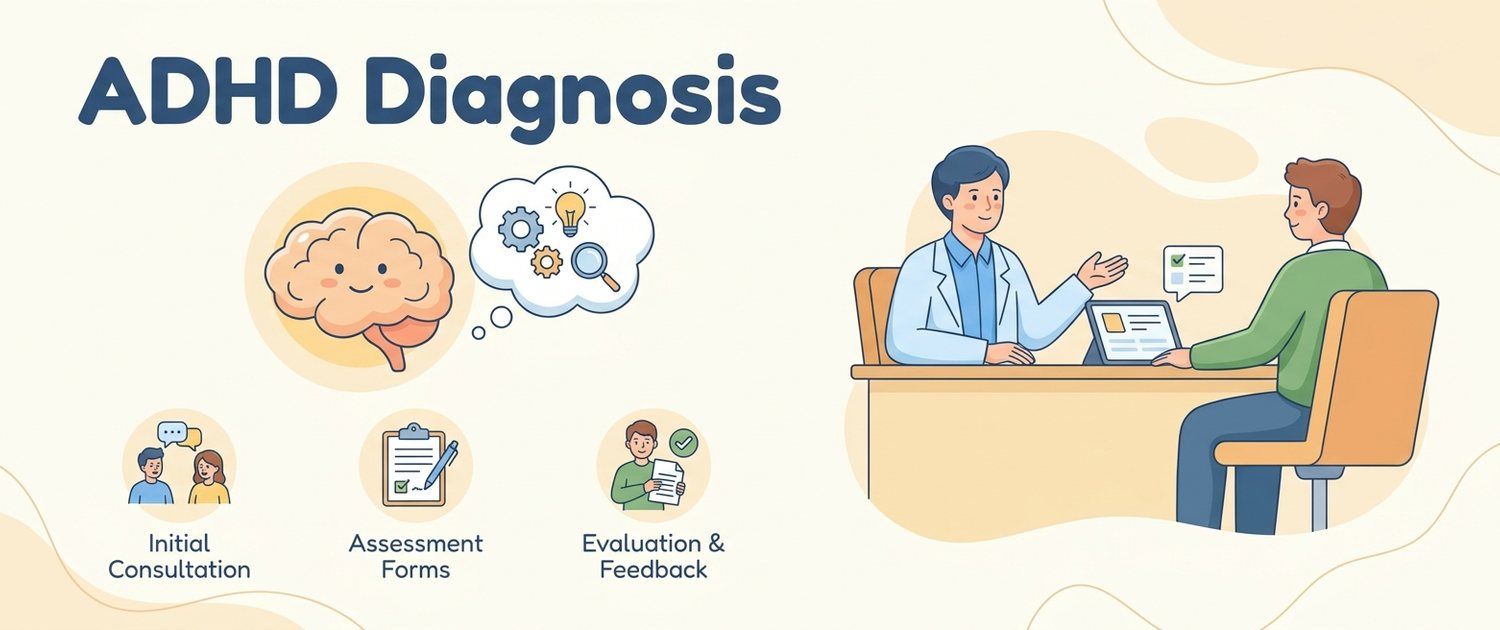
An adult ADHD diagnosis is made by a psychiatrist — in person, on the basis of a structured interview against the criteria, confirmation from childhood and an assessment of what the signs cost the person in real life. No online test, no rating scale and no blood test makes the diagnosis: they help decide whether to go, and what to bring.
Which doctor to see
A psychiatrist is the relevant specialist: ADHD belongs to mental and behavioural disorders, and the right to diagnose sits with them. A psychiatrist-psychotherapist may as well. A neurologist is often the first door and can be useful for ruling out neurological causes, but the ADHD diagnosis is not their area. A psychologist does not make diagnoses at all: they work with the state and with skills, not with classification.
The appointment can take place in a state clinic or a private one. There is no restriction on seeking a consultation; questions of registration, certificates and clearances are handled separately and do not follow automatically from a single visit.
How an adult ADHD assessment works
The appointment is built as an analysis, not as filling in a form. It usually takes one to several visits and covers four parts.
- The signs now. The doctor works through the criteria of both lines — inattention and hyperactivity-impulsivity — and pins each one to concrete situations from the past six months. What counts as a sign is unpacked in the article on the signs of adult ADHD.
- Childhood. Confirmation is needed that several signs were present before the age of 12. School reports, diaries and — most often — an account from parents or from whoever remembers you as a child all serve.
- Reach and cost. The manifestations must appear in at least two areas of life (work, study, home, relationships, money) and genuinely interfere rather than merely exist.
- Other explanations. The doctor checks whether something else produces the same picture: depression, anxiety disorder, bipolar disorder, a sleep disorder, substance use, the after-effects of head injury, physical conditions.
The presentation is settled at the same time: predominantly inattentive, hyperactive-impulsive or combined — see the piece on the types and forms of ADHD.
DIVA, ASRS and the other scales: what is what
- DIVA (Diagnostic Interview for ADHD in Adults) is a structured diagnostic interview and the international working standard: the doctor goes through each DSM criterion separately for adulthood and for childhood, asking for examples. It is a clinician's instrument, not a self-test.
- ASRS is the short WHO screening scale (Kessler et al., 2005) and its DSM-5 version (ASRS-5, Üstün et al., 2017). Both are free and good at filtering out those who need not go. You can take it here: the ASRS screening scale.
- Self-report questionnaires of any length show how closely a pattern of answers resembles what a doctor checks — and nothing more. Our adult ADHD test gives a detailed profile across 16 facets plus a checklist of the four conditions; at an appointment it is useful as a gathered history, not as a conclusion.
Which code goes in the record: F90 in ICD-10
In ICD-10, the classification Russian doctors work with, the condition sits under F90 — "hyperkinetic disorders". A code in a record is not a brand but a way of naming the condition in documentation. What the term itself means and why the condition has so many names is in the article on what ADHD is, and the argument between "disorder" and "difference" is unpacked in the piece on neurodivergence.
A separate frequent question is how the code affects conscription. Under the Russian Schedule of Diseases this is article 18; in detail in the article on ADHD and military service.
Where to get assessed
Practice is broader in large cities: both state clinics and private ones employ doctors familiar with adult ADHD. Sensible selection criteria do not depend on the city:
- the doctor works from a structured interview (DIVA or an equivalent), not from one short scale;
- asks about childhood and requests confirmation;
- checks other causes rather than diagnosing from the first account;
- does not promise the diagnosis in advance or sell it as a service.
What to bring to the appointment
- A history from childhood: what you remember, what your parents remember, school documents if any survive.
- Concrete examples from the past six months — not "I am scattered" but what happened and how often.
- Recent blood work, if you have it: it closes the question of imitators.
- A list of what you have already tried — routine, lists, therapy.
A history gathered in advance saves the first appointment: it does not get spent on recall.
What gets ruled out first: when it is not ADHD
The same picture is produced by conditions that can be tested for and treated: iron deficiency (low ferritin, before anaemia), lack of vitamin B12, hypothyroidism (a shifted TSH), apnoea and chronic sleep loss, depression, anxiety disorder, burnout. How they are separated from ADHD is covered in ADHD or burnout, anxiety, depression and in what steals attention. If you already have results, the service will help you read them in plain language.
What happens after the diagnosis
A diagnosis is not the finish line but the start of the work: what follows is a route, skills and support. Which of the popular promises are true and which are not is unpacked in can adult ADHD be cured. For women the road to a diagnosis is usually longer — here is why.
This article is informational and does not diagnose. It does not describe treatment and does not replace an in-person psychiatric consultation.
For informational purposes only
This article is for informational purposes only and does not constitute medical advice, diagnosis, or treatment. Please consult a healthcare professional for medical guidance.