ADHD Explained: What It Is in Plain Words, Signs and Causes
Reviewed by the LabReadAI medical team
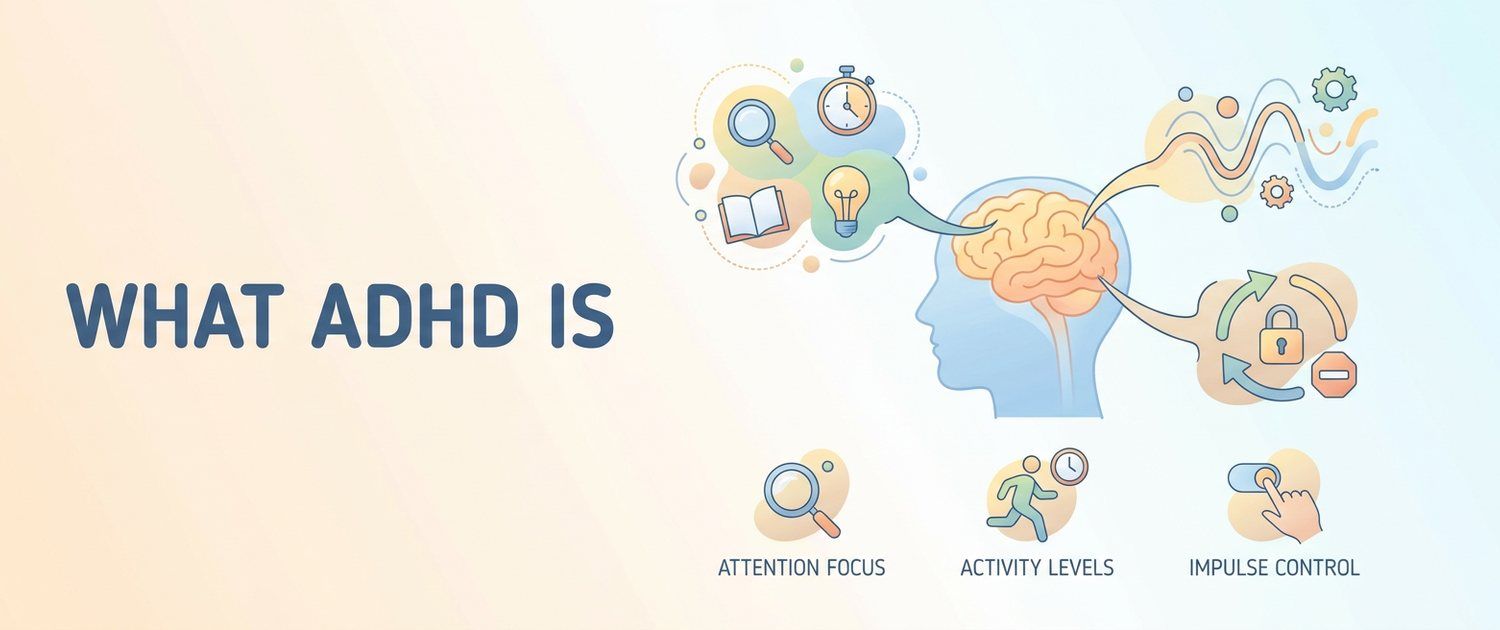
ADHD is attention-deficit/hyperactivity disorder: a stable feature of how the brain works that makes it hard to point attention where it is needed, to start tasks without outside pressure and to hold back an impulse before it turns into action. The signs are visible from childhood, show up in several areas of life rather than one, and last for years. It is not a stretch of tiredness and not a character flaw to be re-educated out of.
What the abbreviation ADHD stands for
ADHD stands for attention-deficit/hyperactivity disorder. Older texts use ADD — attention deficit disorder, without the hyperactivity part. Why today these are not two separate illnesses but variants of one condition is covered in the piece on the types and forms of ADHD.
In ICD-10, the classification Russian doctors work with, the condition sits under F90, "hyperkinetic disorders". What that code means in a medical record and who is allowed to put it there is explained in the article on how adults are diagnosed with ADHD.
What ADHD is in plain words
The word "deficit" is misleading. People with ADHD do not have less attention than others — its steering is what fails. The brain is poor at deciding what to look at right now, and poor at holding that decision once something brighter shows up. Hence both halves of the picture:
- inattention — the thought slips away mid-paragraph, a task is dropped one step before the end, keys and deadlines vanish from memory, time is felt as "now" and "not now" with nothing in between;
- hyperactivity and impulsivity — in an adult this is rarely running around the room: more often an inner motor that will not switch off, an inability to sit through waiting, and words and purchases that happen before the decision to make them.
There is one more layer that popular texts usually lose: self-regulation — holding a goal in mind, breaking it into steps, postponing the pleasant for the necessary and calming yourself down after a flare. This is the layer ADHD relates to most directly: Russell Barkley's classic work describes it as a disorder of inhibition and executive function rather than a shortage of attention in the everyday sense. The emotional side follows from the same place: a meta-analysis shows emotion dysregulation is markedly stronger in adults with ADHD, and it belongs to the picture rather than sitting beside it.
Where ADHD comes from: causes
The main contribution is inherited. Twin studies put the heritability of ADHD at around 74 %, one of the highest figures in psychiatry; at the same time there is no single "ADHD gene" — hundreds of variants with small individual effects are involved, and the first genome-wide significant loci were only found in 2019. External factors (extreme prematurity, severe pregnancy and birth complications) do contribute, but explain a small share of cases.
What is not on the list of causes, contrary to popular articles: sugar, screens, "weak parenting" and "not enough discipline". Screens and sugar can worsen anyone's sleep and wellbeing, but they do not create a condition that is visible from childhood and lasts for decades.
How ADHD looks in adults
The adult picture differs from the childhood one: visible hyperactivity fades for many, while trouble with attention, organisation and starting tasks remains and becomes more noticeable — work, money, paperwork and relationships all rest on it. A detailed walk-through with examples is in the article on the signs and symptoms of adult ADHD.
Three storylines come up most often, and are usually searched for without the word ADHD at all: procrastination, which does not yield to "just start"; the dopamine pit — a popular name for the state where nothing gets you going; and hyperfocus — the ability to disappear into something interesting for six hours and notice nothing around. In women the picture is more often inattentive and well masked, which is why it is found later — here is why.
Is ADHD an illness, a diagnosis or a trait
Formally ADHD is a diagnosis: it exists in both ICD-10 and DSM-5, a doctor makes it, and it entitles a person to help. In substance it is a stable feature of the nervous system that becomes a problem when the demands of the environment exceed the capacity for self-regulation. The same intensity of signs can barely register on a free schedule and wreck a job with hard deadlines.
Hence the argument about words — "disorder" or "difference". A whole movement stands behind it: more on what lies beneath the word neurodivergence, and why the honest answer is "both, depending on what exactly is being discussed".
How many people live with ADHD
A systematic review estimates the prevalence of symptomatic adult ADHD at roughly 2.6 % when childhood persistence is required, and about 6.8 % under a broader definition. The World Federation of ADHD consensus statement stresses the point: the condition is diagnosed less often than it occurs, not more — the problem in world practice is under-diagnosis, not a fashion for the label.
What ADHD is not
- Not "everyone is inattentive now". The difference is not in having the signs but in their number, their age of onset and their cost: with ADHD they run from childhood, across several areas at once, and cost the person jobs, money or relationships.
- Not a bad character. Forgetfulness and lateness in ADHD are not about respect for other people.
- Neither a sentence nor a superpower. Both extremes get in the way equally: the first devalues what the person already manages, the second stops them asking for help.
- Not something to diagnose yourself with from a short video. Recognising yourself in a description is the start of a conversation with a doctor, not the end of it.
When it is not ADHD
The same picture — scattered attention, forgetfulness, fog and an inability to gather yourself — is produced by conditions that can be tested for and treated: chronic sleep loss and sleep apnoea, iron deficiency (low ferritin even before anaemia), lack of vitamin B12, hypothyroidism (a shifted TSH), depression, anxiety disorder and burnout. The dividing line is simple: ADHD runs from childhood and cuts across areas of life, while its imitations are situational and tied to a period. How the versions are told apart is covered in ADHD or burnout, anxiety, depression and in what steals attention. If you already have blood work, the service will help you read the results in plain language.
How to tell whether this is about you
An order that saves time and money:
- Check the body. Sleep, iron, B12 and the thyroid — the things that imitate ADHD and can be fixed.
- Look at onset and reach. Was it there in the school years. Does it show up both at work and at home, not in one place only.
- Weigh the cost. Not "does this ever happen to me" but "what does it cost me".
- Take a structured test. We built an adult ADHD test: 60 statements, the two DSM-5 lines, 16 facets and an honest checklist of the four conditions a doctor checks. There is also a short free option — the ASRS screening scale, six questions.
- Get to a psychiatrist. Only they make the diagnosis, in person and across a whole life history. What happens next and what of it is true is in can adult ADHD be cured. A separate frequent question is conscription and ADHD.
This article is informational and does not diagnose. ADHD is diagnosed by a doctor in person, across a full life history; no online test replaces that.
For informational purposes only
This article is for informational purposes only and does not constitute medical advice, diagnosis, or treatment. Please consult a healthcare professional for medical guidance.