The Dopamine Pit and Dopamine Fasting: What Is Actually True
Reviewed by the LabReadAI medical team
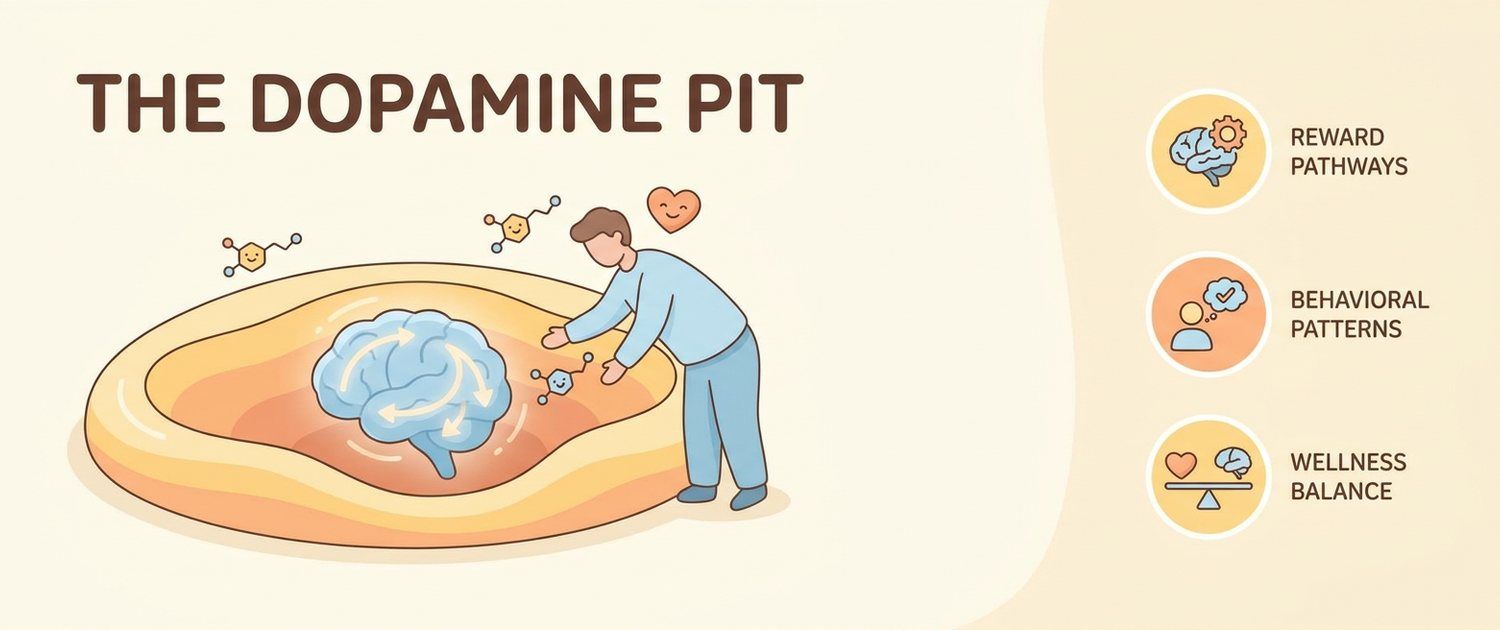
The "dopamine pit" is a phrase from the internet, not from medicine. It describes something real and widespread: ordinary tasks stopped pulling, short pleasures stopped pleasing, and between them sits an emptiness you want to fill with a feed. The state itself is real. The explanation "dopamine ran out" is not. Here is what actually happens, and which of the popular advice has something behind it.
What dopamine actually is
Dopamine is a neurotransmitter that popular texts call the "pleasure hormone". This is the most durable inaccuracy in the topic. Dopamine is responsible above all for motivation, reward prediction and willingness to spend effort: it switches on BEFORE the pleasure arrives and says "that is worth going towards", not "this feels good right now". Pleasure itself is served by other systems.
Hence a property of dopamine that explains everything: the signal comes from the unexpectedness of a reward, not from the reward itself. A reward that always arrives on schedule stops being news, and the signal for it falls. This is exactly what endless feeds and game mechanics are built on: unpredictable reinforcement holds attention better than predictable reinforcement.
If you want the laboratory side of the question — what can and cannot be measured in blood — it is covered in the article on neurotransmitters: serotonin, dopamine and GABA. A separate storyline is how iron affects dopamine synthesis.
Does the dopamine pit exist
As a state, yes. As the physiological fact of "dopamine levels falling into a pit", no — and here is why.
- Dopamine is not consumed like fuel. It is not "spent" over an evening and not "saved up" over a weekend.
- There is no everyday way to measure it in the brain. Blood and urine tests do not reflect brain concentrations.
- What genuinely changes is sensitivity to available reward. When a source of strong, free reinforcement is always at hand, everything else looks pale beside it. That is not a breakdown, it is a comparison.
Hence the honest phrasing: not "dopamine dropped" but "the bar moved". It feels the same — but it is dealt with differently.
The dopamine loop and phone scrolling
The "dopamine loop" is the circle: boredom → short stimulation → instant relief → boredom becomes even less tolerable. The key here is not the substance but the speed of the reward. Anything that delivers in a second beats anything that delivers in an hour — and the more second-long rewards there are in a life, the harder it becomes to hold on to hour-long ones.
The same mechanism sits behind putting tasks off: the delay removes the unpleasant feeling immediately while the cost arrives later. The full walk-through is in the article on procrastination.
Do dopamine fasting and dopamine detox work
The term was coined not by a neurologist but by an author of popular productivity texts, and it shows: you cannot "fast" from a neurotransmitter — the body needs it constantly, including for movement. There is no medical procedure called a dopamine detox.
What is workable in the idea:
- cut the fastest and most available sources of stimulation — not "give up joy", but remove the ones that beat everything else unfairly;
- bring delayed rewards back — things that deliver in an hour and in a week;
- let boredom last — that is where what previously seemed uninteresting starts up again.
What is not in the idea: restoring a "level", resetting receptors in 24 hours, or any figure like "dopamine recovers in N days". All of that is invented.
Dopamine and ADHD
Here the link is genuine and studied: work by Volkow and colleagues showed reduced markers of the dopamine system in reward pathways in adults with ADHD, and tied it to the motivation side rather than the pleasure side. But the conclusions need care:
- it is a group finding, not a test: it cannot diagnose a particular person;
- it does not mean "dopamine is low, so add some" — decisions about any therapy are made only by a doctor and do not reduce to "raise a neurotransmitter";
- it does explain a familiar picture well: the boring will not start, the interesting swallows you whole. On that second half, see the piece on hyperfocus.
If the inability to start has lasted for years, runs across every area at once and goes back to childhood, the question is no longer about dopamine but about what a doctor checks: the adult ADHD test shows the picture across 16 facets, and the short free entry point is the ASRS screening scale. The general frame of the condition is in what ADHD is in plain words, and what happens next is in can adult ADHD be cured.
How to climb out of the dopamine pit
No promises and no "in three days":
- Narrow what is most available. Not a ban but friction: take the app off the first screen, take the phone out of the bedroom.
- Bring slow rewards back. Something that pays off in an hour rather than a second — movement, hands, a live conversation.
- Fix sleep. Sleep loss hits motivation harder than any feed.
- Check the body. Apathy and "I don't want anything" are typical of iron deficiency, hypothyroidism and depression, not only of habits.
- Do not diagnose yourself from a video. If the state has lasted for months, that is a conversation with a specialist.
When it is not about dopamine
The same picture — vanished motivation, nothing pleases, an inability to gather yourself — is produced by conditions that can be tested for: iron deficiency (low ferritin, before anaemia), lack of vitamin B12, hypothyroidism (a shifted TSH), chronic sleep loss and apnoea, depression. What exactly to look at is in the piece on what steals attention. If you already have blood work, the service will help you read the results in plain language.
This article is informational and does not diagnose. It does not describe treatment and does not replace a consultation with a doctor.
For informational purposes only
This article is for informational purposes only and does not constitute medical advice, diagnosis, or treatment. Please consult a healthcare professional for medical guidance.