Procrastination: What It Is and How to Stop Putting Things Off
Reviewed by the LabReadAI medical team
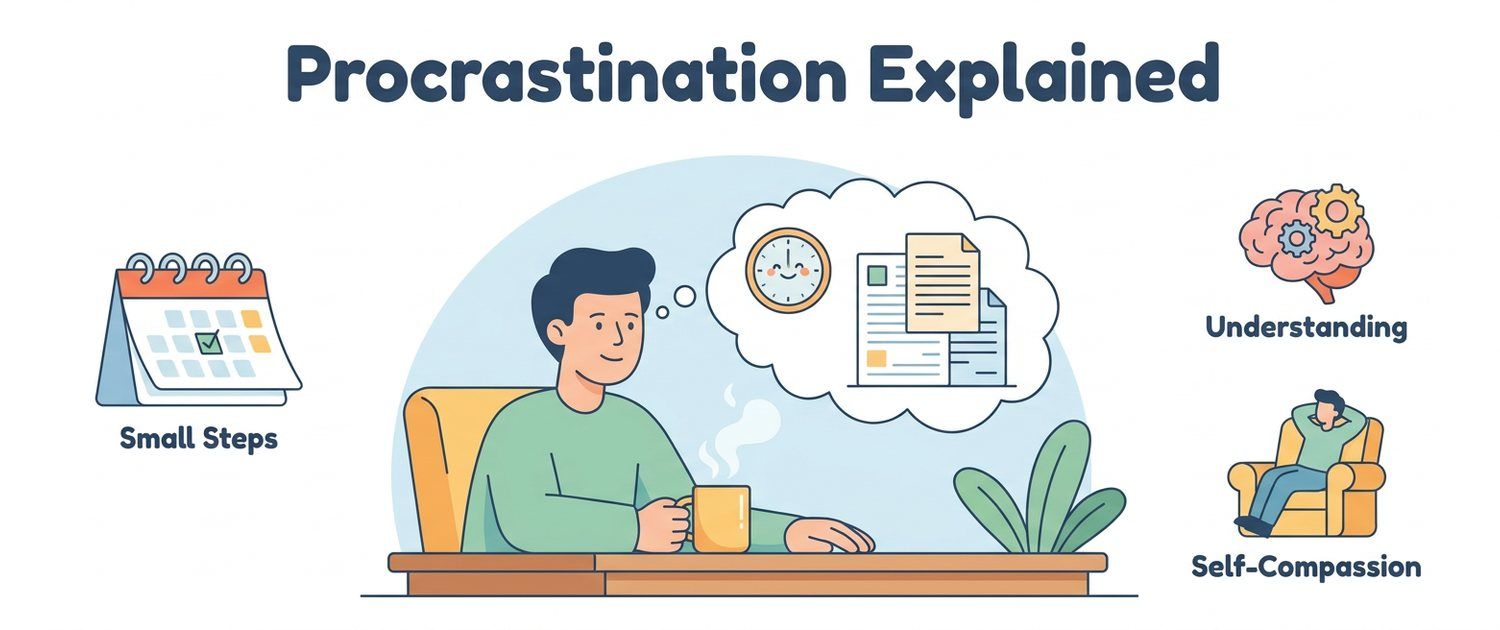
Procrastination is voluntarily postponing an intended task while already knowing that the delay will only make things worse. The definition from the classic meta-analysis says exactly that: a delay against one's own interests. So putting off a report in order to sleep first is not procrastination but prioritising; scrolling a feed instead of the report while tomorrow's deadline sits there is precisely it.
Procrastination in plain words
A procrastinator is not someone who does nothing. Usually they do a great deal: dishes, inbox, reading about time management. Exactly one thing does not get done — that one task. Hence the main marker: the task is postponed not for rest but for other activity.
Three things describe the state better than any definition:
- starting weighs more than the task itself — an hour of work is more frightening at the moment it must begin than while it is under way;
- guilt grows with the delay — and the guilt itself becomes a new reason not to start;
- time compresses — the deadline is "still far off" and then suddenly "already today", with no state in between.
Procrastination and laziness: the difference
Laziness is not wanting to spend effort: the person does not need it, so they do not do it. In procrastination the wanting is there, often intensely, and starting still fails — hence the suffering that laziness lacks. One question separates them: do you feel relief once the task is postponed? With laziness, yes. With procrastination, no — the delay brings anxiety rather than peace.
Which is also why "just start" and "pull yourself together" do not work: they address a shortage of desire that is not there.
Why people procrastinate: the causes
A meta-analysis of 691 correlations identified four strongest predictors:
- Task aversiveness — the more unpleasant, boring or vague the task, the greater the delay. "Vague" matters more than "difficult": a task with no clear first step is the easiest to postpone.
- Distance of the reward — a reward a month away barely holds behaviour today.
- Impulsivity — the most robust personality link. Twin studies show procrastination and impulsivity share a genetic basis and connect through goal-management ability; this does not, of course, imply a "laziness gene".
- Low self-organisation and low self-efficacy — not a bad character but weakness in specific planning skills.
A fifth cause stands apart and explains why procrastination is so stubborn: it is a way to repair your mood right now. Postponing removes the unpleasant feeling immediately; the cost arrives later, the relief arrives at once. The mechanism is the same as in the popular account of the dopamine pit: the brain picks what is available now over what matters later.
Why "just start" does not work
The advice assumes that only resolve stands between "I must" and "I am doing it". In reality three separate operations stand there: remembering the task at the right moment, breaking it down to a first physical step, and holding yourself in it for the first five minutes. Any of the three can fail, and willpower only treats the second half of the third. This is why, for people whose starting mechanism itself fails, honest attempts to "pull themselves together" collapse for years — and that is not about character.
How to stop procrastinating
What works are techniques that take load off starting rather than pressing on the will:
- narrow the first step to a physical action — not "write the report" but "open the file and type the heading";
- bring the reward and the consequence closer — a short deadline instead of a distant one, an external hand-in point instead of an internal one;
- make time visible — a timer and a clock on the desk work better than a sense of time that lets you down;
- remove the vagueness the evening before — write down tomorrow's first step;
- allow a bad first version — perfectionism blocks the start more often than the finish.
You can train the holding-and-switching skill itself on short exercises — for example the Schulte table; it is not a treatment, but it is honest feedback on how your attention behaves.
When procrastination is about ADHD
There is no diagnosis called procrastination. But there is a picture worth looking at more widely: delay across every area at once, from childhood, with a real cost (lost jobs, debts, damaged relationships) — and alongside it forgetfulness, a lost sense of time, an inability to sit through anything boring. That already resembles what a doctor checks when ADHD is suspected: a detailed walk-through is in the signs of adult ADHD, and the adult ADHD test or the short free ASRS screening helps see your own picture point by point.
The other side of the same mechanism is hyperfocus: the very switching difficulty that blocks starting something boring lets you fall into something interesting for six hours. The general frame of the condition itself is in what ADHD is in plain words, and what is actually done about it is in can adult ADHD be cured.
When it is not about character
Before deciding you are a hopeless procrastinator, it is worth checking the simple things. Chronic sleep loss, iron deficiency (low ferritin), hypothyroidism (a shifted TSH), lack of vitamin D, depression and burnout produce exactly the same inability to start — and unlike character, they can be tested for. What to look at is in the piece on what steals attention, and how these versions are told apart is in ADHD or burnout, anxiety, depression. If you already have results, the service will help you read them in plain language.
This article is informational and does not diagnose. Procrastination is not a medical diagnosis; if the delay comes with low mood and loss of interest in life, it is worth seeing a specialist.
For informational purposes only
This article is for informational purposes only and does not constitute medical advice, diagnosis, or treatment. Please consult a healthcare professional for medical guidance.