Hyperfocus: What It Is and How the Postponed Life Grows From It
Reviewed by the LabReadAI medical team
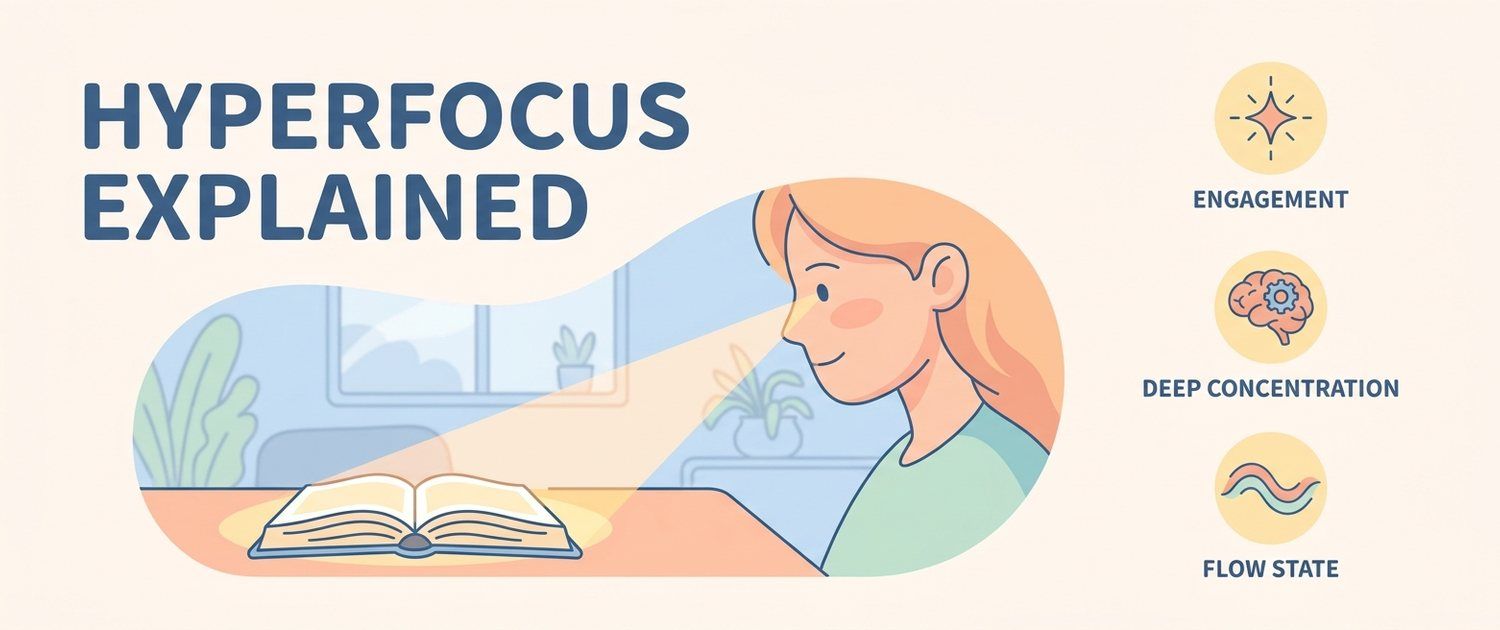
Hyperfocus is a state of deep absorption in a single task in which the sense of time disappears, hunger, messages and people nearby stop registering, and leaving by your own decision becomes almost impossible. It is most often discussed in connection with ADHD — and there it looks like a paradox: how can someone have an attention deficit while spending six hours without looking up from a screen.
What hyperfocus is
There is no paradox. In ADHD what fails is not the amount of attention but its management: deciding what to look at, and holding that decision. When a task lands in a zone of strong interest, no management is required — attention holds itself. The result is a mirror picture of one and the same deficit: the boring will not start at all, the interesting will not let go.
Hence a practical consequence: hyperfocus is not a second mode and not a reward but the same weakness of switching with the sign reversed. The general frame is in the article on what ADHD is, and the full set of signs is in the piece on the signs of adult ADHD.
Hyperfocus and flow: the difference
Flow is a concept from the psychology of activity: full engagement when the difficulty of the task matches the skill. Hyperfocus looks similar from outside but differs on three points.
| Flow | Hyperfocus | |
|---|---|---|
| Entry | usually chosen | happens by itself, often on the wrong task |
| Exit | by decision | hard, sometimes only from outside |
| Object | usually a meaningful task | anything, including a feed or a game |
| Cost | restores | eats sleep, meals and plans |
The main difference is controllability. Flow can be summoned and ended; hyperfocus happens and ends on its own, often at the cost of a night.
What science actually knows about hyperfocus
Less than popular texts suggest. Reviews call hyperfocus a described but poorly studied phenomenon: there is no agreed definition, no standard way to measure it, and most data come from self-report. Work by Hupfeld and colleagues showed that adults with pronounced ADHD traits do report such episodes more often, but stressed the same caution: this is self-description rather than a measured phenomenon.
So the correct phrasing is "a frequent accompanying experience", not "a symptom" and certainly not "proof of a diagnosis". For the same reason hyperfocus confirms nothing and rules nothing out: to see the whole picture, the adult ADHD test counts the switching facet separately, or take the short free ASRS screening scale.
What hyperfocus costs
- Missed deadlines on everything else — six hours went into a task that was not the urgent one.
- The body — skipped meals, unfinished water, postponed sleep.
- Relationships — the person next to you reads absorption as indifference, and it is the most common grievance in couples.
- A false sense of productivity — a great deal was done, just not the right thing.
The flip side of the same mechanism is procrastination: the inability to enter the boring. Both are about starting and switching, not about willpower. The popular explanation through the "dopamine pit" is unpacked separately in the piece on what is actually true.
The postponed life
This is not a medical diagnosis but a description of a life strategy: real life is mentally relocated into the future and will begin once a condition is met — after the move, after the degree, after the renovation, after losing weight. Until the condition is met, current time counts as preparation, so nothing is invested in it: comfortable things are not bought, habits are not started, relationships are not begun.
The link to hyperfocus is direct. When the sense of time works in jerks, "now" and "later" stop being connected: the future stops feeling like a continuation of today and becomes a separate place where everything important is stored. Hence the combination many people recognise: for months the necessary thing will not start — and then six hours suddenly vanish into the unimportant.
Signs of a postponed life
- life is described through a future condition ("once I…");
- nothing is invested in the present, even in small things;
- there is a feeling of "not living but preparing to live";
- decisions are postponed not because it is early but because "something else has to come first".
How to come out of it
No promises and no quick schemes, but to the point:
- Test the condition for reality. It often turns out to be unreachable in principle, or already met, while the habit of waiting stayed.
- Give the present the status of life — do, in current circumstances and at the smallest possible scale, the thing that was postponed until later.
- Make time visible. Timers, alarms for leaving a task, a clock in view — these are a prosthesis for the sense of time, not a sign of not being serious.
- Agree on an external stop signal — ask someone close or a colleague if leaving the absorption by yourself does not work.
- Work out what is underneath. If the postponing is total and runs from childhood, this is a conversation about regulation rather than motivation: see the types of ADHD and can adult ADHD be cured.
Can hyperfocus be used
Partly — and honestly it sounds like this: the state itself can barely be controlled, but the conditions of entry and exit can be. Choose in advance a task worth falling into. Set an external limiter. Prepare water and food. Do not start two hours before bed. Romanticising hyperfocus as a "superpower" is unwise: the cost is real, and the choice of task is usually not ours.
Switching and holding themselves can be trained on short exercises — N-back and the Schulte table give honest feedback on how attention behaves, though they are not a treatment.
When it is not ADHD
Time sinks and "getting stuck" happen for other reasons too: chronic sleep loss, depression, anxiety disorder and ordinary overload. A separate story is conditions in which what suffers is not switching but clarity itself: iron deficiency (low ferritin), hypothyroidism (a shifted TSH), low melatonin and a broken sleep schedule. The walk-through is in the article on what steals attention. If you already have blood work, the service will help you read the results. And why some people call all of this a different wiring rather than a disorder is in the piece on neurodivergence.
This article is informational and does not diagnose. Neither hyperfocus nor the postponed life is a medical diagnosis.
For informational purposes only
This article is for informational purposes only and does not constitute medical advice, diagnosis, or treatment. Please consult a healthcare professional for medical guidance.