Adult ADHD: Symptoms and Signs, How It Shows Up in Adults
Reviewed by the LabReadAI medical team
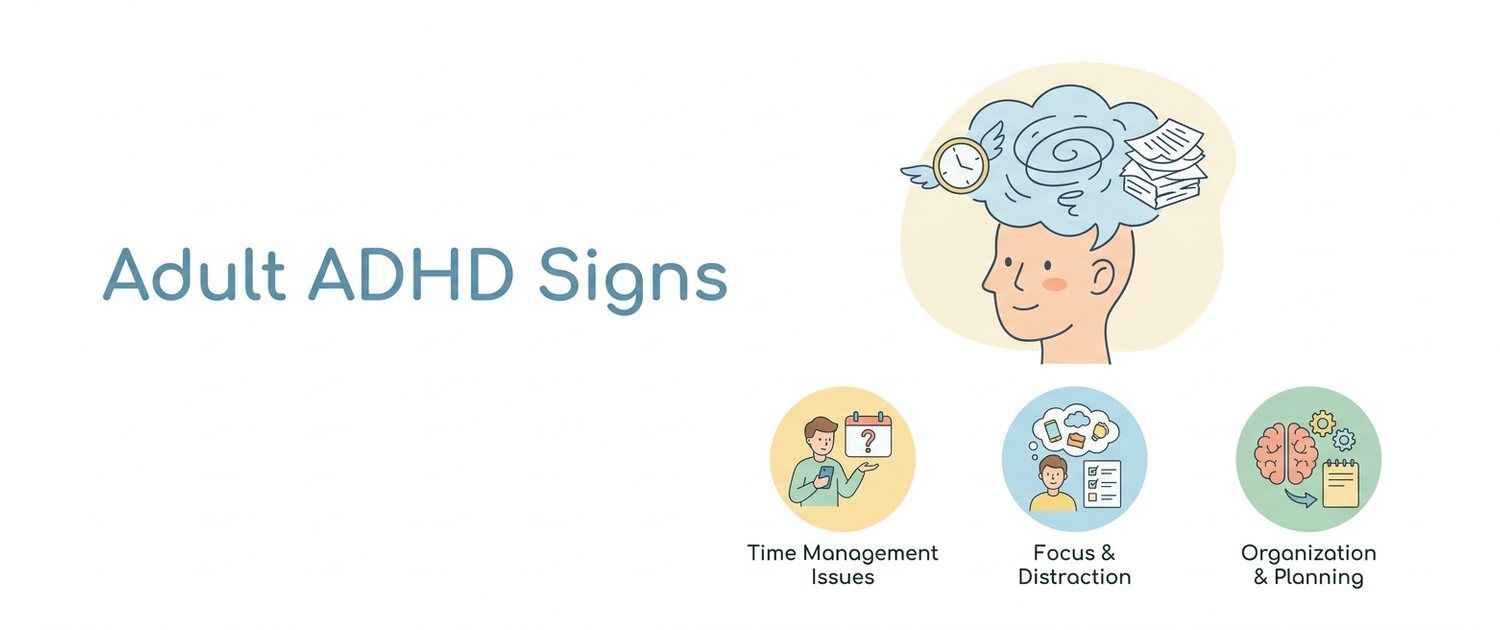
The signs of ADHD in adults gather into two lines: inattention with organisation, and hyperactivity with impulsivity. The adult picture differs from the childhood one not in the set of signs but in what is visible from outside: running around the room turns into an inner motor, and the main cost is no longer school grades but work, money, paperwork and relationships. A third part stands apart — the emotional one: how fast the flare comes and how sharply criticism lands.
How inattention shows up
This is not "I am an inattentive person" but specific repeating storylines:
- holding attention — the thought slips away mid-paragraph or mid-sentence of the person speaking; a page has to be returned to three times;
- detail and finishing — a task gets to ninety per cent and stays there; mistakes appear on the last step, once the interest has run out;
- everyday forgetfulness — keys, documents, the reply that will "definitely be written in a minute";
- the sense of time — time splits into "now" and "not now" with nothing in between, so a deadline becomes real on the final evening;
- order in tasks — a task list exists but does not turn into an order of actions;
- starting a task — the most expensive one: a wall stands between "I must" and the first movement, and resolve does not break it. This has its own name and its own piece: procrastination.
How hyperactivity and impulsivity show up in adults
Adult hyperactivity is almost always internal:
- the inner motor — simply sitting is hard; a leg bounces, hands need something to do, resting is harder work than working;
- impulsivity — the word left before the decision to say it, the purchase happened before it was weighed; abrupt changes of job and plan belong here too;
- waiting and boredom — a queue, a meeting and a slow conversation are physically hard to sit through; an empty pause demands to be filled.
Adult hyperactivity is rarely visible from outside, and that is exactly why it gets missed: the person looks calm while the motor never cuts out.
The emotional side: what school-age descriptions leave out
A meta-analysis shows emotion dysregulation is markedly stronger in adults with ADHD than in people without it: a faster flare, a longer return, a sharper reaction to rejection and criticism. This is not a bad character sitting on top of a diagnosis and not a separate misfortune — it is the same weakness of inhibition, applied to feelings rather than actions. For the bright side of the same mechanism — the ability to fall into something interesting for hours — see the piece on hyperfocus.
How ADHD looks from outside and why it goes unnoticed
From outside it often reads as irresponsibility, laziness or arrogance: the person was late, did not answer, interrupted, abandoned a project. From inside it is constant work against one's own brain, paid for in exhaustion. Many adults build compensations by thirty (lists, alarms, working at night, choosing a profession without deadlines) — and the picture stays invisible right up to the moment the load grows: a child is born, a promotion arrives, external control disappears.
Signs of ADHD in men and in women
The set of signs is the same. The difference is which line is louder and what the environment does with it. In men the impulsive line is noticed more often: a short fuse, abrupt decisions, risky driving, conflict. In women the inattentive profile more often dominates while impulsivity turns inward — into self-criticism and anxiety; add stronger social pressure to "be organised", and you get masking and a late diagnosis. In detail in the piece on ADHD in women.
How many signs does it take
This is where the border runs between "I recognise myself" and "this resembles what a doctor checks". Under DSM-5, an adult from 17 needs at least five signs in a cluster (children need six), several signs before the age of 12, manifestations in at least two areas of life, significant impact and a duration of at least six months. It is these four conditions — onset, reach, cost and the exclusion of other causes — that turn a set of difficulties into a clinical question. Which cluster reaches the threshold also settles the presentation — see the piece on the types and forms of ADHD. How it works at an appointment is in the article on how adults are diagnosed with ADHD.
When it is not ADHD
The same list of symptoms is produced by conditions that can be tested for: chronic sleep loss and sleep apnoea, iron deficiency (low ferritin, before anaemia), lack of vitamin B12, hypothyroidism (a shifted TSH), depression, anxiety disorder, burnout. The dividing sign: ADHD runs from childhood and across all areas at once, while imitations are tied to a period of life. How the versions are separated is covered in ADHD or burnout, anxiety, depression and in what steals attention. If you already have the results, the service will help you read them in plain language.
What to do if you recognise the signs
- Check the body — sleep, iron, B12, the thyroid.
- Look back at the school years: was something similar there.
- Weigh the cost: not "does it happen" but "what does it cost".
- Take a structured test: the adult ADHD test — 60 statements, two lines, 16 facets and a checklist of the four conditions; or the short free ASRS screening scale.
- Get to a psychiatrist. What comes next is in can adult ADHD be cured. The general frame is what ADHD is; the argument about words is neurodivergence; a frequent question at conscription age is ADHD and military service.
This article is informational and does not diagnose. Having the signs is not the same as having the diagnosis: ADHD is diagnosed by a doctor in person, across a full life history.
For informational purposes only
This article is for informational purposes only and does not constitute medical advice, diagnosis, or treatment. Please consult a healthcare professional for medical guidance.