Ferritin in Men: Normal Levels by Age, High Ferritin and Causes
Reviewed by the LabReadAI medical team
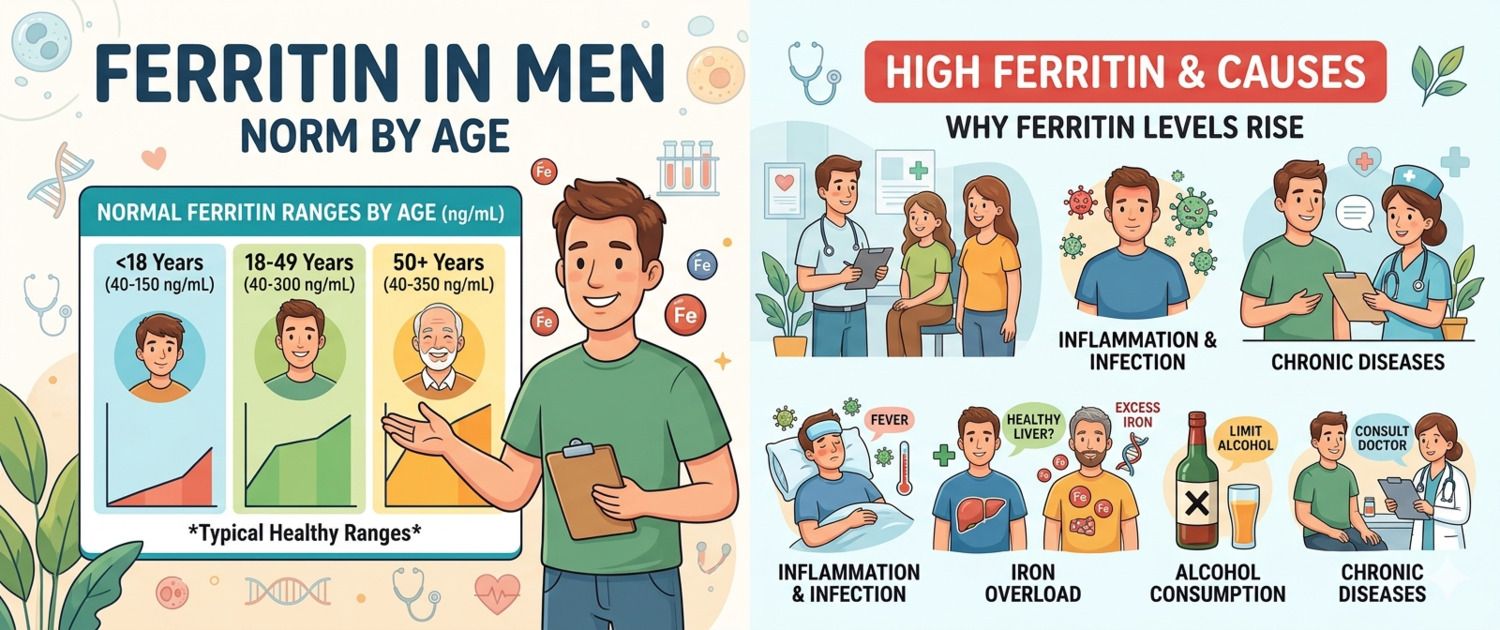
Ferritin behaves differently in men than in women. Reference ranges are higher, typical deviations differ, and the most common finding in men's blood tests is not iron deficiency but iron excess. A high ferritin result is often left unexplained — the laboratory reports a value above the reference range and the answer stops there. Yet chronically elevated ferritin in a man is not a random number: it reflects inflammation, a metabolic disturbance or iron overload, each of which requires a different approach.
Why Ferritin Is Higher in Men Than in Women
Ferritin is an iron storage protein — it is the molecule in which the body's reserve iron supply is held within cells. Blood levels reflect total iron stores. In men, these stores are physiologically larger for several reasons.
Menstruation in women removes approximately 30–40 mL of blood monthly — a continuous iron drain that keeps ferritin lower. Men have no equivalent physiological "release valve": iron accumulates. Testosterone also stimulates erythropoiesis — red cell production — which increases iron and ferritin turnover. Greater muscle mass in men means more myoglobin, the iron-containing muscle protein that additionally influences iron metabolism.
The result: the ferritin reference range in men is wide — typically 20–350 µg/L, compared with 10–150 µg/L in women of reproductive age. But falling within the reference range and being at the optimum are two different things.
Normal Ferritin Levels in Men by Age
Reference intervals vary by laboratory and method, but the general age-related trend is consistent:
| Age | Reference (µg/L) | Functional optimum (µg/L) |
|---|---|---|
| 18–30 years | 20–250 | 70–150 |
| 31–50 years | 20–300 | 80–180 |
| 51–60 years | 20–350 | 80–200 |
| Over 60 years | 20–400 | 80–200 |
The functional optimum is the range in which ferritin acts as an iron buffer without generating excess oxidative stress. Below 30 µg/L — latent iron deficiency even with a normal haemoglobin. Above 250–300 µg/L — a range that requires an explanation: inflammation, a metabolic disorder or iron overload.
A critical point: ferritin is an acute-phase reactant. Any acute or chronic inflammation raises it regardless of iron stores. This is why ferritin must always be interpreted alongside C-reactive protein: if CRP is elevated, ferritin above the reference range automatically loses its usefulness as a marker of iron reserves.
High Ferritin in Men: Main Causes
Ferritin above 300–350 µg/L in a man is not a diagnosis — it is a signal to find the cause. The range of possibilities is wide: from simple inflammation to a genetic disorder.
Chronic inflammation is the most common cause. Ferritin is an acute-phase protein: any inflammation — from periodontal disease to non-alcoholic fatty liver — raises it alongside CRP. In this situation, treating the ferritin number is pointless; the inflammation itself needs addressing.
Metabolic syndrome and obesity. Visceral fat is a source of pro-inflammatory cytokines that drive hepatic ferritin synthesis. In obese men, ferritin of 300–500 µg/L is a frequent finding. A 10% weight reduction often normalises it without additional treatment.
Insulin resistance. Elevated insulin directly stimulates ferritin synthesis. This is why ferritin is part of the insulin resistance monitoring panel: it simultaneously reflects the metabolic disturbance and participates in the inflammatory mechanism.
Alcohol. Regular alcohol consumption is one of the most underappreciated causes of elevated ferritin in men. Ethanol damages hepatocytes, which release ferritin into the bloodstream. A ferritin of 400–700 µg/L in a man with no obvious disease warrants a careful alcohol history.
Liver disease. Any hepatocyte injury — fatty liver, viral hepatitis, cirrhosis — is accompanied by ferritin release. At values above 500–1000 µg/L without another explanation, liver function assessment is essential.
Hereditary haemochromatosis. A genetic disorder in which iron is excessively absorbed and deposited in organs (liver, pancreas, joints, heart). It affects approximately 1 in 300 men of Northern European descent. Ferritin above 500–1000 µg/L without signs of inflammation is a direct indication to measure transferrin saturation and test for HFE gene mutation.
Malignancy. Cancers — particularly leukaemia, lymphoma and liver cancer — can dramatically raise ferritin. At values above 1000–2000 µg/L without another explanation, oncological investigation is mandatory.
Ferritin and Inflammation: How to Tell Them Apart
The practical task when ferritin is elevated is to determine whether it is driven by inflammation or by true iron excess. The algorithm is straightforward:
- Measure high-sensitivity CRP simultaneously with ferritin.
- If CRP is elevated (> 3 mg/L) — ferritin reflects inflammation, not iron stores. Find the source of inflammation; do not treat the ferritin number.
- If CRP is normal (< 1 mg/L) — elevated ferritin likely indicates iron excess. Measure transferrin saturation and serum iron.
- Transferrin saturation above 45% with elevated ferritin — suspect haemochromatosis; refer to haematology.
A complete blood count with red cell indices (MCV, MCH) adds context: the blood picture in haemochromatosis differs from iron deficiency anaemia, in which ferritin is conversely low.
Ferritin and Testosterone: An Underappreciated Connection
Men with chronically elevated ferritin due to inflammation or iron overload frequently show reduced testosterone. The relationship is bidirectional: excess iron deposits in the testes and pituitary gland, disrupting LH secretion and testosterone synthesis. Conversely, low testosterone promotes visceral fat accumulation and chronic inflammation — which then drives ferritin higher.
This explains why men with symptoms of hypogonadism (reduced libido, fatigue, muscle loss) and borderline testosterone results should have ferritin and CRP checked: chronic inflammatory suppression of the hormonal axis is not uncommon. Reviewing ferritin alongside the iron panel gives the complete picture.
Low Ferritin in Men: When It Matters
Ferritin below 20–30 µg/L in a man represents latent iron deficiency. Haemoglobin may remain normal, but symptoms are already present: chronic fatigue, reduced work capacity, impaired concentration, and hair loss. Muscles function less efficiently — iron is required by mitochondria for ATP synthesis.
The causes of iron deficiency in men differ from those in women — menstruation is irrelevant. Common sources: occult gastrointestinal bleeding (ulcer, polyp, haemorrhoids — must be excluded first), malabsorption from coeliac disease or chronic gastritis, intensive athletic training with high iron turnover, and a diet low in haem iron.
A detailed workup for iron deficiency in men, including haemoglobin and iron panel assessment, is covered in the article on iron deficiency anaemia.
How to Lower High Ferritin: What Actually Works
The approach depends on the underlying cause — which is why "lowering ferritin" without a diagnosis is meaningless.
Inflammatory origin: remove the source of inflammation — lose weight, eliminate alcohol, treat fatty liver disease, address chronic infections. Ferritin will fall on its own.
Metabolic syndrome: a 7–10% weight reduction and correction of insulin resistance lower ferritin by 30–50% over 3–6 months.
Haemochromatosis: phlebotomy (therapeutic bloodletting) is the primary treatment. Regular blood donation (every 1–3 months) gradually depletes iron stores. A diet limiting red meat and alcohol is an essential adjunct.
Alcohol origin: complete alcohol cessation normalises ferritin within 4–8 weeks.
Supplements marketed as "blood cleansers" do not lower ferritin. Tea and coffee mildly reduce iron absorption but have no meaningful systemic effect on ferritin levels.
When to See a Doctor
Electively: ferritin above 300 µg/L with normal CRP — measure transferrin saturation and serum iron; ferritin below 20 µg/L — exclude occult bleeding; ferritin rising on serial measurements without explanation.
Promptly: ferritin above 1000 µg/L — exclude malignancy, haemochromatosis and acute liver injury; ferritin above 500 µg/L with transferrin saturation > 45% — refer to haematology.
Ferritin in men is not simply "iron stores." It is an integrated marker reflecting inflammation, metabolic health and tissue iron accumulation simultaneously. It can only be read correctly in context alongside other values — and this is precisely why ferritin without CRP and transferrin saturation provides only half the answer. Ferritin as a marker of biological ageing pace — in the article ageing of the body: causes and mechanisms. A comprehensive longevity monitoring protocol — in the guide how to live long and healthy.
This article is for informational purposes only. Interpretation of test results and treatment decisions are the responsibility of a qualified physician.
For informational purposes only
This article is for informational purposes only and does not constitute medical advice, diagnosis, or treatment. Please consult a healthcare professional for medical guidance.