Cold Sore on Lip: Symptoms, Treatment and How to Stop Recurrences
Reviewed by the LabReadAI medical team
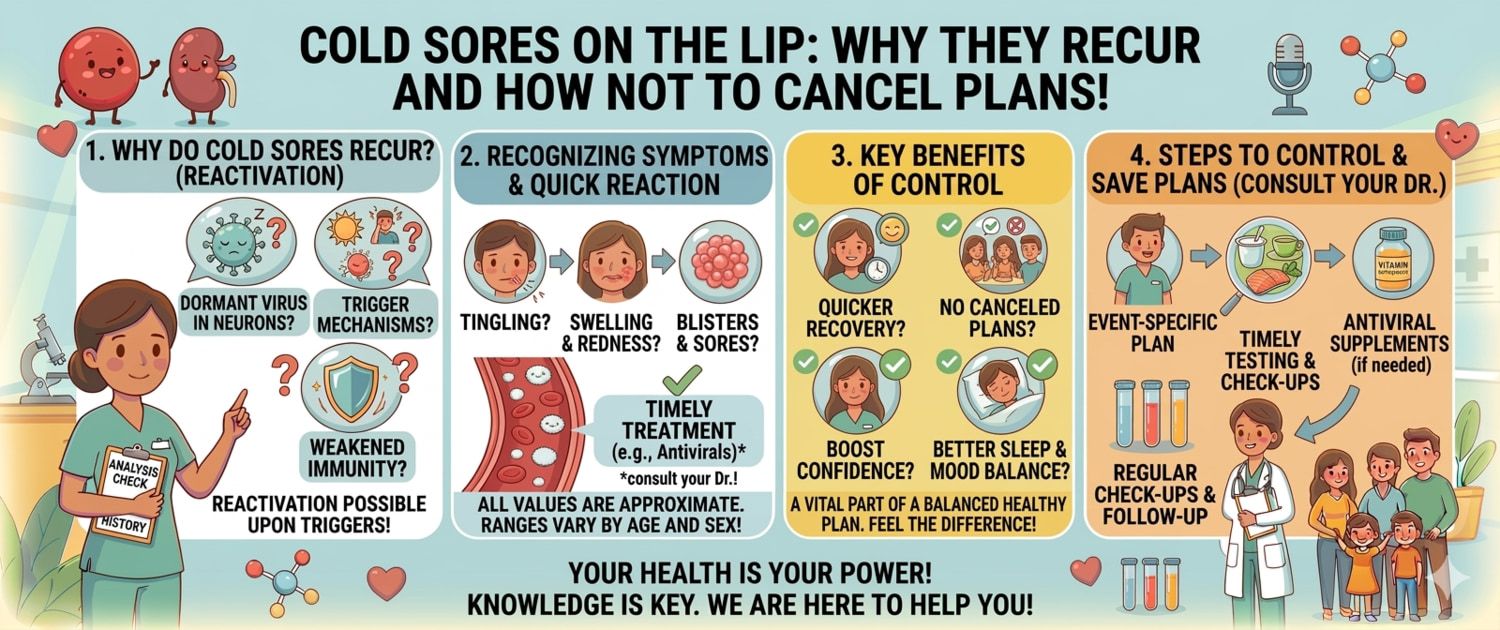
That familiar tingling at the corner of the lip — and a few hours later a blister appears. Cold sores are among the most widespread infections in the world: HSV-1 is estimated to infect 67–80% of the global adult population. But "everyone gets them" doesn't mean "nothing to worry about": in weakened immunity, pregnancy, or immunodeficiency, the virus can behave unpredictably. Let's break down how the virus works, why it keeps returning, and what genuinely helps treat and prevent outbreaks.
What HSV-1 Is and Why It Stays Forever
The cause of labial herpes is herpes simplex virus type 1 (HSV-1). It belongs to the herpesviridae family — a group of DNA viruses that establish lifelong latent infection in nerve cells.
After the initial infection, the virus enters sensory nerve endings around the mouth and travels along nerve fibers to the trigeminal ganglion — a nerve cluster at the base of the skull. There it enters latency: it stops replicating but does not disappear. The immune system can detect it but cannot eliminate it: the virus hides inside a neuron, where antibodies cannot reach it.
Under certain conditions — stress, cold, illness — the virus reactivates, travels back along the nerve to the skin, and causes a recurrence. This is not a new infection; it is the old virus waking up.
It is important to distinguish HSV-1 from HSV-2: HSV-2 is the genital herpes virus, although both types can infect any site. The overwhelming majority of cold sores are caused by HSV-1.
Stages of a Cold Sore: From Tingling to Healed
A typical recurrence passes through five stages. Knowing them matters: antiviral medications work most effectively only within the first 48–72 hours.
| Stage | Duration | What happens |
|---|---|---|
| Prodrome | 6–48 hours | Tingling, burning, itching, sometimes pain at the future outbreak site |
| Papule | 1–2 days | Redness and slight skin thickening; mild swelling |
| Vesicle | 2–3 days | One or more small fluid-filled blisters appear |
| Ulcer | 1–2 days | Blisters rupture, leaving painful weeping erosions |
| Crust | 3–5 days | Erosions form a scab that gradually falls off without scarring |
A full uncomplicated recurrence cycle lasts 8–12 days. Treatment with acyclovir or another antiviral started in the prodromal stage can shorten this to 4–6 days — or prevent blisters from appearing at all.
The virus is most contagious in the vesicular and ulcer stages — blister fluid contains a high concentration of viral particles. However, viral shedding also occurs during asymptomatic periods (asymptomatic viral shedding) — this is the main reason HSV-1 spreads so widely.
Why Cold Sores Keep Coming Back: Outbreak Triggers
In some people cold sores appear once every few years; in others, every month. The difference is determined by immune system status and the presence of external triggers.
Immune fatigue is the most common mechanism. Any condition that reduces T-cell activity can provoke reactivation: a cold, influenza, another viral infection. It is no coincidence that cold sores are colloquially called "fever blisters" — they genuinely appear most often during or after a viral illness.
Chronic stress. Cortisol suppresses cellular immunity — specifically the arm that keeps HSV replication in check. Chronically elevated cortisol reduces NK-cell and cytotoxic T-lymphocyte activity, giving the virus a window for reactivation.
Ultraviolet radiation. One of the most thoroughly studied triggers. UV exposure of the lips — at the beach or on a ski slope — directly reactivates HSV-1 in the trigeminal ganglion neurons. A lip balm with SPF protection is a proven preventive measure in people with frequent recurrences.
Cold and heat exposure. Thermal stress reduces local mucosal and skin immunity.
Hormonal changes. In some women, recurrences are clearly tied to the menstrual cycle — typically the premenstrual phase, when immune reactivity is physiologically reduced.
Lip trauma and procedures. Dental work, lip tattooing, and dermabrasion can trigger reactivation by mechanically irritating the trigeminal nerve branches.
Diagnosis: When Lab Tests Are Needed
In most cases, diagnosis is clinical — based on the characteristic appearance of the lesions. Laboratory confirmation is needed for atypical presentations and for assessing immune status.
PCR of blister fluid — the gold standard for atypical lesions or when HSV-1 and HSV-2 need to be distinguished. Highly sensitive; results in 1–2 days.
Anti-HSV-1 IgG antibodies — confirm past infection (lifelong positive in carriers). Anti-HSV-1 IgM appears during primary infection and in some reactivations, but is less reliable.
Complete blood count — in severe or atypical cases, helps assess the inflammatory response. Elevated leukocytes with a neutrophilic shift points to bacterial superinfection, which frequently complicates open erosions.
C-reactive protein — when dissemination or complications are suspected: herpetic stomatitis, eczema herpeticum, or CNS involvement.
In patients with recurrent herpes occurring six or more times per year, an immune workup is warranted: HIV testing, immunoglobulin levels, and cellular immunity assessment. Frequent severe recurrences in an adult without obvious cause should prompt exclusion of infectious mononucleosis and other conditions affecting the lymphocyte arm of immunity.
Treatment: What Works
There is currently no cure that removes HSV-1 from neurons. However, treatment demonstrably shortens episode duration, accelerates healing, and reduces recurrence frequency.
Antiviral medications — the mainstay of treatment:
| Drug | Form | Regimen for recurrence | Notes |
|---|---|---|---|
| Acyclovir (Zovirax) | 5% cream / tablets | Cream 5× daily for 4 days; tablets 200 mg 5× daily for 5 days | First line; topical form only effective when started early |
| Valacyclovir (Valtrex) | Tablets | 2000 mg × 2 doses in one day | Higher bioavailability; convenient 1-day course |
| Famciclovir | Tablets | 1500 mg single dose | Single-dose regimen; comparable efficacy to valacyclovir |
| Penciclovir | 1% cream | Every 2 hours for 4 days | Higher topical activity compared to acyclovir cream |
The golden rule: starting treatment in the prodromal stage — before blisters form — delivers maximum benefit. Applying cream to an already ruptured erosion is substantially less effective.
Symptomatic topical agents:
- Lidocaine gel — reduces erosion pain
- Zinc paste — dries the lesion and protects against secondary infection
- SPF lip balm during healing — prevents UV triggering the next recurrence
What does not work: iodine, gentian violet, toothpaste, essential oils — none of these have antiviral activity against HSV-1. They may superficially dry the lesion but do not affect viral replication.
Suppressive therapy — daily low-dose antiviral medication for patients with six or more recurrences per year. Valacyclovir 500 mg/day reduces recurrence frequency by 70–80%. This is a clinical decision made after evaluating indications and contraindications.
Cold Sores During Pregnancy and in Immunodeficiency
Pregnancy. A labial herpes recurrence in a pregnant woman is not, in most cases, a threat to the fetus: maternal IgG antibodies protect the baby. Far more dangerous is a primary HSV-1 infection in the third trimester: the mother has no protective antibodies, and the virus can be transmitted to the newborn during delivery or in the first days of life.
Neonatal herpes is rare but severe: CNS, eye, and organ involvement. This is why primary HSV infection in the third trimester prompts acyclovir treatment and a joint decision about mode of delivery.
For recurrent herpes during pregnancy — shared decision-making with the obstetrician-gynecologist. Acyclovir in pregnancy is considered relatively safe, with a substantial evidence base from thousands of treated patients.
Immunodeficiency. In HIV infection, organ transplantation, or cancer chemotherapy, herpes can present atypically: extensive necrotizing ulcers, acyclovir-resistant strains, and dissemination to internal organs. In these patients, herpetic lesions require urgent infectious disease evaluation and may need systemic intravenous acyclovir or foscarnet.
Preventing Recurrences: What Genuinely Helps
Eliminating recurrences entirely in latent HSV-1 carriers is not currently possible, but their frequency and severity can be substantially reduced.
UV protection. SPF 30 or higher lip balm during sun exposure — especially in mountains and near water. Apply before symptoms appear, not after.
Stress management and immune support. Chronic psychoemotional stress is the leading lifestyle-driven trigger. Normalizing sleep, regular moderate physical activity, and stress-reduction techniques reduce reactivation frequency by supporting the cellular immune response.
Personal trigger list. Most people with frequent recurrences can identify their individual triggers within 2–3 months of observation. Keeping a log of episodes — "when it appeared, what preceded it" — reveals a pattern that can be directly targeted.
Hygiene. During an active outbreak: avoid kissing, sharing utensils, sharing towels. Do not touch the lesion with fingers — risk of spreading virus to the eyes (herpetic keratitis) or fingertips (herpetic whitlow). Wash hands after contact with the affected area.
Vaccination. There is currently no approved vaccine against HSV-1, though clinical trials are ongoing.
This article is for informational purposes only and does not replace professional medical advice. Consult a dermatologist or infectious disease specialist for frequent recurrences or atypical cold sore presentations.
For informational purposes only
This article is for informational purposes only and does not constitute medical advice, diagnosis, or treatment. Please consult a healthcare professional for medical guidance.