Low White Blood Cell Count: Causes of Leukopenia and What to Do
Reviewed by the LabReadAI medical team
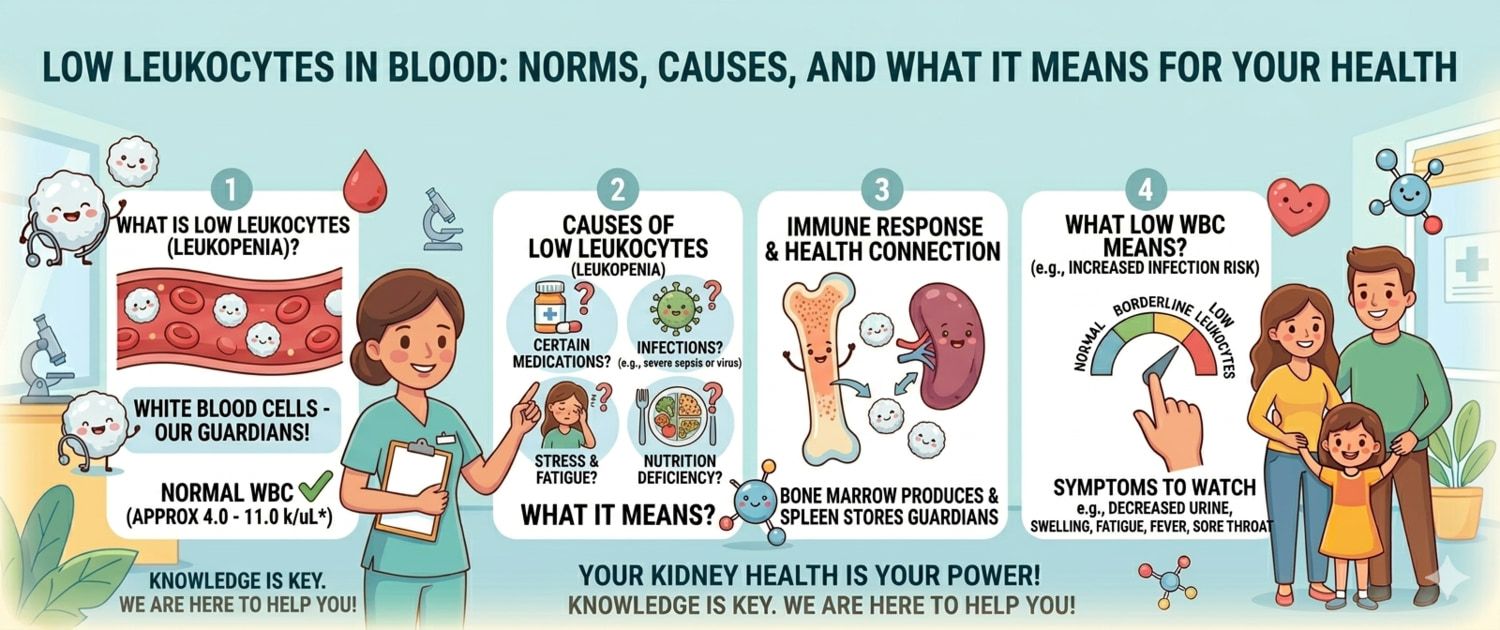
You received your complete blood count and your white blood cells are below normal. The instinct is to worry. But before drawing conclusions, know this: the degree of the drop, which cell fraction is affected, and the clinical context determine everything. A mild transient leukopenia after a viral illness is one thing; a sharp fall during cancer treatment is another entirely. This article explains what white blood cell count is considered low, what causes the decrease, why neutropenia is the most dangerous variant, and when you need to seek care without delay.
White Blood Cell Normal Range: When Is a Value Considered Low?
Leukocytes — white blood cells — are the body's immune army. They are not uniform: each fraction — neutrophils, lymphocytes, monocytes, eosinophils, basophils — defends a different aspect of immunity. A low total count and a low individual fraction carry different clinical meanings.
Leukopenia is defined as a total white blood cell count below 4.0 × 10⁹/L in adults. Normal values shift with age:
| Category | Normal range (× 10⁹/L) |
|---|---|
| Adults | 4.0–9.0 |
| Pregnant women | 6.0–11.0 |
| Infants under 1 year | 6.0–17.5 |
| Children 1–6 years | 5.0–15.5 |
| Children 6–12 years | 4.5–13.5 |
| Adolescents | 4.5–11.0 |
An important caveat: 3–5% of otherwise healthy adults — more commonly people of African descent — have chronically low white blood cell counts in the 3.0–4.0 × 10⁹/L range with no underlying disease. This is called benign ethnic neutropenia and is diagnosed only after all other causes have been excluded.
Severity classification:
- Mild: 3.0–4.0 × 10⁹/L — often asymptomatic and transient
- Moderate: 2.0–3.0 × 10⁹/L — requires investigation and monitoring
- Severe: below 2.0 × 10⁹/L — significant risk of infectious complications
Causes of Low White Blood Cells in Adults
The causes of leukopenia fall into three broad categories: suppressed production in the bone marrow, accelerated destruction or consumption of leukocytes, and redistribution — where cells are present but pool in tissues or the spleen.
Viral infections — the most common cause of transient leukopenia. Influenza, common respiratory viruses, cytomegalovirus, Epstein-Barr virus, hepatitis B and C all temporarily suppress leukocyte production or accelerate their destruction. A classic example: in infectious mononucleosis, white blood cells often fall in the early phase of illness before giving way to a reactive lymphocyte surge. Viral leukopenia typically resolves on its own within one to three weeks.
Medications — the second most common cause in adults. Drugs known to cause leukopenia include:
- Cytotoxic and chemotherapy agents — direct bone marrow suppression
- Certain antibiotics (chloramphenicol, linezolid, trimethoprim)
- Antipsychotics, especially clozapine
- Anticonvulsants (carbamazepine, valproate)
- Antithyroid drugs (methimazole, propylthiouracil)
- Metamizole sodium (dipyrone) with prolonged use
Autoimmune diseases — systemic lupus erythematosus, rheumatoid arthritis, Sjögren's syndrome. In these conditions, the immune system produces antibodies against leukocytes or their bone marrow precursors.
Vitamin B12 and folate deficiency — both vitamins are essential for cell division in the bone marrow. Their deficiency disrupts production of all blood cell lines, including white cells. Leukopenia typically appears alongside anemia and thrombocytopenia — a tri-lineage suppression pattern.
Hypersplenism — an enlarged, overactive spleen (from liver cirrhosis, sarcoidosis, lymphomas) traps and destroys excess leukocytes.
Bone marrow disorders — aplastic anemia, myelodysplastic syndrome, leukemia, metastatic infiltration. These conditions disrupt blood cell production at the source. All three cell lines are usually affected simultaneously.
HIV infection — the virus targets CD4 lymphocytes specifically, making chronic lymphopenia one of the early markers of disease progression.
Low White Blood Cells in Children: Ranges and Special Considerations
In children, normal white blood cell counts are significantly higher than in adults and decline gradually with age. This means that a value of 5.0 × 10⁹/L in an infant under one year warrants close attention, whereas the same number in an adult is perfectly normal.
The most common causes of leukopenia in children:
- Viral infections — the most frequent and most benign cause, just as in adults. Particularly characteristic of the first days of influenza and adenoviral infection.
- Primary immunodeficiencies — rare, but childhood is when these conditions first manifest. Recurrent infections alongside persistently low white blood cells should prompt an immunology referral.
- Cyclic neutropenia — a rare genetic condition in which neutrophils drop to critically low levels every 21 days before recovering spontaneously.
If a child had a respiratory illness and a follow-up blood count shows low leukocytes, a repeat test in two to four weeks is usually sufficient. The vast majority of these cases resolve without treatment.
Low White Blood Cells During Pregnancy
Leukopenia in pregnancy is relatively uncommon, because pregnancy itself causes a physiological leukocytosis. Normal values in pregnant women are elevated — 6.0–11.0 × 10⁹/L — from the first trimester onward.
A value below 4.0 × 10⁹/L in a pregnant woman is therefore not expected physiologically and requires investigation.
Possible causes include:
- Autoimmune conditions — systemic lupus erythematosus and antiphospholipid syndrome, which often first present during pregnancy
- Vitamin B12 and folate deficiency — especially in multiple pregnancy or inadequate nutrition
- Viral infections — parvovirus B19, cytomegalovirus
Leukopenia during pregnancy requires coordinated management between a haematologist and an obstetrician, as several immunomodulatory treatments are contraindicated in pregnancy.
Neutropenia: The Most Dangerous Form of Leukopenia
Of all white blood cell fractions, a drop in neutrophils is the most clinically critical. Neutrophils make up 50–70% of all white blood cells and are the front line of defence against bacterial and fungal infections. As neutrophil counts fall, the risk of serious infection rises exponentially.
Neutropenia severity by absolute neutrophil count (× 10⁹/L):
| Grade | Value | Infection risk |
|---|---|---|
| Mild | 1.0–1.5 | Slightly elevated |
| Moderate | 0.5–1.0 | Substantially elevated |
| Severe (agranulocytosis) | < 0.5 | High: life-threatening infections |
Agranulocytosis — virtual absence of neutrophils — is a life-threatening emergency. Organisms that a healthy immune system handles without difficulty become potentially fatal. Any fever during agranulocytosis is a medical emergency.
A critical clinical point: the total white blood cell count can be within normal range while neutrophils are dangerously low — and this constitutes neutropenia with all its risks. This is why leukopenia always warrants a full differential count, not just the total white cell number.
Symptoms Associated with Leukopenia
Mild leukopenia is often entirely asymptomatic and discovered incidentally on a routine blood test. Symptoms emerge when immune defences fall far enough that the body can no longer handle ordinary microbial exposure.
Non-specific symptoms:
- Persistent fatigue and low energy
- Frequent respiratory infections that are more severe than usual and slow to resolve
- Slow-healing cuts, boils, or mouth ulcers
- Low-grade fever without an obvious source
Symptoms of severe neutropenia — seek emergency care:
- Fever above 38 °C — combined with neutropenia, this is "neutropenic fever" and requires urgent hospitalisation
- Ulceration and necrosis of the oral and throat mucosa
- Signs of sepsis: rigors, rapid deterioration, falling blood pressure
An important clinical caveat: in severe neutropenia, the classic signs of infection — pus, pronounced redness, swelling — may be absent, because there are too few neutrophils to produce these inflammatory responses. Fever may be the only warning sign.
When Low White Blood Cells Require Urgent Medical Attention
A mild post-viral leukopenia without symptoms and with a good general sense of wellbeing — a repeat test in three to four weeks is usually appropriate. But several situations call for immediate consultation:
- Total white blood cell count below 2.0 × 10⁹/L — regardless of symptoms
- Absolute neutrophil count below 0.5 × 10⁹/L — agranulocytosis
- Leukopenia combined with anaemia and thrombocytopenia — tri-lineage suppression
- Fever above 38 °C in a patient with known leukopenia — emergency
- White blood cell count declining across successive tests without an obvious cause
- Enlarged lymph nodes or spleen alongside leukopenia
- Leukopenia in a child without a preceding illness, or in a newborn
The workup for leukopenia includes a full differential blood count, biochemical panel, vitamin B12 and folate levels, autoimmune markers, and — when indicated — a haematology consultation with consideration of bone marrow biopsy.
Conclusion
Low white blood cells — leukopenia — is a finding, not a diagnosis. Behind it can lie conditions that vary enormously in seriousness: transient post-viral suppression, a drug side effect, an autoimmune process, or bone marrow disease. The key questions when interpreting the result are: how low, which fraction, are there symptoms, and is there a downward trend? Mild asymptomatic leukopenia warrants a repeat test in three to four weeks. Severe neutropenia or fever alongside leukopenia demands urgent medical care without delay.
From here the question narrows to a single fraction. If granulocytes pulled the total down, the answer is in high and low neutrophils — benign ethnic neutropenia, drug-induced forms, and the threshold at which a low count becomes genuinely dangerous. If the lymphocyte line is the one that fell, read high and low lymphocytes — lymphopenia after a viral illness, on corticosteroids, and, rarely, as a finding in its own right.
This content is for informational purposes only and does not replace professional medical advice.
For informational purposes only
This article is for informational purposes only and does not constitute medical advice, diagnosis, or treatment. Please consult a healthcare professional for medical guidance.