Alexithymia: What It Is in Plain Words and How It Relates to Autism
Reviewed by the LabReadAI medical team
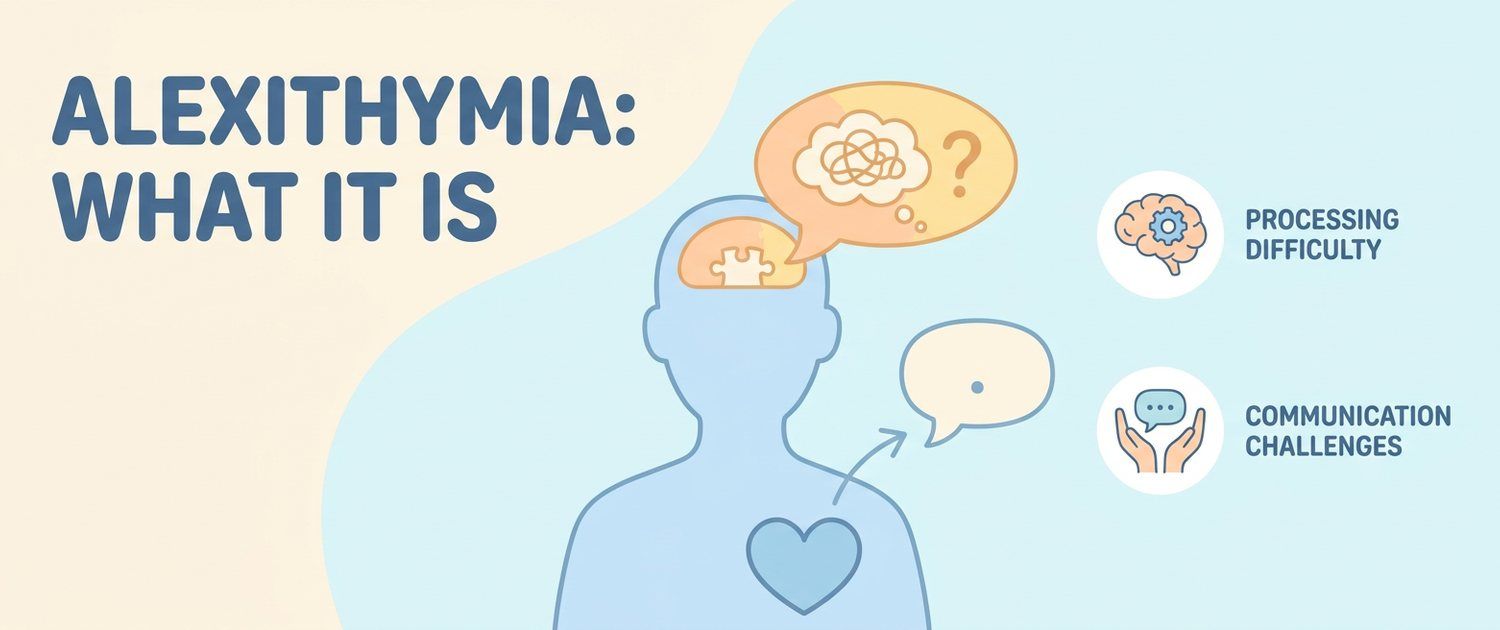
Alexithymia is difficulty recognising, distinguishing and naming your own feelings. The word is built from Greek roots and literally means "no words for feelings". One misunderstanding is worth clearing up immediately: this is not an absence of emotion. The emotions are there, often very strong — what is missing is the internal labelling that turns a bodily state into a usable word.
A person with pronounced alexithymia will not say "I am hurt". They will say "something is off", "I am probably tired", "everything is fine", or say nothing at all, because they honestly do not have an answer to "what are you feeling right now?".
It is not a diagnosis
Alexithymia appears in neither ICD-10, ICD-11 nor DSM-5. It is a construct — a measurable trait that varies in degree from person to person, like height or reaction speed. It is described by scales (the best known is the Toronto Alexithymia Scale, TAS-20, developed by Bagby, Parker and Taylor in 1994), not by classification headings.
Hence a practical conclusion: "I have alexithymia" is not a diagnosis that gets assigned or removed but a description of how easily you reach your own feelings. And that description can change.
What the construct is made of
The three-factor structure of the TAS-20 sets out three parts, and it helps to see them separately — different people have different ones pronounced.
- Difficulty identifying a feeling. Something is happening inside, but what exactly is unclear. Neighbouring states blur worst: anxiety and excitement, anger and tiredness, sadness and hunger.
- Difficulty describing a feeling to someone. Sometimes the state is recognised but the words will not come: any attempt to explain sounds either too flat or too long.
- Externally oriented thinking. Attention naturally moves toward facts, tasks and how things work rather than toward inner experience. Not avoidance of feelings — simply a different default focus.
Signs of alexithymia in daily life
The body speaks before the words, and often louder.
- A clenched jaw or shoulders by evening, while "what happened?" leaves you stuck.
- A lump in the throat or a heavy chest during a conversation that "went fine".
- Exhaustion "for no reason" after a day in which nothing special occurred.
- Irritation you discover through your own sharp sentence rather than in advance.
- A partner asking "are you angry?" produces genuine bafflement — and irritation an hour later.
- Feelings become legible in retrospect: a day later, a week later, in conversation or on paper.
- Care shows up as action (fix it, bring it, solve it) where words were expected.
A separate difficulty is how others read this. Silence in response to "what are you feeling?" gets taken as coldness or unwillingness to invest. It is one of the commonest misunderstandings in close relationships: the person is not refusing to talk about feelings — at that moment they cannot tell them apart.
The misunderstanding lasts longest where the gap is covered by learned formulas: "I am a bit sad", "I am happy for you" sound smooth and give no sign from outside that the word was picked to fit the situation rather than the state. Rehearsed adapting of exactly this kind is much of why the picture in autism in women surfaces so late.
Where the term came from
The concept was introduced by the psychiatrist Peter Sifneos in the early 1970s. He described patients who arrived with bodily complaints and, in conversation, turned out to have a very sparse vocabulary for inner states and a mind turned toward external circumstances. The construct has since travelled far beyond psychosomatics and is studied across very different groups.
Alexithymia and autism: a link, not a synonym
Precision matters here, because the confusion harms both sides.
A systematic review with meta-analysis (Kinnaird, Stewart, Tchanturia, 2019) gathered the research and confirmed that pronounced alexithymia is markedly more common among autistic people than among non-autistic people. But the same review showed the crucial part: the overlap is partial. A substantial share of autistic people have no alexithymia and name feelings very well; conversely, pronounced alexithymia occurs in people with no relation to the spectrum at all.
There is also a separate research line (Bird and Cook, 2013) proposing to separate the two on principle: some difficulties historically attributed to autism as such — emotion recognition, for instance — are, on their data, better explained by co-occurring alexithymia than by the spectrum. The scientific debate continues, but the practical takeaway is already useful: do not derive one from the other. Not "if I struggle to name a feeling, I must be autistic", and not "since I am autistic, I must not understand feelings".
The old stereotype of "coldness" grew out of the same confusion: descriptions that ran for decades under the historical term Asperger's syndrome credited people with an absence of feeling where only the words for it were missing.
On the spectrum and its wording, see the piece on the ASD diagnosis; to see what is pronounced in your own case and how much energy goes into camouflaging, a structured adult autism test helps.
Where else it shows up
Pronounced alexithymia is described in very different contexts: after hard events and prolonged stress, in depression, in eating disorders, in chronic pain, in some neurological conditions. A separate and very common everyday reason is an environment where feelings were never discussed: if the question "what are you feeling?" never came up in childhood, the vocabulary simply never formed.
A similar gap between bodily response and word is described in a neighbouring topic — sound intolerance: the reaction to a trigger unfolds before the person can name it, and putting it into words is only possible afterwards.
From which something important follows: alexithymia on its own proves nothing. It describes access to your own states, not the reason that access is the way it is.
Why this matters at a medical appointment
There is a practical side rarely written about. A doctor relies on how a person describes their state: where it hurts, how long, what it resembles, what makes it worse. If inner states are hard to tell apart, the description comes out sparse — "fine", "bearable", "I do not know" — and the picture the doctor receives is poorer than the reality.
Two common distortions follow. First, the person comes late, because the signal was not recognised in time — exhaustion, nausea, a heavy chest all read as "just tired". Second, the person comes with a bodily complaint that sits on top of long-running tension, but the two cannot be connected in the consulting room, because the words for the second part are missing.
What helps is bringing notes rather than relying on memory in the moment. A short two-week diary — what happened in the body, when, after what — replaces a description that is hard to assemble out loud. The same trick works with test results: numbers and observations gathered together give a far fuller picture than an answer to "how are you feeling?".
What actually helps
There is nothing here to "cure" — but access to feelings is trainable, and the way in runs through the body rather than the emotion.
- Start with the body, not the feeling. "What am I feeling?" often has no answer; "where is the tension and what is it like?" almost always does. Jaw, shoulders, throat, stomach, chest. Then move from sensation to word, not the other way round.
- Build your own dictionary. Not an abstract list of emotions but a personal mapping: "shoulders up and I want to leave" = probably overload; "hot face and speaking faster" = probably anger. This map is individual; someone else's will not fit.
- Write rather than speak. For many people text gives access that live conversation does not: writing does not demand answers at another person's tempo.
- Use a delay. Allow yourself an honest "I will know by evening" instead of an invented answer. It is far more accurate than guessing.
- Negotiate the form of the question. A direct agreement — ask "is this hard right now or fine?" instead of "what are you feeling?" — removes half the conflicts: a closed question is reachable where an open one is not.
- Separate out overload. Often "I do not know what I feel" is a state following sensory or social overload rather than a permanent trait. On that mechanism, see sensory overload; on accumulated depletion, see autistic burnout.
When it is not autism
Difficulty naming a feeling says nothing about the spectrum by itself. It is worth separating from the following.
- The aftermath of hard events and trauma. Cutting off access to feelings is a well-known protective mechanism. The key is timing: if the words used to be there and stopped after a particular period, this is not an inborn trait.
- Social anxiety. Here the words exist but are frightening to say: the person knows what they feel and fears judgement.
- Personality traits and upbringing. Reserve, and an environment where feelings were never discussed, produce the same picture with no spectrum involved.
- ADHD. Emotions in ADHD are usually the opposite — very visible, a fast flare and a long return; yet recognising them in the moment can be just as hard. The overlaps are unpacked in autism and ADHD.
- Long depletion and depression. Blunted feeling and emotional flatness are a typical part of that picture, and reversible. On the bodily side, see burnout and blood tests.
- Bodily causes. A shifted thyroid (TSH), low iron (ferritin, long before anaemia), a long-raised or rhythm-shifted cortisol and chronic sleep loss produce blunting, slowing and a foggy head. What to look at is in the piece on what steals attention; the service will help you read results you already have.
And the caveat that matters most: the body explains blunting and exhaustion, but not how a person has communicated since childhood or how they respond to sound, light and touch. If alexithymia travels together with that second line, and that line has always been there, it is a different conversation — about the spectrum, not about blood work.
This article is informational and does not diagnose. Alexithymia is not a diagnosis; assessment is made by a specialist in person.
For informational purposes only
This article is for informational purposes only and does not constitute medical advice, diagnosis, or treatment. Please consult a healthcare professional for medical guidance.