Sensory Overload, Meltdown and Shutdown: What They Are and What Helps
Reviewed by the LabReadAI medical team
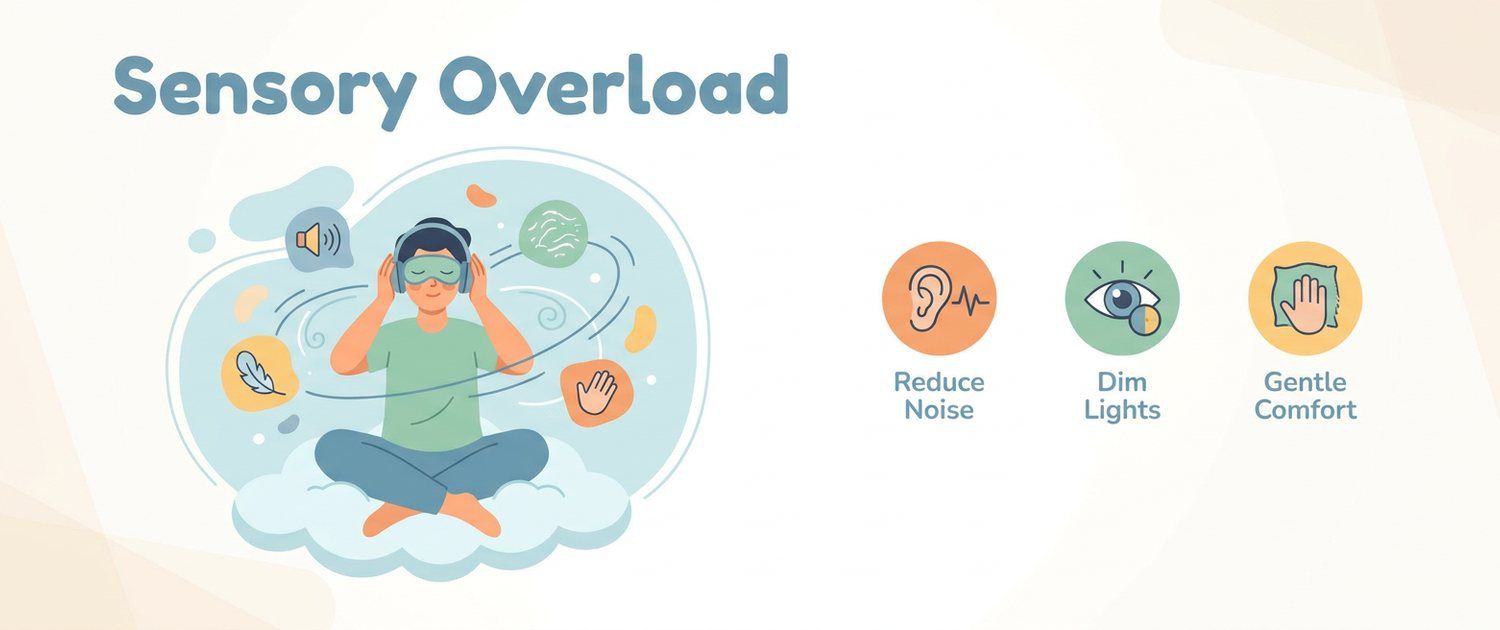
Sensory overload is described from the inside in much the same way by everyone: there are too many signals, they do not get filtered out, and at some point attention can no longer hold the conversation, the task, or the self. From outside it usually reads as "they suddenly turned difficult": fine a minute ago, then walking out, going silent, or snapping. The whole topic lives between those two descriptions.
How overload works
Background is normally filtered automatically: ventilation hum, lighting, a shirt label, conversations behind you drift to the periphery and stop demanding attention. If the filter works differently, the background never leaves — it keeps arriving in full and has to be held consciously. That is not a metaphor for tiredness: holding it costs exactly the same resource as work, which is why an hour in an open-plan office can cost more than the task done in it. From outside only the even part of the day is visible, and its price never enters the assessment — that gap is what keeps the "high-functioning" label alive.
Overload almost always accumulates. It has no single cause, only a sum: noise plus light plus smell plus the need to keep a conversation going plus uncomfortable clothes plus the commute plus being unable to leave. Hence the main practical conclusion: what needs fixing is the sum, not the last drop on which everything visibly broke.
Strömberg et al. (2022) shows well what this turns into in a specific setting: autistic adults described sensory and communicative barriers in healthcare — light, sound, waiting, uncertainty — and it directly affected whether they reached care at all. Environment decides more than comfort.
Hyper- and hyposensitivity: different things
The topic often collapses into "heightened sensitivity", which is a simplification. The meta-analysis by Ben-Sasson et al. (2009) across 14 studies found the largest difference from comparison groups not in over-responsivity but in under-responsivity — a reduced response to signal; over-responsivity and sensation seeking followed.
In practice all three share one person and even one day:
- over-responsivity — light cuts, a label makes thinking impossible, someone else's conversation cannot be un-heard;
- under-responsivity — hunger, thirst, a full bladder, pain and cold go unnoticed; "I feel bad" arrives hours late;
- sensation seeking — strong input is needed: pressure, movement, loud music in headphones, spicy food, a weighted blanket.
A mixed profile is not a contradiction. That is why advice of the "just remove the stimuli" kind does not always work: some people need not less but more — the right input, in a dose they control. MacLennan et al. (2022), built with 49 autistic adults, separately notes that under-responsivity and sensation seeking are studied far less than hypersensitivity, and that what proves central in the experience is control over the situation and the role of other people. Control — being able to leave, to dim, to decline — often matters more than the level of the stimulus itself.
Sound is the most frequent and most expensive channel; when the issue is specific triggers rather than volume, it pays to tell the phenomena apart, which is covered in the article on sound intolerance.
Meltdown and shutdown
These are two different outcomes of the same overload.
A meltdown is loss of control at the peak: tears, shouting, abrupt movements, an inability to speak coherently, sometimes a physical reaction such as hitting a wall. The key point: by then choice is no longer available. A meltdown is addressed to no one — it does not serve the purpose of obtaining anything, and that is what fundamentally separates it from what it gets confused with.
A shutdown is the opposite in form: switching off. The person freezes, stops speaking (speech can disappear entirely for minutes or hours), does not respond, goes inward. From outside it reads as sulking, deliberate silence or indifference. From inside it is not a choice.
Phung et al. (2021), built from the accounts of autistic young people and continuing an earlier description made with autistic adults, examines four linked phenomena — burnout, inertia, meltdown and shutdown — and records that all of them are multi-faceted, with emotional, cognitive and physical components at once, and that they are regularly misread by the people around, so the support offered is the wrong support.
Why neither is a tantrum: a tantrum implies an audience and a goal, while meltdown and shutdown are what happens once the system is already past its limit. "Pull yourself together" at that moment is not merely useless — it adds one more signal to an environment that already has too many.
What happens in the body
The bodily part usually outruns awareness: a clenched jaw, shallow breathing, a racing pulse, ringing or humming in the ears, heat or chills, nausea, headache, vision that swims. Afterwards comes a characteristic emptiness and a long comedown, sometimes over a day or more, during which tolerance for everything drops and the next stimulus lands on raw skin.
One extra difficulty: if recognising your own bodily signals is hard, the first event you notice is the breakdown itself. Then a map of bodily precursors — what exactly happens ten minutes before — is the single most useful tool available; more on that difficulty in the article on alexithymia.
Monotropism: attention as a tunnel
Monotropism is a model proposed by Murray, Lesser and Lawson (2005): attention is not spread thinly across many channels but concentrated into a small number of tunnels. The authors derive the other criteria directly from that architecture: what gets described as narrow interests and what gets described as communication difficulty turn out to be two consequences of a single attention-allocation mechanism.
What follows in practice:
- Switching is expensive. Not laziness or stubbornness — leaving the tunnel costs resource, and getting back in costs more.
- Interruption hurts more than duration. Four uninterrupted hours cost less than four hours cut by five "just a second"s.
- Conversation is a multi-channel task. Words, tone, face, your own reactions, the background — all at once. With tunnel attention that is expensive in itself, even without noise.
- The depth is the same trait as the cost. Being able to disappear into a task and finding it hard to come out are not two separate properties.
The useful part of the model is that it does not sort behaviour into good and bad — it explains both with one architecture.
What to do in advance
- A trigger map. Two weeks of short notes: where, what, how long, what happened in the body, how long recovery took. That gives more than any list from the internet.
- A load budget. Count a loud day as work and schedule recovery right after it — in the calendar, not "if there's energy left".
- Environmental tools. Filtering earplugs, headphones, a cap or tinted glasses, familiar clothes without labels, your own chair, familiar food for the journey.
- A plan agreed in advance. A line for the people close to you ("I'm stepping out for ten minutes, it isn't about you"), a quiet place chosen beforehand, an agreement at work that leaving a meeting is allowed.
- Open channels for regulation. Being able to move, rock, spin an object is a working regulator, not something to get rid of; more in the article on stimming.
- Watching the accumulation. If recovery after an ordinary week has stopped working and skills that used to be available are disappearing along with the energy, that is a separate topic: autistic burnout.
What to do in the moment
- Cut the input, do not analyse it. Leave, dim, take off, close your eyes. Any reduction of the stream already helps.
- Do not demand speech. Not from yourself, not from anyone else. Speech comes back last, and often as ready-mades first — repeating what was heard and reaching for stock lines, that is, echolalia, rather than sentences assembled from scratch.
- Give the body sameness. Pressure, rocking, a weighted blanket, walking in circles, cold water — whatever you have already tested on yourself.
- Minimum decisions. No questions with options at that moment, from yourself or from others.
- Count the comedown as part of the event. It will end; scheduling time for it is more honest than demanding you be back at work in half an hour.
If the picture repeats over years and reaches back to childhood — the environment hits your senses, communication needs decoding, changes are costly — it is worth looking at the whole rather than at single episodes: the autism test for adults brings those lines together. It neither makes a diagnosis nor rules one out — a psychiatrist does that in person.
When it is not autism
Sensory overload is non-specific: a similar picture arises for quite different reasons.
- The aftermath of hard events and traumatic experience. Background vigilance amplifies every channel at once, and sudden stimuli become triggers.
- Social anxiety. The hard part is not the stimuli but being evaluated; a noisy place amplifies exactly that.
- Personality traits and temperament. High sensitivity to stimuli is common and does not on its own form an autistic picture.
- ADHD. Being unable to filter background noise and irritation at noise are familiar here too — and ADHD frequently co-occurs with autism.
- Long-running exhaustion and depression. At the bottom of the tank tolerance drops for anyone; the question is whether it was always like this or started within the last year.
Separately the bodily side: iron deficiency and low ferritin, a shifted TSH, lack of vitamin B12 and vitamin D, chronic sleep loss and migraine produce the same intolerance of light and sound and the same "everything hits my head". What to look at is in the piece on what steals attention and in the guide to blood work in burnout; results you already have, the service will help you read. The boundary is simple: the body explains fatigue and falling tolerance — it does not explain why communication and sensory processing have been built this way since childhood.
This article is informational and does not diagnose. It does not claim that you are autistic, nor that you are not: that is determined by a psychiatrist in person.
For informational purposes only
This article is for informational purposes only and does not constitute medical advice, diagnosis, or treatment. Please consult a healthcare professional for medical guidance.