Autistic Burnout: Exhaustion, Skill Loss and What Tells It Apart
Reviewed by the LabReadAI medical team
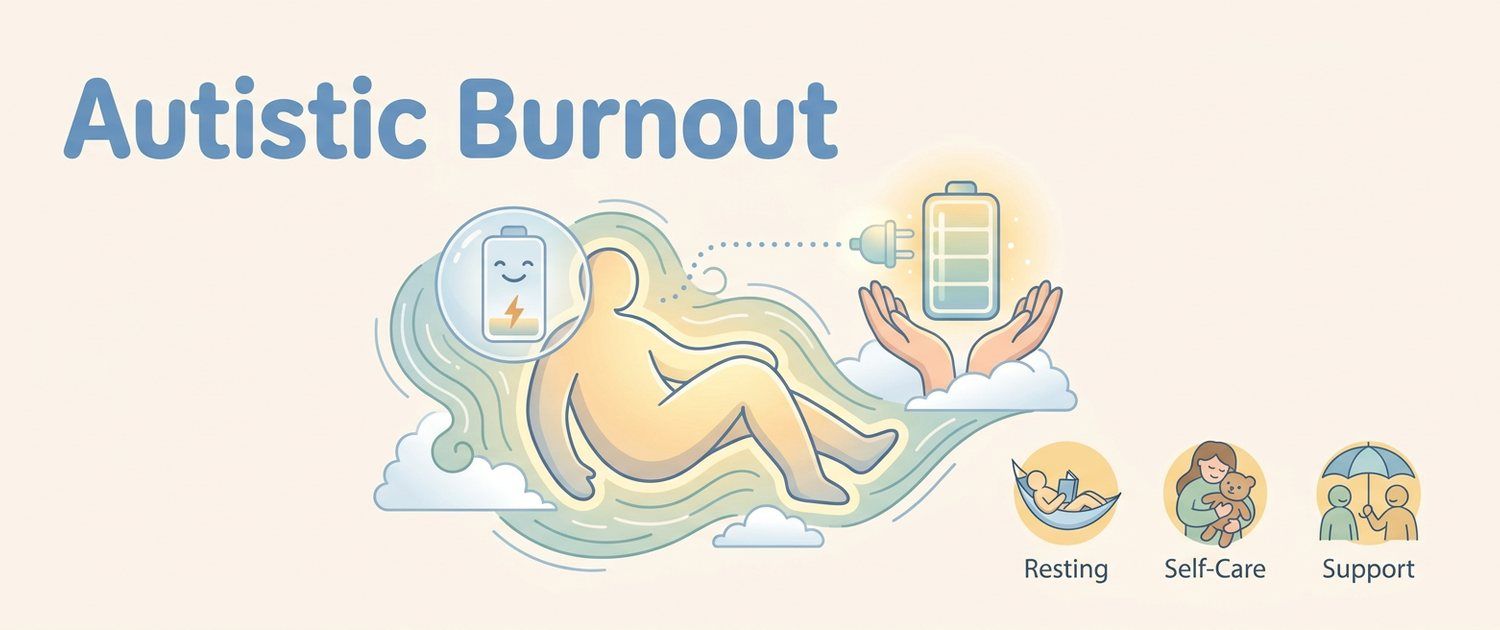
For a long time autistic burnout existed only as a word inside the community: people described the same state to each other while the academic literature barely mentioned it. Research in recent years has fixed that — and the description turned out precise enough to be usable.
What research describes about autistic burnout
Raymaker et al. (2020), in Autism in Adulthood, gathered 19 interviews with autistic adults and 19 public internet sources and produced the definition cited ever since: a state arising from chronic life stress and a mismatch between expectations and abilities without adequate supports, characterised by pervasive, long-term (typically three months or more) exhaustion, loss of function and reduced tolerance to stimulus. The authors note separately that, judging by the accounts, this appears distinct both from occupational burnout and from clinical depression.
A year later Higgins et al. (2021) built a definition using the grounded Delphi method, with autistic adults who had lived through the state serving as the experts. In 2023 Arnold et al. tested both formulations with 141 participants: the Higgins definition drew strong agreement, while duration and frequency gained no clarity — participants described both short episodes and very long ones. The same paper carries an important detail: many participants had previously been given diagnoses of depression, anxiety, bipolar disorder or borderline personality disorder. A paperwork tangle sits on top of that: some adults hold a report issued decades ago under a name current classifications no longer carry — Asperger's syndrome — and searching by that word turns up no current description of the state.
Two honest points follow at once. First: the state is described and recognisable. Second: it is not a diagnostic category, it has no criteria by which it is assigned, and it does not replace medical assessment — not least because the conditions standing next to it are treatable and need help. That is where it differs from the spectrum itself, which does have wording in the classifications: how that wording is built is covered in the piece on the ASD diagnosis.
The three pillars: exhaustion, skill loss, tolerance
Exhaustion. Not tiredness after a hard week but a baseline that rest does not lift. Weekends do not restore; a holiday helps for a few days. The feeling is "the battery no longer charges", not "the battery is flat". One more thing gets in the way of noticing that baseline in time: if putting a name to your own state is hard in principle — the trait covered in the article on alexithymia — the first event you register is a skill already gone, not the months that led to it.
Loss of previously available skills. This is the most recognisable and the most frightening part. What disappears is not something that was never there but something that used to work: holding a conversation, answering a message, cooking, leaving the house, driving a familiar route, and for some people speaking aloud in a difficult moment. People conclude "I am deteriorating", though the description is different: the resource those skills rested on has run out.
Falling tolerance. Light, sound, touch and smell start hitting harder than six months ago. A place where an evening used to be possible now lasts twenty minutes. How that side works is covered in the article on sensory overload.
How it differs from occupational burnout
Occupational burnout is described through the relationship to work: exhaustion, cynicism and reduced efficacy in a professional context. Autistic burnout is not tied to work. It arrives in people without a job, on holiday, after a house move, a wedding or a renovation — after any period where demands outweighed recovery.
The second difference is what gets lost. Occupational burnout takes down engagement with the job; autistic burnout takes down everyday and social skills that have nothing to do with the job. A holiday helps here exactly to the extent that it removes load altogether rather than swapping one load for another.
From outside almost none of this is legible: the biography stays successful, and the everyday skills that vanished never enter it. For the same reason public lists of autistic people show only the visible half — who on them spoke about themselves and who was labelled from outside is sorted in the article on famous autistic people.
The general frame of burnout as a phenomenon is in the Burnout test: it looks at the state together with the environment it arose in, and is useful as a starting point when it is unclear what is going on.
How it differs from depression
The distinction here is not cosmetic — what to do next depends on it.
- What comes first. In depression low mood, loss of interest and a sense of meaninglessness lead, with fatigue following. In autistic burnout exhaustion leads, and mood sags as a consequence of nothing working.
- What happens to interest. Autistic burnout usually does not cancel interest as such: a passion can remain wanted while there is no entry point to it — it will not start, rather than having stopped appealing. In depression interest more often goes out on its own.
- What helps. Load relief and sensory relief shift things noticeably in autistic burnout; in depression that is usually not enough, and professional help is needed.
- What the history says. Autistic burnout typically follows a long period of overload and masking, and often recurs in cycles around the same loads.
An important caveat: one does not exclude the other. Arnold et al. (2023) found that many participants had previously been diagnosed with depression, anxiety or bipolar disorder — which can mean either misattribution or a genuine combination. So "it's not depression, it's autistic burnout" is not a conclusion to reach on your own.
What causes it: masking and cumulative load
The same things recur across participants' accounts:
- Prolonged masking. Constantly suppressing your own means of regulation and fitting behaviour to expectations is work without days off that no one counts. On one of the suppressed mechanisms, see the article on stimming.
- An environment without pauses. An open-plan office, a home with no corner of your own, mandatory socialising on a schedule, no option to step out.
- A mismatch of demands and capacity without support. That is the wording the definition itself uses: not "weakness" but a gap between what is required and what it is resourced by.
- Accumulating events. A move, a child, a new role, a relative's illness — survivable one at a time, a sum together.
- Neurodivergence recognised late. Years of explaining your own difficulties to yourself as "lazy / disorganised / too sensitive" is a load of its own. On why this happens more often to women, see the article on autism in women.
Other people's assessment works on its own too: someone who looks from outside like they are managing is offered support least often and finds it hardest to ask — why the "mild form" label turns against a person is covered separately.
What helps
- Remove load for real. Not "work a bit less" but take away as much as can be taken away: cancel the optional, cut socialising, negotiate an arrangement at work. Half-removed load gives half a result.
- Give yourself permission not to mask where that is safe. In the Raymaker study it was exactly acceptance, social support, time off with reduced expectations and being able to do things in one's own way that participants linked to recovery.
- Restore the sensory environment. A quiet room, dimmed light, familiar food, familiar clothes, free access to regulation.
- Bring skills back through support, not force. Ready-made food instead of cooking, written communication instead of calls, delivery services — that is not capitulation but a way of not spending what is left on things that currently cost disproportionately much.
- Plan a long recovery. The state built up over months; expecting "a weekend" is a reliable way of adding a sense of failure to the exhaustion.
- See a specialist. If only to rule out what is treatable: depression, an anxiety disorder, bodily causes. The same boundary is drawn in the piece on whether autism can be cured: help is addressed to the conditions alongside and to the load, not to the way information is processed.
If the picture is recognisable but the question of neurodivergence itself is unresolved, it makes sense to gather the lines in one place — for example through the autism test for adults. It neither makes a diagnosis nor rules one out: a psychiatrist does that in person.
If thoughts of not wanting to live appear
In the research on autistic burnout, suicidal behaviour is mentioned directly, among the consequences participants describe. So this is not the part to postpone.
If there are thoughts of not wanting to live, of not waking up, or plans to harm yourself, you need help from a real person today, not after the weekend. Tell someone close to you, contact a crisis line, reach your own doctor or a psychiatrist. In Russia the emergency number is 112. If the state is acute and you are not sure you can manage alone, you do not have to be alone.
This is not a sign of weakness or of "the wrong attitude to yourself" — it is a sign that load exceeded capacity for far too long, and that is not something people get through by themselves.
When it is not autism
Long-running exhaustion with loss of skills is not the property of a single topic.
- The aftermath of hard events and traumatic experience. Chronic tension eats resource in the same way, and some skills stop being available.
- Social anxiety. Avoidance grows, the circle narrows, and from outside that looks like losing abilities.
- Personality traits. Introversion and high sensitivity explain the need for pauses but not the loss of skills.
- ADHD. Exhaustion from compensating is a familiar storyline here too, and co-occurrence with autism is common.
- Depression and long-running exhaustion as such. The most frequent alternative and the most important one: it is treatable, and missing it is costly.
Separately, the bodily side. A shifted TSH, iron deficiency with low ferritin, lack of vitamin B12 and vitamin D, anaemia, sleep disorders and apnoea produce exactly the same "the battery no longer charges" and may well be the only cause. What to look at is in the guide to blood work in burnout and the piece on what steals attention; results you already have, the service will help you read. But hold the boundary honestly: the body explains fatigue and falling tolerance — it does not explain why communication and sensory processing have been built this way since childhood.
This article is informational and does not diagnose. Autistic burnout is a state described in research, not a diagnostic category; assessment is done by a doctor in person.
For informational purposes only
This article is for informational purposes only and does not constitute medical advice, diagnosis, or treatment. Please consult a healthcare professional for medical guidance.