Can Autism Be Cured? Why Support Replaces a Cure in Adults
Reviewed by the LabReadAI medical team
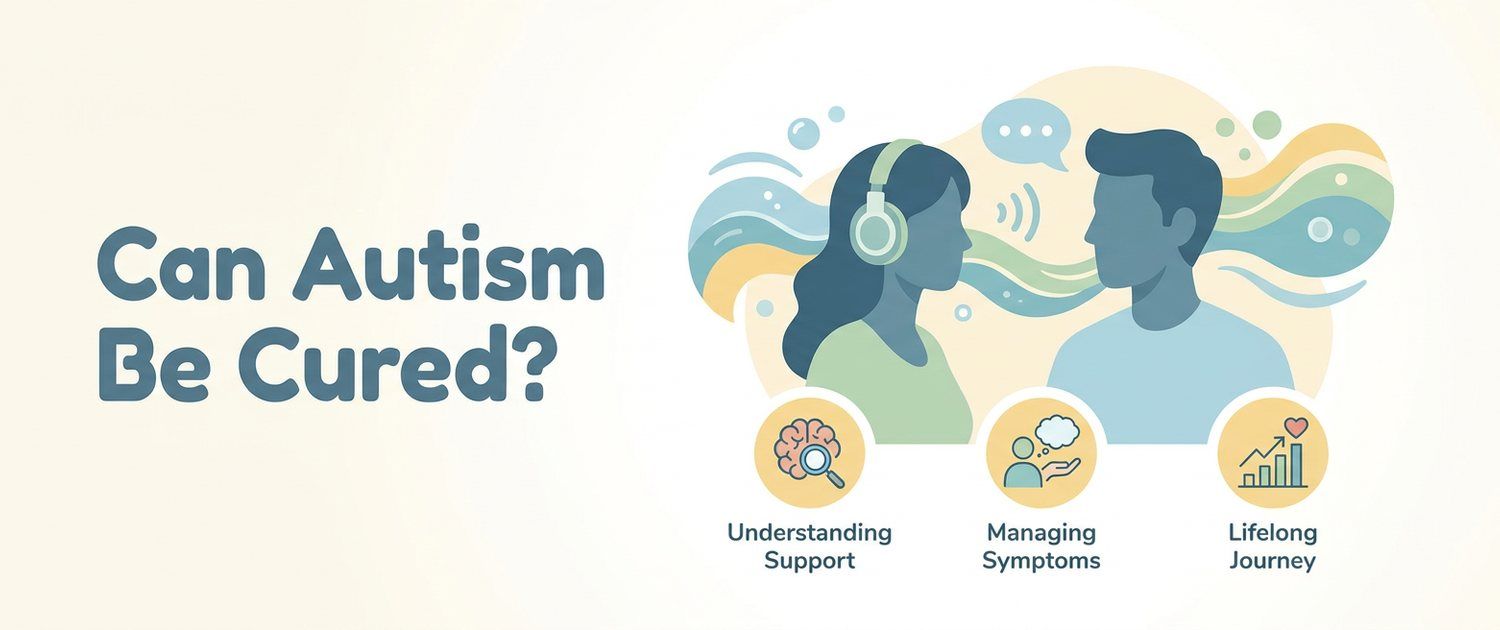
"Can autism be cured" is one of the most common searches, and there is nothing naive about it. That is how ordinary medical language works: if a condition has a name and a code, there should be a treatment somewhere nearby. With autism that logic fails. Explaining why is fairer than brushing it off with "it doesn't get cured" — because behind the question there is almost always a real one: "this is hard, what can be done about it." That one does have an answer.
Why there is no yes-or-no answer
Autism is not an infection, not inflammation and not a breakage to be repaired. It is an inborn setting of the nervous system: a different way of processing sensory input, allocating attention and taking part in communication. It is present from early childhood, stays for life and does not "pass" — not because medicine is powerless, but because there is nothing to pass. A cold has a pathogen; a fracture has a fracture line. Here there is neither: there is a person built a certain way.
Hence the oddity of the phrasing itself. "Can autism be cured" is built like "can left-handedness be cured" or "can being 190 cm tall be cured." This is not mockery of whoever asks — it is a pointer that the answer lives elsewhere. What the diagnosis does and does not mean is unpacked separately in the piece on the ASD diagnosis; the wider view of differently wired nervous systems is in the article on neurodivergence.
A separate awkwardness is the language of documents. In ICD-10, still in force in Russia, autism sits in the F84 group, and an adult receives a wording containing the word "childhood" (F84.0). That is a feature of a classification written in the late eighties, when autistic adults were barely treated as a group of their own. The word describes the age at which the condition first appears, not the age of the person holding the certificate.
What help is actually for: co-occurring conditions
Autistic adults come to doctors not with autism but with what travels alongside it. The systematic review and meta-analysis by Hollocks and colleagues found that anxiety and depressive conditions occur in adults with ASD substantially more often than in the general population. That is the real target: anxiety, low mood, insomnia, panic states are addressed in an autistic person with the same methods as in anyone else — allowing for differences in tolerance and in how things are presented.
What matters is not to swap cause and consequence. A person can spend years treating anxiety without realising that the anxiety grew out of daily overload and constant self-monitoring in conversation. Then help works at half strength: it lifts the symptom without touching what produces it.
Environment is the other half of the answer
The second address for help is not the person but the conditions they live in. An open-plan office with flickering light and background noise, an unpredictable schedule, communication by hints, no right to step into silence — all of it costs energy, and the cost accumulates.
The far end of that accumulation is described in research as autistic burnout: prolonged exhaustion, loss of skills that used to come easily, and heightened sensory sensitivity — a state the authors explicitly distinguish from depression and from ordinary tiredness. More on it in the article on autistic burnout.
In practice this means much of what gets filed under "help" is not medicine at all:
- sensory settings — earplugs or headphones, matte light instead of fluorescent, the right to pause without explaining;
- predictability — a plan known in advance, a written agenda, warning before changes;
- communication agreements — asking for direct speech instead of hints, email instead of a call, time to think before answering;
- recovery built into the schedule, not earned as a reward for productivity.
Here too belongs the study by Crompton and colleagues: information transfer between autistic people proved no less effective than between non-autistic people, and degraded specifically in mixed pairs. That is an important turn: the difficulty of mutual understanding belongs to the gap between two ways of communicating, not to one participant. The British sociologist Damian Milton described this as the double empathy problem — the misunderstanding is mutual, and "fixing" one side makes no sense.
What support means instead of a cure
"Support" sounds softer than "treatment" but names more concrete things. It is work along four lines: co-occurring conditions (a doctor), environment (an employer, a family, yourself), skills and accommodations (a psychologist familiar with autism), recovery (a calendar). The aim is not to become non-autistic but to lower the daily cost of living — because it is cost, not the list of features, that decides whether life is hard. For the list itself see the article on the signs of autism, and for adults with intact speech and intellect, the piece on Asperger's syndrome in adults.
A separate part of support is understanding yourself. Many adults get an explanation of their own biography for the first time at thirty, forty, fifty — and that alone changes how past difficulties are read. If the picture is recognisable and you want to organise your observations before speaking to a specialist, there is an adult autism test — it does not diagnose, but it gathers what usually has to be recalled on the spot in an appointment. Who to take those notes to, and how an in-person adult assessment runs, is covered in diagnosing autism in adults.
When someone promises a cure: unproven methods
Around this topic there is a market of "autism treatments" addressed both to parents and to adults. It rests on a single move: turn a difference into a disease, then sell a remedy for it. There is no need to walk through specific protocols here — the principle is enough.
Autism has no target for a cure, so any promise to cure it is a statement about the seller, not about medicine. A few practical markers:
- a result is promised ("it will go", "we will clear it") for a condition with no described mechanism of cure;
- the method is explained by one universal cause — toxins, parasites, "cleansing", diet;
- instead of publications there are stories and testimonials, and criticism is explained by conspiracy;
- payment up front for a course, refusal to talk to the treating doctor.
What is known on the substance: the Cochrane review of chelation in ASD found no evidence of benefit and separately pointed to described risks of the intervention. That is the one sentence worth keeping: absence of benefit in such protocols does not mean absence of harm.
Separately, about approaches whose stated goal is to remove outward features and teach someone to "look ordinary". Autistic adults in camouflaging research describe exactly this strategy as a source of exhaustion: masking helps you pass an interview and costs health over distance.
What changes over time
Autism stays, but life with it is not static. What changes is the vocabulary for your own states, the set of accommodations, the circle of people who speak plainly, and how much of your environment you get to choose. From outside this often looks like "it got easier" — and it is true, only the source of the change is fit, not cure.
It also works in reverse, and that is fairer said in advance. If the environment gets harsher — a move, unstructured work, the loss of a quiet corner, a long stretch without recovery — the picture can look heavier than it did five years ago. That is not the autism worsening or "progressing": what changed is the load on the setting, not the setting. The practical conclusion is simple: when things get harder, the first place to look is not yourself but what has changed around you over recent months.
What autistic adults most often ask for
Ask autistic adults what they need and the list comes out surprisingly dull and not medical at all: clear written agreements instead of guessing at hints; warning about changes in advance rather than at the last minute; the option to answer in text rather than by voice; a quiet place to step into for ten minutes; and the right not to explain every time why any of it is needed. Not one item requires a diagnosis in your pocket or anyone's permission — most of them a person can introduce themselves, and they are exactly where it makes sense to start while the long road to assessment is still under way.
When it is not autism
A similar picture — fatigue, withdrawal, difficulty in conversation — can come from elsewhere, and the two are worth separating.
- Aftermath of hard events and traumatic experience: avoidance and wariness appear after something, not from childhood.
- Social anxiety: the rules of interaction are clear but being judged is frightening; in an autistic profile the difficulty is in the interface itself, not in fear.
- Personality traits — being introverted and needing solitude mean nothing on their own.
- ADHD: inattention and impulsivity without a need for sameness and without sensory hyperreactivity; the two often co-occur, which is covered in autism and ADHD.
- Long exhaustion and depressive states: here the narrowing of contact is new, not lifelong.
Bodily causes are separate. A shifted thyroid (TSH), low iron (low ferritin well before anaemia), low vitamin B12 and vitamin D, chronic sleep loss explain fatigue, brain fog and irritability — but they do not explain sensory sensitivity and communication difficulty present since childhood. What to look at is in the pieces on what steals attention and which tests make sense in burnout; results you already have, the service will help you read.
This article is informational and does not diagnose. Autism is diagnosed by a psychiatrist in person; decisions about help for co-occurring conditions are made by a doctor.
For informational purposes only
This article is for informational purposes only and does not constitute medical advice, diagnosis, or treatment. Please consult a healthcare professional for medical guidance.