Autism Assessment in Adults: Who Diagnoses and How It Works
Reviewed by the LabReadAI medical team
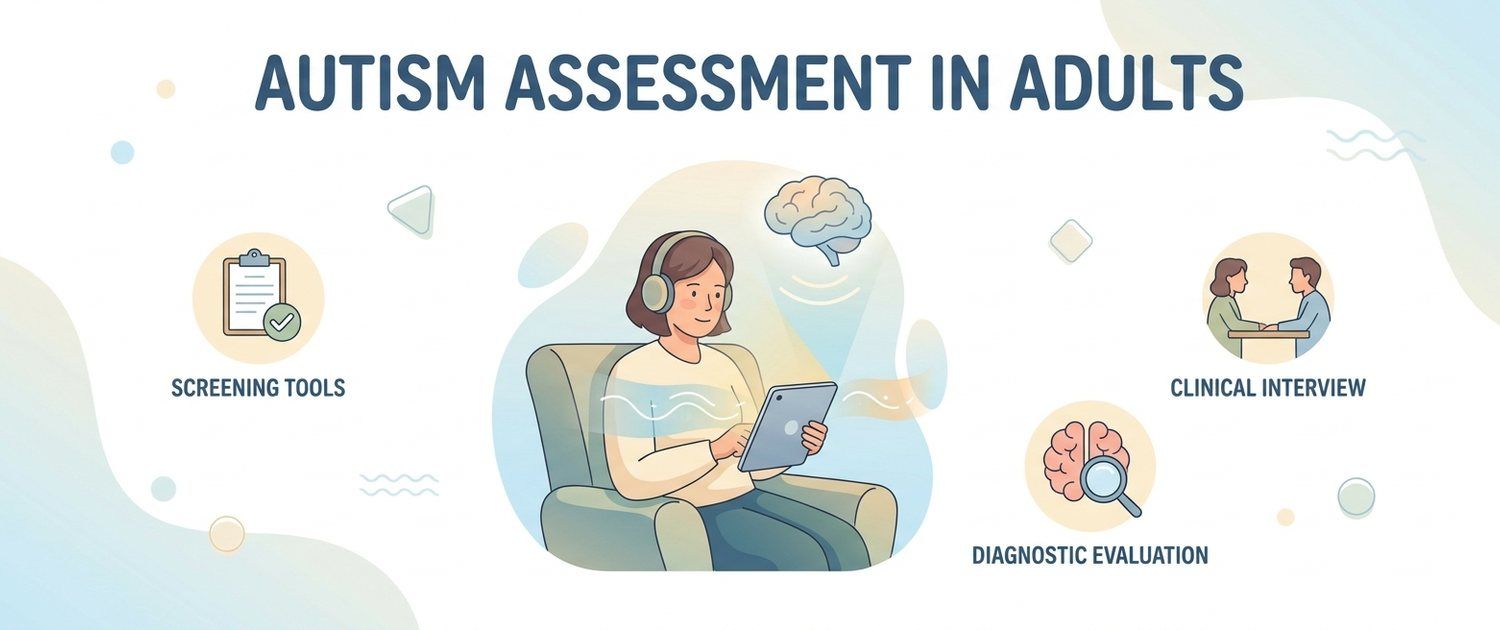
An adult who recognises themselves in a description of autism almost always hits the same question: where exactly do I go. The paediatric route is mapped out; the adult one barely is. The review of research on diagnosing autism in adulthood by Huang and colleagues describes this picture directly: the path for adults is longer, there are fewer clinicians, and the person often ends up organising their own route. Here is how that route works in practice.
Who makes the diagnosis
The diagnosis is made by a psychiatrist, in person. A clinical psychologist can run a detailed assessment, administer instruments and write a full report, but the diagnostic decision itself stays with the doctor. No online questionnaire, article or test report is a diagnosis or a substitute for the consulting room.
The practical difficulty is that clinicians who work with adult autism are scarce. Adult psychiatry sees mostly depressive and anxiety states, and familiarity with how an autistic profile looks in an adult with a job, fluent speech and a degree varies a great deal between doctors. That is not a reason to skip the appointment — it is a reason to ask in advance whether the clinician works with adult ASD, and not to treat a first opinion as final. Most often the assessment stops at the first impression that the person is managing, while what that costs never reaches the room; why there is no such thing as a "mild form" is covered separately.
What the assessment looks like
Assessment has four parts, and none of them is "a test".
- A conversation about how life works now. How a working day goes, what happens after a meeting or a noisy trip, how long recovery takes, what causes overload, how unexpected changes land, what meeting new people is like.
- A conversation about childhood. This part is not optional: one condition of the diagnosis is that the features were present from early development, even if they became visible later. Expect questions about play, friends, speech, reactions to sound, food, clothing, about school years and about what absorbed you to the point of obsession.
- Talking to people close to you. Parents about childhood, a partner or friend about how you look from outside today. This is not a lie detector: from outside people see what has long since become background from inside.
- Structured instruments — where the clinician is trained in them. Most often semi-structured observation (ADOS-2) and a structured parent interview (ADI-R), plus screening scales used to open the conversation.
One common expectation is worth removing here: checking yourself against public biographies adds nothing to this preparation. In the popular lists half the names are guesses made at a distance rather than anything the person said about themselves, and the picture they build comes out skewed; how to tell one from the other is shown in the article on famous autistic people.
Self-completed questionnaires belong here too — as material, not as a conclusion. If you would rather arrive with organised observations than reconstruct everything on the spot, a structured adult autism test helps: it does not diagnose, but it lays the picture out along its lines — communication, sensory load, need for predictability, the cost of masking.
What ADOS-2 is
ADOS is the Autism Diagnostic Observation Schedule; the second edition (ADOS-2) is the one most used today. It is not a form with questions but a script for live interaction: the clinician offers a series of activities and conversation topics and rates not the correctness of answers but how the person builds contact — how they respond to an invitation to talk, how they use gesture and intonation, how they tell a story. For adults with fluent speech, Module 4 is used.
Two honest caveats. First, ADOS-2 is administered by a trained clinician face to face, and there is no such thing as "taking ADOS online" — whatever is offered under that name on the internet has nothing to do with the instrument. Second, the instrument's accuracy is not absolute. Work by Fusar-Poli and colleagues and by Kamp-Becker and colleagues shows that in real clinical practice ADOS-2 and ADI-R perform well as part of a comprehensive assessment but, taken alone, produce a noticeable share of mismatches — especially in adults without intellectual disability. The conclusion is therefore always assembled from several sources rather than from one score.
There is no blood test for autism
No blood test, MRI, EEG or genetic panel confirms or rules out autism in an adult. The diagnosis is clinical: it rests on life history and observation.
So why might a doctor order investigations? To remove other explanations for the part of the complaint that does not point to autism. Fatigue, brain fog, irritability, worse memory and sleep have bodily causes, and checking them is cheaper and faster than guessing — the thyroid, iron metabolism, vitamin B12 and D, sleep quality. This is not "looking for autism in blood" but ordinary differential-diagnosis hygiene.
Autism in ICD-10: where "childhood" comes from
Russia currently uses ICD-10, where autism sits in the F84 group of pervasive developmental disorders and the main code, F84.0, carries a name containing the word "childhood". An adult receiving a report sees that word applied to themselves and is usually alarmed.
The explanation is simple: the classification was written in the late eighties, when autistic adults were barely treated as a separate clinical group, and the word in the code name describes the age at which the condition first appears, not the age of the patient. ICD-11 restructures the group and drops the word, but paperwork still carries the older wording. What the diagnosis means and does not entail is covered in the article on the ASD diagnosis.
What to bring
The more material you bring, the shorter the path. Worth gathering in advance:
- childhood memories, yours and your parents': what you played, whether you had friends, how you handled noise, light, clothing seams, new food, changes to routine;
- school reports, notebooks, medical records — anything that records who you were then;
- a list of what overloads you now, with specifics: not "noise" but "background music in a cafe makes conversation impossible";
- examples of the cost — how long recovery takes after a day in the office, what happens after three meetings in a row;
- a history of previous help — which diagnoses were given before, what helped and what did not.
The last point matters more than it looks: many adults have years of work on anxiety or low mood behind them, and the fact that help produced only partial results is itself informative. It also sets a sober expectation of the report: help is still addressed to anxiety, depletion and the environment rather than to the way information is processed — why the question of curing autism is posed wrongly is covered separately.
How long it takes and where to go
Honestly: the path can be long. In public services, reaching a clinician who works with adult autism is not possible everywhere; private centres and specialists are more available, but they too should be chosen by experience with adults rather than by advertising.
On the psychiatric registration people often fear, the accurate and non-alarming version is this. Adult psychiatric care in Russia is provided in two forms: consultative care on voluntary request, and dispensary observation, which is established by a medical commission for a chronic condition with severe persistent manifestations. These are different things, and seeing a psychiatrist does not by itself entail the second. Specifics for your own situation are worth asking the doctor directly at the appointment.
And one more thing: no report, however detailed, guarantees that a particular institution will accept it. Requirements differ; that has to be checked wherever the document is being presented.
A separate topic is how assessment looks for women, whose picture more often slips past the instruments: see the article on autism in women. For adults with fluent speech and intellect, once placed in a separate category, see the piece on Asperger's syndrome in adults.
When it is not autism
Part of the picture that brought you in may be explained otherwise, and a good clinician separates these in the room.
- Aftermath of hard events and traumatic experience: avoidance and wariness appeared after something rather than always being there.
- Social anxiety: the rules of interaction are clear; being judged is what frightens.
- Personality traits: being introverted and enjoying solitude say nothing on their own.
- ADHD: inattention and impulsivity without a need for sameness and without sensory hyperreactivity; the two can co-occur, which is covered in autism and ADHD.
- Long exhaustion and depressive states: the social circle narrowed recently, not lifelong.
Bodily causes are separate. A shifted thyroid (TSH), low iron (low ferritin), low vitamin B12 and vitamin D, chronic sleep loss explain fatigue and brain fog but not sensory sensitivity and communication difficulty present since childhood. What to look at is in the pieces on what steals attention and which tests make sense in burnout; results you already have, the service will help you read. The general list of features is in signs of autism.
This article is informational and does not diagnose. The diagnosis is established by a psychiatrist in person.
For informational purposes only
This article is for informational purposes only and does not constitute medical advice, diagnosis, or treatment. Please consult a healthcare professional for medical guidance.