High-Functioning Autism: Why There Is No Such Thing as a Mild Form
Reviewed by the LabReadAI medical team
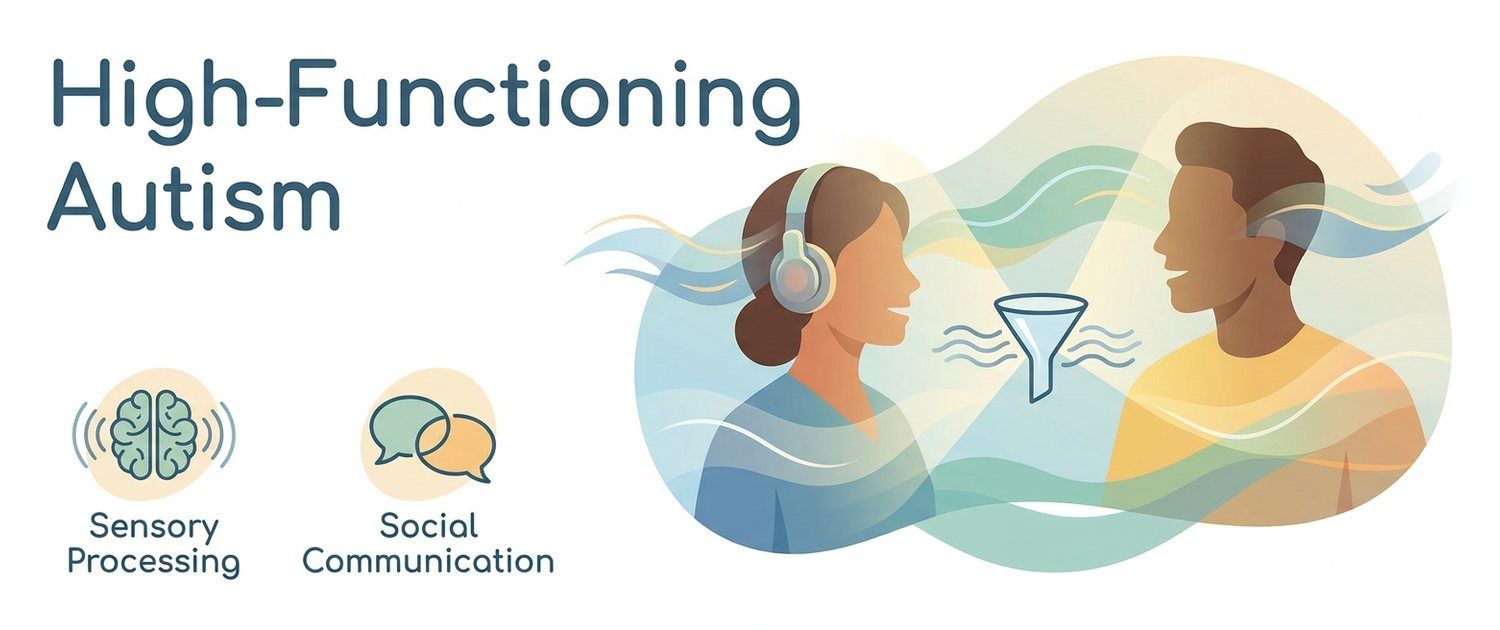
"High-functioning autism", "mild form", "level 1 autism" — these are the words people search for most when trying to work out where exactly they sit. This article has one central claim, and it is better said at once: these words describe not a person but how convenient they are for the people around them. "High-functioning" usually means exactly one thing — nobody sees the cost.
Where the word came from
The term appeared in the 1980s as a working shorthand, separating autistic people without intellectual differences from those who had them. It appears in neither DSM-5 nor ICD-11 — it is a colloquial label, not a heading. ICD-10, in force in Russia, does not carry it either: there, section F84 holds headings such as F84.0 and F84.5 — how that looks on paper is covered in the piece on the ASD diagnosis. The colloquial label of those years leaned on an official neighbour: heading F84.5 was known to people as Asperger's syndrome, and each propped the other up until DSM-5 retired the separate term in 2013.
The trouble with the label is that it mixes two entirely different things: level of intelligence and the ability to manage daily life. The study by Alvares and colleagues (Autism, 2020) says exactly this: the authors called the term a misnomer precisely because intelligence turned out to be an imprecise predictor of how a person copes day to day. Put plainly, "clever and fluent" does not imply "finds it easy".
What the word "functioning" actually describes
It describes the observer. "High-functioning" is an assessment from outside: this person goes to work, holds a conversation, causes no inconvenience. Everything behind that stays out of the assessment:
- how many hours after a meeting it takes for speech to come back;
- how many conversation scripts were prepared in advance;
- what the natural-looking eye contact actually costs;
- what happens in the evening, once the day is over.
Hence the commonest storyline: the "high-functioning" adult is offered support least often — precisely because from outside they look like they are managing. The amount of support needed may be no smaller.
Camouflaging: the invisible cost
The mechanism that keeps the label alive is camouflaging. Hull and colleagues (2017) described it from interviews with adults: conscious, continuous work — copying other people's reactions, rehearsing lines, monitoring your own face, suppressing your usual ways of self-regulating. Continuous, invisible and very expensive.
Which is why "but they talk fine" is a poor argument. Talking well and talking easily are different things. On what happens when that work accumulates over years, see the piece on autistic burnout.
The same logic shows up whenever public figures are discussed: a successful biography gets read as proof that "the form is mild", although a person has told the world exactly as much about the cost as they chose to — most often nothing at all. Who on those lists spoke about the spectrum themselves and who was labelled from outside is sorted in the piece on famous autistic people.
"Levels" and "mild form": why the spectrum is a field, not a ladder
This is worth saying directly. "Mild form", "level 1", "high-functioning" are search language: people ask this way because they have no other words. But the spectrum is built differently.
A spectrum is a multidimensional field, not a ruler on which you must locate your mark. The field has several axes: communication, sensory sensitivity, need for predictability, speech, executive function, recovery after load. A person occupies a point in that field, not a rung on a ladder.
The practical consequence: "what level am I" has no answer, in the same way "how tall am I in kilograms" has none. The useful question is different: which axis is more pronounced, and where exactly is support needed.
And one more thing that removes a lot of guilt: position along the axes moves. Not because autism comes and goes, but because load does. On holiday, in quiet, among their own people, someone can look entirely different from how they look in an open-plan office in the third week of a crunch.
What support levels really mean
Instead of "forms" and "degrees", DSM-5 describes levels of support needed — separately for social communication and separately for repetitive behaviour with the sensory part. The three levels are worded as "requiring support", "requiring substantial support" and "requiring very substantial support".
Three things matter about them:
- They are about the environment, not the personality. A level answers "how much help is needed for this person to have access to what others have", not "how severe is this person".
- The two areas can carry different levels. A common situation: speech and conversation are manageable, while the sensory side and tolerance of change require substantial support. One number cannot describe that.
- A level is not for life. It shifts with circumstances: the job, the environment, whether a quiet place exists, accompanying conditions, accumulated depletion.
Why the same person is "unremarkable" and unbearably overloaded
The classic scene: the adult who was negotiating an hour ago stands in a supermarket unable to choose a yoghurt. That is neither pretence nor contradiction — those are different axes.
Conversation loads the social axis, and there are prepared materials for it: scripts, phrases, habit. A supermarket loads the sensory one: the hum of fridges, flickering light, dozens of labels, people moving in different directions — all arriving at once and not filtered out in the background. On top of that, the negotiation has already spent the shared reserve that pays for both. The mechanism is unpacked in the piece on sensory overload.
To see what is pronounced along each line in your own case, and how much energy goes into camouflaging, a structured adult autism test helps: it counts communication, sensory features and the price of adapting separately rather than issuing one number. The overall set of presentations is in the article on the signs of autism.
The misunderstanding runs both ways
Another reason functioning labels mislead: they quietly assume that non-autistic communication is the measure and that an autistic person's task is to approach it. Work of the last decade has changed that frame. The double empathy problem (Milton; a ten-year review in 2022) holds that the difficulty arises at the junction of two different ways of communicating: non-autistic people read autistic interlocutors just as poorly as the reverse. The experiment by Crompton and colleagues (2020) confirmed this on chained information transfer: within autistic groups information travelled as effectively as within non-autistic ones, and was lost specifically in mixed chains.
That changes the question. Not "how well does this person function", but "how legible are the environment and the communication in both directions". The wider frame for this language is in the piece on neurodivergence.
What to do with the word
- In search it is fine to use: you are looking for what you heard.
- In describing yourself it is more accurate to name axes: "noise is hard for me", "I need written tasks", "I need an hour of quiet after meetings". That is clearer and it works.
- In asking for support the label hurts: "high-functioning" reads as "will manage alone". Ask by specific need, not by label.
- With people close to you the key thing is worth saying out loud: what looks easy from outside can cost the whole evening.
How in-person adult assessment works and what it looks at is in the piece on diagnosing autism in adults.
When it is not autism
The feeling of "I manage, but at what cost" also occurs without the spectrum. It is worth separating from the following.
- The aftermath of hard events and trauma. Constant vigilance, controlling the setting, depletion around people. The key is timing: autistic features run back to early childhood, post-traumatic ones start after an event.
- Social anxiety. Conversation drains because of fear of judgement, not because of invisible rules; the sensory part is usually not involved.
- Personality traits. Introversion and a love of quiet are character; on their own they do not form a spectrum.
- ADHD. Overload, difficulty switching and being "burnt out by Wednesday" look very similar. See the piece on autism and ADHD.
- Long depletion and depression. When nothing is left, any load feels impossible — and that is a state, not a trait. See burnout and blood tests.
- Bodily causes. A shifted thyroid (TSH), low iron (ferritin, long before anaemia), low vitamin D and chronic sleep loss produce the same exhaustion and the same foggy head. What to look at is in the piece on what steals attention; if you already have results, the service will help you read them.
And the caveat that matters most: the body explains exhaustion and scattered attention, but not how a person has communicated since childhood or how they respond to sound, light and touch. If that second line has always been there, blood work does not cancel it — but checking the body is still worth doing, because exhaustion adds up.
This article is informational and does not diagnose. Assessment is made by a psychiatrist in person; a functioning label is not a diagnosis.
For informational purposes only
This article is for informational purposes only and does not constitute medical advice, diagnosis, or treatment. Please consult a healthcare professional for medical guidance.