ASD: What the Abbreviation Means and What the Diagnosis Gives
Reviewed by the LabReadAI medical team
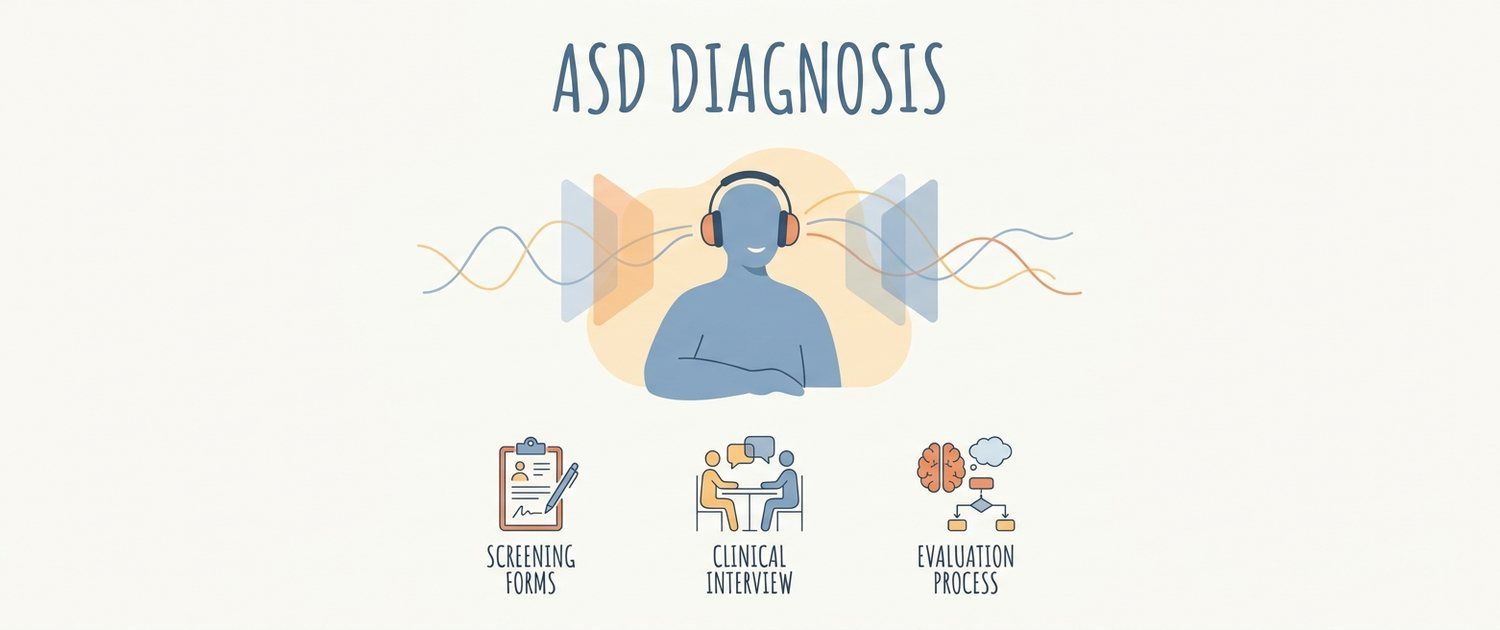
ASD is a three-letter abbreviation most people first meet in someone else's report or on the internet. It stands for autism spectrum disorder. Behind it sits not an illness to be treated but a description of an inborn way of processing information, taking in sensory signals and making contact. Here is what the abbreviation actually means, how the diagnosis looks on paper in Russia, and what it does — and does not — change in an adult's life.
What the three letters carry
The abbreviation describes a stable pattern in two areas, traceable to early childhood:
- social communication and interaction — how a person makes contact, reads a hint and a tone, keeps a conversation about nothing going, grasps unwritten rules;
- repetitive behaviour, deep narrow interests and sensory features — a need for predictability, personal ways of self-regulating — what is called stimming — strong responses to sound, light, smell, texture.
Both lines are needed at once. Social reserve alone, without the sensory part and without a childhood history, is not a spectrum. The set of presentations is unpacked in the article on the signs of autism; this piece is about the wording itself.
One more word deserves attention: "disorder". It is inherited from medical tradition and means only that the condition is described in a classification, which is what gives a person access to support. It does not mean something is broken: autism is a different way for a nervous system to work, not a fault in one. That is also the answer to the question of whether autism can be cured: help is addressed to anxiety, depletion and insomnia, not to the way information is processed.
A spectrum is a field, not a ladder
The commonest misunderstanding: people hear "spectrum" and picture a ruler running from mild to severe, on which they must locate themselves. That is wrong.
A spectrum is a multidimensional field. One person has almost no sensory difficulty but pays for a conversation with a new person with an evening of recovery. Another speaks fluently and manages a team, yet cannot enter a supermarket without headphones. A third finds speech hard and contact by writing easy, and in tight moments their speech runs on ready-mades and on repeating what was just heard — echolalia. These are not "different degrees" of the same thing — they are different points in a field with several axes.
Hence a practical conclusion: asking "what degree do I have" is roughly like asking "how tall am I in kilograms". The useful question is different: which line is more pronounced, and where exactly does this person need support. Why "mild form" and "high-functioning" mislead is covered separately in the piece on high-functioning autism.
How the wording looks on paper in Russia
Russia applies ICD-10. The autism spectrum lives there in section F84, split across several headings — F84.0, F84.1, F84.5 and others. There is no single "ASD" line in ICD-10: the clinician picks a heading. So a report may read "Asperger's syndrome", "childhood autism" or "atypical autism" — all belong to the same section.
The word "childhood" is worth naming directly. Section F84 was written in the late 1980s, when adults were hardly ever assessed, and headings were named after the age at which the features were first noticed. So an adult may receive a heading with "childhood" in its title. That is a feature of the document, not a statement about the person and not a hint about their level. What happened to the historical term, and why F84.5 is still alive, is covered in Asperger's syndrome in adults.
ICD-11, adopted by the WHO, works differently: one category for the whole spectrum, with qualifiers about language and intellectual development. DSM-5, which most research follows, likewise carries a single category with a description of how much support is needed in each of the two areas.
How adults are assessed
The scoping review on diagnosing autism in adulthood (Huang et al., 2020) describes the situation honestly: there is no single gold standard for adults, the instruments were built for children and are being adapted, and clinicians who work with adults are scarce almost everywhere. The logic behind the diagnosis, however, is stable:
- A history from early childhood. How speech came in, how peer relationships went, what happened with food, clothing, sounds, change. Parents' accounts, school books, reports and home video all help.
- A structured interview and observation. The clinician watches not only what a person says but how they say it.
- Questionnaires are an entrance, not a conclusion. Screening scales sort; they do not decide.
- Separating out look-alike conditions. More on that below.
To see what is pronounced and how much energy goes into camouflaging, a structured adult autism test helps: it counts both lines separately and shows the price of adapting — the part short screeners usually lose. The test does not diagnose; it prepares the conversation with a clinician. How the in-person assessment works is in diagnosing autism in adults.
Why adults arrive at this late
A question almost everyone asks: "if it has been there since childhood, why am I finding out at thirty-five?"
There are several reasons, and none of them is "you made it up".
- Criteria and instruments were built on children, and mostly on boys with visible behaviour. A quiet child who did well at school and disturbed no one never entered the field of view.
- Adapting worked. Prepared phrases, copied reactions, a profession and a circle chosen to fit — all of it makes the picture invisible from outside. That adaptation holds exactly until the load rises: an open-plan office, a child, a move, the loss of familiar structure.
- The consequence arrives first. An adult comes in with anxiety, long depletion or insomnia; those get addressed, and the cause they grew from is not sought. The depletion itself has a description of its own — autistic burnout, where skills that used to be available disappear along with the energy.
- Clinicians who work with adults are scarce. The review literature notes this too: instruments are being adapted, but in many places no pathway for adults has been built at all.
Late does not mean wasted, and it does not mean a life missed. A diagnosis arriving late changes not the past but how a person plans their load from here.
What the diagnosis means and does not mean
It means:
- an explanation for what was always there — often the main value: exhaustion around people stops looking like laziness or arrogance;
- grounds for reasonable adjustments: a quiet place, written tasks instead of spoken ones, a predictable schedule, headphones — why sound turns out to be the most expensive channel is covered in the piece on sound intolerance;
- a basis for working on accompanying conditions (anxiety, depression, long depletion) with the picture in view;
- access to a community with similar experience.
It does not mean:
- that the person "became different" — they are exactly who they were the day before the report;
- an automatic loss of work, licences or legal capacity: in Russia restrictions follow specific medical indications assessed separately, not the heading itself;
- that every difficulty is explained by the spectrum — the body, sleep and circumstances do not disappear;
- that this is a sentence or, conversely, a superpower. Neither: it is a way of processing information, with both a price and real strengths.
Both extremes are easy to see in public names: some people spoke about their own spectrum and named what it costs them, while others were labelled at a distance and posthumously — where that line runs is unpacked in the piece on famous autistic people.
The wider frame this word shares with ADHD, dyslexia and others is in the piece on neurodivergence.
On mutual misunderstanding
The classic description spoke of a person's difficulty understanding others. Work of recent years has shown the difficulty is not one-sided: non-autistic people read autistic interlocutors just as poorly, and autistic people pass information between themselves as effectively as non-autistic people do among themselves. The breakdown, in other words, sits at the junction of two different ways of communicating, not inside one person. That changes the task: not "teach a person to be like everyone", but make the environment and the communication legible in both directions.
Next to this sits a frequent companion of the spectrum — difficulty putting a word to one's own feeling, alexithymia: the other person waits for the name of an emotion, while what is there instead is a bodily signal with no label, and the pause reads as coldness.
When it is not autism
The wording should be separated from conditions that produce a similar picture.
- The aftermath of hard events and trauma. Avoidance, freezing, a need to control the setting. The key is timing: the spectrum runs back to early childhood; a post-traumatic picture starts after an event.
- Social anxiety. The person knows the rules and fears getting them wrong; in autism the rules are more often simply not visible.
- Personality traits. Introversion, a love of order, deep absorption in a subject are character, and on their own they do not form a spectrum.
- ADHD. The overlap is common, and difficulty switching plus overload look alike. See the piece on autism and ADHD.
- Long depletion and depression. A narrowed circle of contacts and interests can be a consequence rather than a trait: see burnout and blood tests.
- Bodily causes. A shifted thyroid (TSH), low iron (ferritin, long before anaemia), low vitamin D and chronic sleep loss produce the same exhaustion and the same foggy head. What to look at is in the piece on what steals attention; if you already have results, the service will help you read them.
And the caveat that matters most: the body explains exhaustion and scattered attention, but not how a person has communicated since childhood or how they respond to sound, light and touch. If that line has always been there, blood work does not cancel it — and equally, the spectrum does not remove the need to check the body.
This article is informational and does not diagnose. The conclusion is made by a psychiatrist in person.
For informational purposes only
This article is for informational purposes only and does not constitute medical advice, diagnosis, or treatment. Please consult a healthcare professional for medical guidance.