Sound Intolerance: Misophonia vs Hyperacusis Explained
Reviewed by the LabReadAI medical team
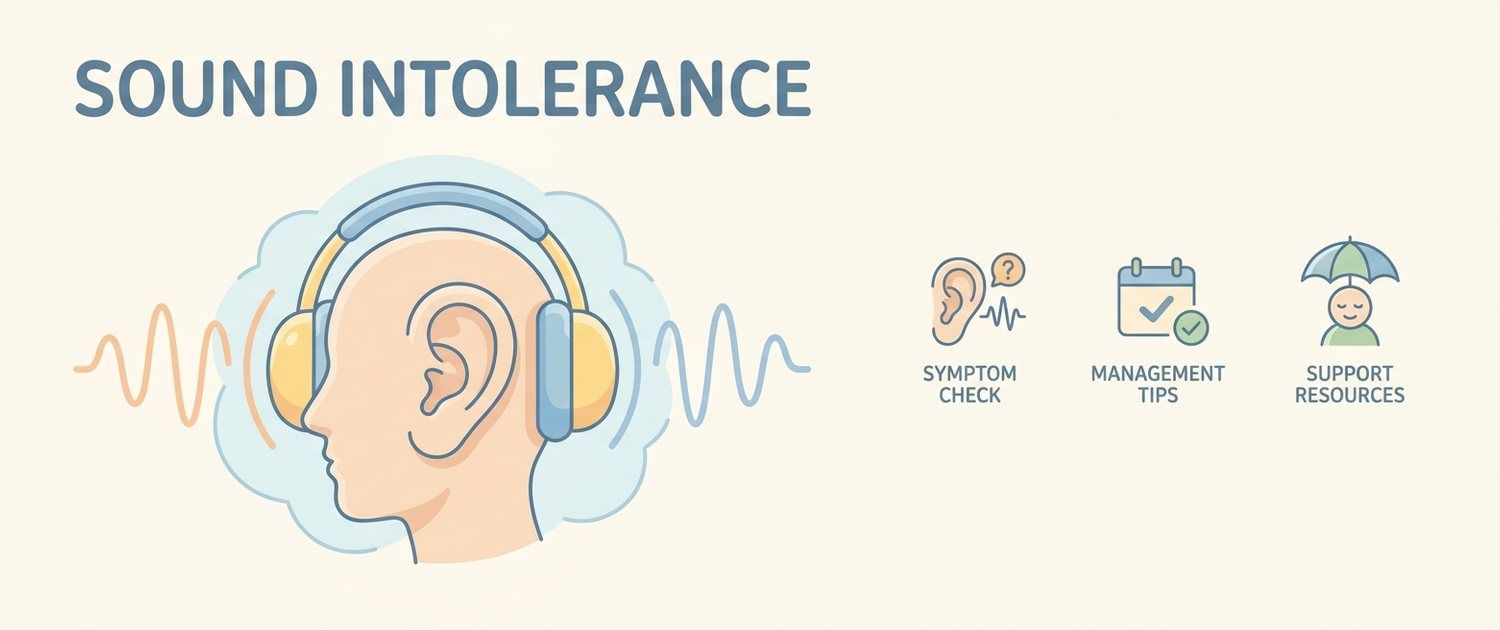
"I can't stand sounds" covers at least two different things. In one case a specific sound derails you: someone at the table is chewing, clicking a pen, sniffing or tapping a nail on a glass — and volume is almost irrelevant; quiet chewing is often worse than loud. In the other, loudness itself is the problem: an ordinary conversation, the dishwasher, a shopping centre all feel like too strong a signal, sometimes with physical pain in the ears. The first is closer to what is called misophonia, the second to hyperacusis. They are confused constantly, and different things help each — so it is worth sorting out from the start.
Misophonia: a reaction to a specific sound
In 2022 an international group of researchers and clinicians published a consensus definition of misophonia built by the Delphi method. The key point: it is decreased tolerance of specific stimuli and the situations tied to them, not of sound in general. Triggers are most often produced by another person — eating, breathing, sniffing, tapping; for some people a visual trigger works with no sound at all (the sight of someone chewing, a jiggling leg).
The reaction is not simply "annoyance". What is described is a fast emotional response — anger, disgust, panic — with bodily tension and a strong urge to leave or to stop the sound. People usually know the response is out of proportion to the situation and feel guilty about it; avoidance often builds up: not eating with the family, not sitting in an open-plan office, not taking a cinema seat next to strangers.
What is known about the mechanism. Work from a Newcastle University group (Kumar et al., 2017) showed that in people with misophonia trigger sounds produce a marked response in the anterior insular cortex — the region that ties bodily signals to emotion — along with altered connectivity to frontal areas, hippocampus and amygdala, and a stronger bodily response (heart rate, skin conductance) recorded alongside. The sound is processed less as loudness and more as a meaningful pattern the body answers before reasoning arrives. That is why "just ignore it" does not work: by the time reasoning switches on, the response has already happened.
Hyperacusis: intolerance of loudness
Hyperacusis is about level. A sound others rate as ordinary feels excessively loud. The review by Tyler et al. (2014) proposes separating several forms: loudness hyperacusis (the signal feels subjectively stronger than it is), annoyance (the sound provokes anger and tension), fear (the person avoids places in advance because of an expected sound) and pain (ordinary levels cause physical pain in the ears). Forms can combine, and which one leads shapes what to discuss with a specialist.
Hyperacusis often travels with tinnitus, can appear after acoustic trauma, after middle or inner ear inflammation, in migraine and in a number of neurological conditions. That is exactly why this is the part of the topic where you start with an audiologist and an ENT: it has a measurable side — loudness discomfort levels — and it is tested with equipment.
One practical note from part II of the same review (Pienkowski et al., 2014): the literature discusses how constant ear protection in already quiet settings may increase sensitivity — the auditory system turns its gain up to match the quiet it is used to. That is not an argument against earplugs but against round-the-clock earplugs: a tool for a specific situation, not a second layer of skin.
Telling them apart in practice
A quick fork worth bringing to a specialist:
- What decides — which sound, or how loud? If quiet chewing is worse than loud music, it points to misophonia. If everything above a certain level is worse, it points to hyperacusis.
- Who is the source? Misophonic triggers usually come from people, especially close ones; hyperacusis does not care whether it is a person or a drill.
- What happens in the body? Misophonia brings a wave of anger and disgust with tension; hyperacusis brings a sense of excessive signal, pressure, sometimes ear pain.
- Is there tinnitus, reduced hearing, past acoustic trauma? That goes straight to an audiologist.
One does not exclude the other: the same person can have both, with a broader sensitivity to light and touch on top.
Where autism fits in
Differences in sensory processing are part of the autistic picture rather than a side detail: hyper- or hypo-reactivity to sensory input sits among the diagnostic criteria alongside communication (how the wording itself is built is covered in the piece on the ASD diagnosis), and the review by Robertson and Baron-Cohen (2017) describes how those differences show up at the level of perception, not only of self-report. For many adults sound turns out to be the most expensive channel: an open-plan office, public transport and a shopping centre burn through capacity faster than the work itself does.
The reverse does not hold. Misophonia and hyperacusis occur in people who are not autistic, and sound intolerance alone proves nothing. If sound is part of a wider picture that reaches back to childhood — communication needs decoding, changes of plan are costly, people take a long recovery afterwards, and there is stimming as a way of gathering yourself — then it makes sense to look wider, for instance by starting with a structured self-description: the autism test for adults brings those lines together. How auditory load stacks with the rest into sensory overload is a separate conversation; the general frame is in the article on the signs of autism.
One more thing worth stating plainly: the misunderstanding here runs both ways. Someone untouched by the sound finds it hard to believe that another person's chewing can be unbearable; someone who is touched by it finds it hard to believe you could not hear it. That is not a fault on either side — it is a difference in how the same signal gets processed.
What actually helps day to day
- Filtering earplugs instead of solid ones. They lower the level while keeping speech intelligible — you can stay in the room rather than leave it. Use them for the situation, not permanently.
- Noise-cancelling headphones and a sound floor. A steady background (rain, a fan, instrumental music) is often easier to tolerate than silence in which the trigger stands out. A home-made version of that floor is repeating one line or a film quote aloud: this is echolalia, and its job is the same — to replace someone else's unpredictable signal with a predictable one of your own.
- Planning the environment. A seat with your back to the room, the shop in the morning, headphones for the commute, your own corner in an open-plan office, an agreed quiet hour at home.
- Warning instead of enduring. A short blame-free line — "this sound is physically hard for me, I'll move seats / put headphones on" — removes more than trying to endure and snapping fifteen minutes later.
- Recovery afterwards. A loud day should be scheduled together with a quiet evening, like any other load.
- A map of your triggers. A week of notes — which sound, where, what came before and after — gives a specialist far more than "everything irritates me". If putting a name to the state is hard in principle — a separately described trait, alexithymia — write down the bodily marker instead: the clenched jaw, the lump in the throat, the urge to stand up.
What not to do is demand that you "get used to it" by force. In neither mechanism does endurance train tolerance; it trains exhaustion.
When to see an audiologist or ENT
Do not put it off if: sound has started to feel louder than before and that changed over weeks or months; there is tinnitus or ringing; there is a blocked feeling or a sense of reduced hearing; there was acoustic or baro trauma; ordinary sound levels cause pain in the ears; there is dizziness. All of this is checked objectively — hearing and loudness discomfort levels are measured, and the doctor takes it from there.
If hearing is fine and what is unbearable is specific sounds from specific people, the conversation is no longer about the ears but about how a meaningful signal is processed, and it is worth seeing a psychiatrist or a clinical psychologist familiar with the topic.
When it is not autism
Sound sensitivity is a non-specific feature, and plenty of things unrelated to autism amplify it.
- The aftermath of hard events and traumatic experience. Sudden sounds can become triggers in their own right, and background vigilance makes everything louder.
- Social anxiety. Here the hard part is not the sound but being evaluated: being visible is frightening, and a noisy place amplifies exactly that.
- Personality traits and temperament. High sensitivity to stimuli is a widespread trait that does not on its own form an autistic picture.
- ADHD. Difficulty filtering background noise, distractibility and irritation at noise occur here too — and ADHD frequently co-occurs with autism.
- Long-running exhaustion and depression. At the bottom of the tank tolerance drops for everyone — first ask whether it was always like this or started within the last year.
Separately, the bodily part. Iron deficiency and low ferritin, a shifted TSH, lack of vitamin B12, chronic sleep loss and migraine explain fatigue, irritability and "sounds hitting the head". What to look at is in the piece on what steals attention and in the guide to blood work in burnout; if you already have your results, the service will help you read them. But hold the boundary: the body explains fatigue and background — it does not explain why communication and sensory processing have been built this way since childhood.
This article is informational and does not diagnose. It does not claim that you are autistic, nor that you are not: that is determined by a psychiatrist in person, from a developmental history and an in-person assessment.
For informational purposes only
This article is for informational purposes only and does not constitute medical advice, diagnosis, or treatment. Please consult a healthcare professional for medical guidance.